
With the purchasing of luxury vehicles on the rise it’s important to be aware of some specific features of the tax system that can impact on the real cost of purchase. Often the tax rules provide taxpayers with a worse tax outcome if the car will be used for business or other income producing purposes compared with a non-luxury car, but this depends on the situation.
Let’s take a look at the key features of the tax system dealing with luxury cars and the practical impact they can have on your tax position.
Depreciation deductions and GST credits
Normally when someone purchases a motor vehicle which will be used in their business or other income producing activities there will be an opportunity to claim depreciation deductions over the effective life of the vehicle. Rather than claiming an immediate deduction for the cost of the vehicle, you will typically be claiming a deduction for the cost of the vehicle gradually over a number of years.
Likewise, a taxpayer who is registered for GST might be able to claim back GST credits on the cost of purchasing a motor vehicle that will be used in their business activities.
However, when you are dealing with a luxury car the tax rules will sometimes limit your ability to claim depreciation deductions and GST credits, impacting on the after-tax cost of acquiring the car.
How does it work?
Each year the ATO publishes a luxury car limit which is $69,674 for the 2025-26 income year. If the total cost of the car exceeds this limit, then this can impact the GST credits or depreciation deductions that can be claimed.
Let’s assume that Alice buys a new car for $88,000 (including GST) in July 2025. To keep things simple, let’s say Alice uses the car solely in her business activities and is registered for GST.
The first issue for Alice is that rather than claiming GST credits of $8,000, her GST credit claim will be limited to $6,334 (ie, 11th x $69,674).
We then subtract the GST credits that can be claimed from the total cost, leaving $81,666. As this still exceeds the luxury car limit, Alice’s depreciation deductions will be capped as well.
While she actually spent $89,000 on the car, she can only claim depreciation deductions based on a deemed cost of $69,674.
The end result is that Alice has missed out on some GST credits and depreciation deductions because she bought a luxury car.
Exceptions to the rules
There are some important exceptions to these rules.
The rules only apply to vehicles which are classified as ‘cars’ under the tax system. That is, the car limit doesn’t apply if the vehicle is designed to carry a load of at least one tonne or it is designed to carry at least 9 passengers.
The rules only apply if the vehicle was designed mainly for carrying passengers. The way we determine this depends on the nature of the vehicle and whether we are dealing with a dual cab ute or not.
For example, let’s assume Steve buys a ute which is designed to carry a load of at least one tonne. This isn’t classified as a car for tax purposes so Steve won’t miss out on GST credits or depreciation deductions.
However, let’s assume Jenny has bought a dual cab ute which is designed to carry a load of less than one tonne and fewer than 9 passengers. This is classified as a car and the luxury car limit will apply unless we can show that it wasn’t designed mainly to carry passengers. As we are dealing with a dual cab ute, we multiply the vehicle’s designed seating capacity (including the driver’s) by 68kg. If the total passenger weight determined using this formula doesn’t exceed the remaining ‘load’ capacity, we should be able to argue that the ute wasn’t designed mainly for the principal purpose of carrying passengers, which means that Jenny should be able to claim depreciation deductions based on the full cost of the vehicle.
The approach would be different if we were dealing with something other than a dual cab ute, such as a four-wheel drive vehicle.
Luxury car lease arrangements
Normally when someone enters into a lease arrangement for a car and they use the car in their business or employment duties there’s an opportunity to claim deductions for the lease payments, adjusted for any private usage.
However, if the value of the car exceeds the luxury car limit then the tax rules apply differently. Basically, what happens is that the taxpayer is deemed to have purchased the car using borrowed money. Rather than claiming a deduction for the actual lease payments, instead we will be claiming deductions for notional interest charges and depreciation, subject to the luxury car limit referred to above.
Luxury car tax
Cars with a luxury car tax (LCT) value which is over the LCT threshold for that year are subject to LCT, which is calculated as 33% of the amount above the LCT threshold.
The LCT thresholds for the 2025-26 income year are:
- $91,387 for fuel-efficient vehicles
- $80,567 for all other vehicles that fall within the scope of the LCT rules
From 1 July 2025 the definition of a fuel-efficient vehicle has changed, meaning that a car will only qualify for the higher LCT threshold if it has a fuel consumption that does not exceed 3.5 litres per 100km (this was 7 litres per 100km before 1 July 2025).
Buying a car or other motor vehicle can be a complex process and there will be a range of factors to consider. If you need assistance with the tax side of things please let us know before you jump in and sign any agreements.
Contact Indigo Financial on (08) 8212 8585 if you need help with any of your accounting and taxation needs.
Note: The material and contents provided in this publication are informative in nature only. It is not intended to be advice and you should not act specifically on the basis of this information alone. If expert assistance is required, professional advice should be obtained.
This tax season, we’ve seen a surge in questions about whether interest on a loan can be claimed as a tax deduction. It’s a great question as the way interest expenses are treated can significantly affect your overall tax position. However, the rules aren’t always straightforward. Here’s what you need to know.
The purpose of the loan
The most important thing when looking at the tax treatment of interest expenses is to identify what the borrowed money has been used for. That is, why did you borrow the money?
For interest expenses to be deductible you generally need to show that the borrowed funds have been used for business or other income producing purposes. The security used for the loan isn’t relevant in determining the tax treatment.
Let’s take a very simple scenario where Harry borrows money to buy a new private residence. The loan is secured against an existing rental property. As the borrowed money is used to acquire a private asset the interest won’t be deductible, even though the loan is secured against an income producing asset.
Redraw v offset accounts
While the economic impact of these arrangements might seem somewhat similar, they are treated very differently under the tax system. This is an area to be especially careful with.
If you have an existing loan account arrangement, you’ve paid off some of the loan balance and you then use a redraw facility to access those funds again, this is treated as a new borrowing. We then follow the golden rule to determine the tax treatment. That is, what have the redrawn funds been used for?
An offset account is different because money sitting in an offset account is basically treated much like your personal savings. If you withdraw money from an offset account you aren’t borrowing money, even if this leads to a higher interest charge on a linked loan account. As a result, you need to look back at what the original loan was used for.
Let’s compare two scenarios that might seem similar from an economic perspective:
Example 1: Lara’s redraw facility
Lara borrowed some money five years ago to acquire her main residence. She has made some additional repayments against the loan balance. Lara redraws some of the funds and uses them to acquire some listed shares. Lara now has a mixed purpose loan. Part of the loan balance relates to the main residence and the interest accruing on this portion of the loan isn’t deductible. However, interest accruing on the redrawn amount should typically be deductible where the funds have been used to acquire income producing investments.
Example 2: Peter’s offset account
Peter also borrowed money to acquire a main residence. Rather than making additional repayments against the loan balance, Peter has deposited the funds into an offset account, which reduces the interest accruing on the home loan. Peter subsequently withdraws some of the money from the offset account to acquire listed shares. This increases the amount of interest accruing on the home loan. However, Peter can’t claim any of the interest as a deduction because the loan was used solely to acquire a private residence. Peter simply used his own savings to acquire the shares.
Parking borrowed money in an offset account
We have seen an increase in clients establishing a loan facility with the intention of using the funds for business or investment purposes in the near future. Sometimes clients will withdraw funds from the facility and then leave them sitting in an existing offset account while waiting to acquire an income producing asset. This can cause problems when it comes to claiming interest deductions.
First, even if the offset account is linked to a loan account that has been used for income producing purposes, this won’t normally be sufficient to enable interest expenses incurred on the new loan from being deductible while the funds are sitting in the offset account.
For example, let’s say Duncan has an existing rental property loan which has an offset account attached to it. Duncan takes out a new loan, expecting to use the funds to acquire some shares. While waiting to purchase the shares, he deposits the funds into the offset account, which reduces the interest accruing on the rental property loan. It is unlikely that Duncan will be able to claim a deduction for interest accruing on the new loan because the borrowed funds are not being used to produce income, they are simply being applied to reduce some interest expenses on a different loan.
To make things worse, there is also a risk that parking the funds in an offset account for a period of time might taint the interest on the new loan account into the future, even if money is subsequently withdrawn from the offset account and used to acquire an income producing asset.
For example, even if Duncan subsequently withdraws the funds from the offset account to acquire some listed shares, there is a risk that the ATO won’t allow interest accruing on the second loan from being deductible. The risk would be higher if there were already funds in the offset account when the borrowed funds were deposited into that account or if Duncan had deposited any other funds into the account before the withdrawal was made. This is because we now can’t really trace through and determine the ultimate source of the funds that have been used to acquire the shares.
To do
It’s worth reaching out to us before entering into any new loan arrangements. In this area, mistakes are often difficult to fix after the fact, which can lead to poor tax outcomes. That’s why getting advice from a tax professional before committing to a loan is essential. We can work alongside you and your financial adviser to ensure your loan is structured in a way that makes financial sense and protects your tax position.
Contact Indigo Financial on (08) 8212 8585 if you need help with any of your accounting and taxation needs.
Note: The material and contents provided in this publication are informative in nature only. It is not intended to be advice and you should not act specifically on the basis of this information alone. If expert assistance is required, professional advice should be obtained.
Find out about what records to keep and for how long for rental properties and holiday homes.
How long to keep rental records
You need to keep records for 5 years. Depending on your situation, that is 5 years from the date:
- you lodge your tax return
- of your last claim for the decline in value of an asset
- it is certain that no capital gains tax event can occur after you acquire, sell or otherwise dispose of property
- you resolve any disputes you have with us.
You will need these records to work out how much:
- rental income you need to declare
- you can claim as a deduction for your expenses
- capital gain or loss you make when you dispose of your rental property.
In some circumstances, you may need to provide these records as proof that you were the one to incur the expense.
Format of your rental records
Rental records must be in English or be readily translatable into English.
You can keep your records in either paper or digital format. If you make copies, they must be a true and clear copy of the original.
We recommend you keep a back-up of all your digital records.
You can use the myDeductions tool in the ATO app to keep track of your records digitally. When you are ready to complete your tax return, you can:
- email your data to yourself or to your tax agent
- upload your data to pre-fill your tax return.
Types of rental records to keep
You should keep a record of the following for your rental property or holiday home:
Rental income
Records of the payments you receive, such as:
- a statement from your property or managing agent
- a rent book or bank statements that shows the rental payments going into your account
- documents that show a record of any bond money you retain in place of rent.
For more information on rental income, see Rental income you must declare.
Rental expenses
Records for expenses you incur, such as:
- bank statements showing the interest charged on money you borrowed for the rental property
- loan documents
- land tax assessments
- documents or receipts that show amounts you pay for
- advertising (including efforts to rent out the property)
- bank charges
- council rates
- gardening
- property agent fees
- repairs or maintenance
- documents showing details of expenses related to
- the decline in value of depreciating assets
- any capital work expenses, such as structural improvements
- before and after photos for any capital works
- travel expense documents, if you are eligible to claim travel and car expenses such as
- travel diary or similar that shows nature of the activities, dates, places, times and duration of your activities and travel (you must have this if you travel away from home for 6 nights or more)
- receipts for flights, fuel, accommodation, meals and other expenses while travelling.
When you buy a rental property
Records when you buy (invest) in a rental property, such as:
- contract of purchase
- conveyancing documents
- loan documents
- costs to buy the property
- borrowing expenses.
While you own a rental property
Records for while you own a rental property, such as:
- documents that show periods of personal use by you or your friends
- document that show periods the property is used as your main residence
- loan documents if you refinance your property
- documents, receipts and before and after photos for capital improvements
- tenant leases
- documents for rental expenses.
When you sell your rental property
Records for when you sell or otherwise dispose of your rental property, such as:
- contract of sale
- conveyancing documents
- sale of property fees
- calculation of capital gain or loss.
Records for multiple properties
Keep separate records for each property, if you have:
- more than one property (including a block of apartments or similar)
- a duplex
- property that has been sub-divided.
This will ensure that you declare the correct rental income and claim the correct rental expenses for each property. It will also ensure that if you later sell or otherwise dispose of one or part of a property, you will have records to work out your capital gain or loss.
Contact Indigo Financial on (08) 8212 8585 if you need help with any of your accounting and taxation needs.
Note: The material and contents provided in this publication are informative in nature only. It is not intended to be advice and you should not act specifically on the basis of this information alone. If expert assistance is required, professional advice should be obtained.
Source: https://www.ato.gov.au
They’re advising from your Insta and TikTok feeds, they’ve got huge followings, they speak with conviction – financial influencers or ‘finfluencers’. Please heed our caution, taking advice from unqualified sources can have serious consequences. We’re seeing examples of misleading claims, exaggerated deductions and outright misinformation. Relying on this advice could not only leave you out of pocket but also expose you to ATO penalties, fines or in the worst case scenario – prosecution.
What’s the problem?
Many finfluencers make money by promoting financial products on behalf of companies, which means that they don’t necessarily have your best interests in mind when sharing information or insights. Finfluencers aren’t always qualified to provide advice on tax or financial products. You just can’t expect to receive solid, reliable or tailored guidance. Unfortunately, we’re seeing some influences share tax hacks that are either completely false or apply only in extremely limited situations.
The ATO and some of the accounting professional bodies have sounded the alarm on some recent false claims, including:
- Claiming your pet as a work related guard dog
- Writing off luxury handbags as laptop bags
- Deducting fuel costs without any documentation
- Trying to claim swimwear as a work uniform
These kinds of suggestions might sound plausible but following them could get you into serious trouble. The ATO uses sophisticated data matching tools to detect suspicious or inflated claims. If your deductions don’t meet the legal criteria, this could trigger an audit and if mistakes are found, the consequences can include:
- An increased tax liability
- Interest charges
- Fines
- A criminal record and in the most serious cases, imprisonment
Here’s how to stay safe and tax smart:
- If it sounds too good to be true, it probably is. Dodgy deduction tips on social media are best ignored, at least until they can be verified.
- Stick to trusted sources. For official tax guidance, visit gov.au.
- Don’t risk your business or personal reputation for a quick deduction.
If you aren’t sure, please reach out to us and we can help you stay compliant, no filters or hashtags!
Contact Indigo Financial on (08) 8212 8585 if you need help with any of your accounting and taxation needs.
Note: The material and contents provided in this publication are informative in nature only. It is not intended to be advice and you should not act specifically on the basis of this information alone. If expert assistance is required, professional advice should be obtained.
In the 2023-24 Budget, the Government announced a reform to align employers’ payment of Superannuation Guarantee (SG) contributions with salary and wages, instead of the current quarterly requirement. This will take effect from 1 July 2026.
This will strengthen Australia’s superannuation system and help deliver a more dignified retirement to more Australian workers by tackling unpaid superannuation. The non-payment and underpayment of superannuation by employers risks the retirement income of millions of Australians. Non-payment and underpayment of superannuation is equivalent to wage theft and has significant impacts on retirement outcomes.
Around 8.9 million employees will benefit from higher retirement savings from receiving their superannuation contributions earlier and more frequently throughout their working life. These reforms will deter superannuation theft and enable the ATO to take quick action to rectify instances of unpaid superannuation.
More frequent payment of superannuation will empower employees to track their entitlements and make it harder for them to be exploited by disreputable employers. Employees will be able to see these payments by reviewing their superannuation account transactions, and will be able to hold employers to account by raising non-compliance directly, or through the Fair Work Ombudsman or the ATO.
More frequent superannuation payments will also make employers’ payroll management smoother with fewer liabilities building up on their books.
This will complement the Government’s other actions to strengthen the superannuation system including increasing the SG rate to 12 per cent by 1 July 2025, paying super on Government Paid Parental Leave, including superannuation as an entitlement in the National Employment Standards, criminalising superannuation theft, legislating the Objective of Superannuation, making super concessions fairer, improving the equity and sustainability of superannuation tax concessions, and expanding the coverage of the annual performance test.
Employers will need to pay SG alongside wages
From 1 July 2026, an employer will be required to make SG contributions on ‘payday’.
Payday is the date that an employer makes an Ordinary Time Earnings (OTE) payment to an employee.
Each time OTE is paid, there will be a new 7 day ‘due date’ for contributions to arrive in the employees’ superannuation fund. This provides time for the movement of funds through the payment system, including clearing houses. An employer will be liable for the new SG charge unless SG contributions are received by their employees’ superannuation fund within 7 calendar days of payday.
There will be some limited exceptions:
- Contributions for OTE paid within the first two weeks of employment for a new employee will have their due date deferred until after the first two weeks of employment.
- Small and irregular payments that occur outside the employee’s ordinary pay cycle would not be considered a payday until the next regular OTE payment or ‘payday’ occurs.
An updated SG charge
Where employers fail to pay contributions in full and on time, they are liable for the SG charge.
The SG charge is being updated for the payday super environment and will continue to reflect the seriousness of underpayment or late payment of SG.
The SG charge will ensure that employees are fully compensated for any delay in receiving their super. It will also create an incentive for employers to address unpaid superannuation quickly.
The updated SG charge framework will:
- put workers in the same position as if the contributions had been received in full and on time;
- incentivise employers to quickly disclose and rectify any instances of unpaid superannuation; and
- scale up consequences for employers who don’t pay on time, with bigger penalties for employers who repeatedly do the wrong thing.
All assessments of the updated SG charge will be made by the ATO. Assessments would be triggered where there is non-payment detected by the ATO, which could occur by voluntary disclosure of an employer, an employee notification or the ATO’s proactive compliance. Additional interest and penalties apply if the assessed SG charge is not paid by the due date.
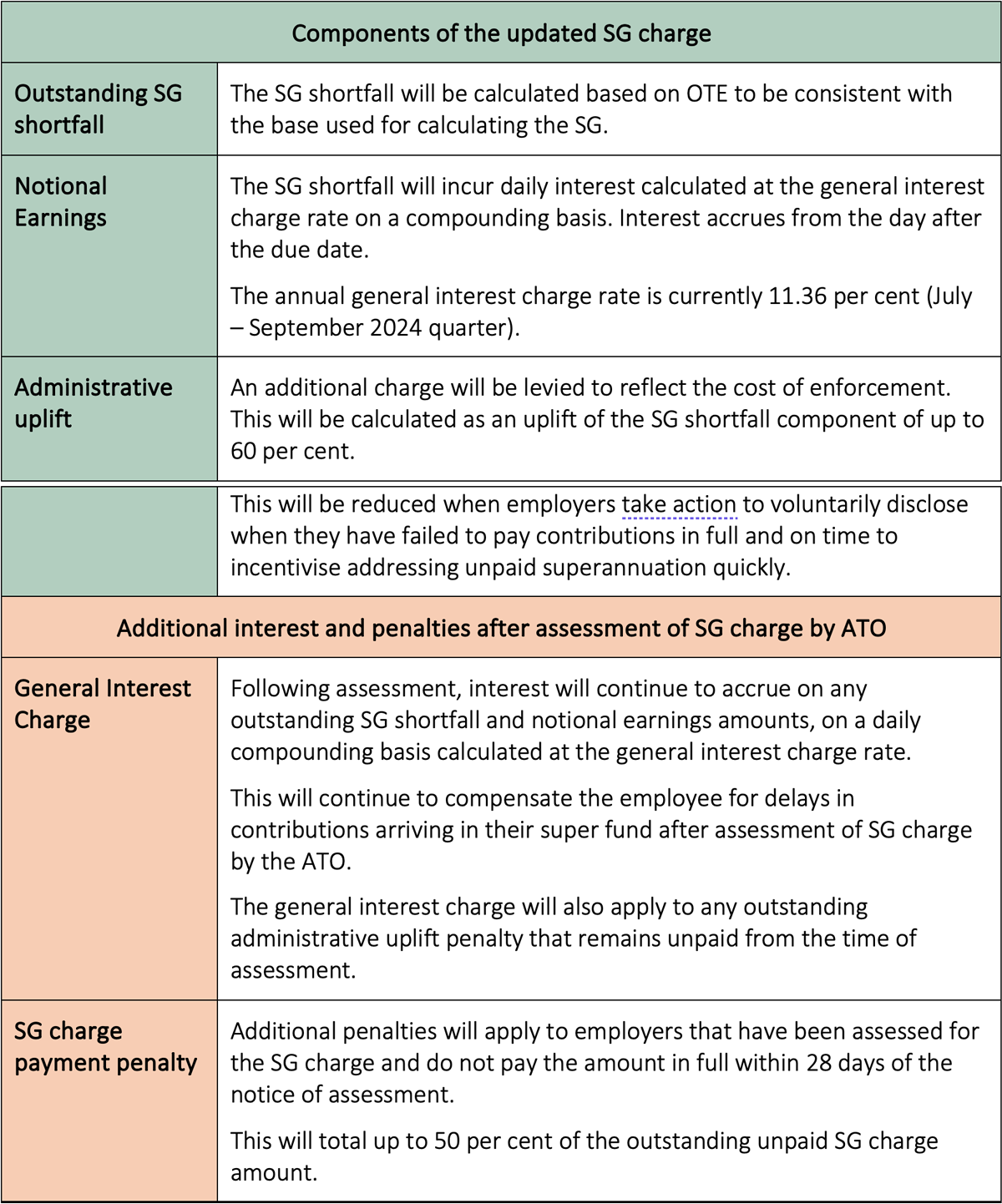
The SG charge will be tax-deductible, ensuring the income tax consequences for paying employees’ superannuation are consistent. Any penalties and interest after assessment of SG charge by the ATO will not be deductible.
Like the current system, an employer’s shortfall and SG charge will be increased where they fail to comply with the rules around giving the employee their choice of fund and following that choice.
Recognising late contributions
Employers will need to pay SG contributions on payday, so they are received in an employee’s super account within 7 calendar days of payday.
If funds are not received in an employee’s superannuation account within 7 days, the employer will be liable to pay the SG charge, even ahead of the ATO issuing an assessment. An employer in this situation should make contributions to their employee’s superannuation fund as soon as possible. This will minimise their liability and penalties.
The longer the period of non-compliance, the larger the SG Charge will be. Employers need to ensure they have the correct governance and systems in place to ensure their workers receive their full legal entitlements, including salary, wages and SG, on time.
The approach to correcting late contributions will be simplified under payday super. Employers will no longer need to make an election or choose which period for which each late contribution should count. Contributions will now automatically count towards the earliest possible payday that has not yet been assessed for SG charge, and which still has an outstanding SG shortfall.
Supporting transition to Payday Super
Several changes are being made to support the transition to Payday Super and protect employees in the onboarding process:
- The deadline for superannuation funds to allocate or return contributions will be reduced to three business days, down from 20.
- The SuperStream data and payment standards will be revised to allow payments via the New Payments Platform and improve error messaging to ensure employers and intermediaries can quickly address errors.
- Given the improvement in payroll software solutions over recent years provides employers with cost-effective and more fit for purpose options for paying superannuation contributions on payday, the ATO’s Small Business Superannuation Clearing House will be retired from 1 July 2026. The ATO will engage with small businesses ahead of time to support them in transitioning to an alternative that is fit-for-purpose for Payday Super.
- Revised choice of fund rules will make it easier for employees to nominate their superannuation fund when they start a new job. Employers will be able to show employees their existing ‘stapled’ fund during onboarding, as part of the choice of fund. This will reduce the risk of unintended duplicate accounts and give employers more timely and accurate details.
- Advertising of superannuation products during onboarding will be limited to MySuper products that have passed the most recent performance test to protect employees from poor outcomes.
ATO’s compliance approach
The ATO will have increased visibility of SG contributions across the employer population, by matching employer Single Touch Payroll (STP) data and superannuation fund reporting. This visibility will allow the ATO to proactively identify missing or late SG payments and intervene sooner to ensure employers can get back on track with their superannuation before problems escalate.
The onus will be on employers to make sure they pay SG at the same time they pay their employees’ wages. Employers who repeatedly fail to pay on time and fail to disclose promptly will be exposed to the maximum administrative uplift component of the SG charge. Where employers promptly disclose their failure to pay SG on time, the amount of administrative uplift they must pay will be reduced. The ATO will streamline services for employers’ voluntary disclosures.
To facilitate this compliance, employers will be required to report in STP both the OTE and the total superannuation liability for an employee, ensuring the SG can be correctly identified.
This will also mean that employees that previously had to wait up to 4 months to determine whether they had been paid SG will be able to check their superannuation account as their wages are paid to determine if their employer is meeting their obligations. This will empower employees to take action before large amounts of unpaid SG accrues, including by raising it directly with their employer, submitting an employee notification form to the ATO, or raising it with the Fair Work Ombudsman.
Contact Indigo Financial on (08) 8212 8585 if you need help with any of your accounting and taxation needs.
Note: The material and contents provided in this publication are informative in nature only. It is not intended to be advice and you should not act specifically on the basis of this information alone. If expert assistance is required, professional advice should be obtained.
The US economy experienced a notable slowdown in the first quarter of 2025. The latest GDP data showed the economy contracted at an annual rate of -0.3%. Businesses stockpiling goods (which increased import volumes) ahead of the implementation of President Trump’s controversial tariff policy was one of the reasons for the contraction in GDP. The other was a decline in Government spending.
Mr Trump’s tariffs are deflationary for the world and inflationary for the US. The sharp weakening in soft economic data points to rising recession risks, although markets still only seem priced for a mild slowdown which now seems right given the backdown.
It is no surprise that China announced a new stimulus package including interest rate cuts and a significant liquidity injection, as the Government looks to boost an economy that has been hit by the collapse in the property market and now the trade war with the US. China’s factory activity contracted at its fastest pace in 16 months in April following the frontloading of orders to beat the tariffs. Trade talks between the US and China have driven market optimism over the past few weeks and sentiment has turned positive. The US-China deal has 30% import taxes on Chinese goods, which could still stem trade flow. The trade announcement with the UK has disappointed many in the market as it kept the 10% tariff on imports into the US up from 3.4%. The EU hasn’t even begun negotiations with the US.
In Australia, the election has come and gone fairly uneventfully for financial markets. We are waiting on GDP data to be released in the next few weeks which should confirm a sluggish economy given consumer spending remains weak. The RBA has cut interest rates and this should underpin mild growth.
The outlook for financial markets remains one of uncertainty reflected by the increase in volatility. Tight policy, lingering inflation risks and tariff-related drag still weighs on markets. What seems to have been achieved so far is a whole lot of volatility and the realisation the US needs China as much as China needs the US. Within the Australian share market there was a notable softening in outlook statements by company management in the recent reporting season. With full-year forecasts being revised lower, it is reasonable to suggest that market-wide earnings growth is slowing, with expectations moderating for the rest of this year and potentially into the next.
Contact Indigo Financial on (08) 8212 8585 if you need help with any of your accounting and taxation needs.
Note: The material and contents provided in this publication are informative in nature only. It is not intended to be advice and you should not act specifically on the basis of this information alone. If expert assistance is required, professional advice should be obtained.
If you’re carrying an Australian Taxation Office (ATO) debt there is a good chance that it will cost you even more from 1 July 2025 onwards. This is because from 1 July 2025 two types of interest charges imposed by the ATO are no longer deductible.
What are the interest charges?
There are two main types of interest that are charged by the ATO. These are:
- General Interest Charge (GIC): This applies when you pay your tax liability late. The ATO applies GIC to encourage tax liabilities to be paid on time and ensure taxpayers who pay late don’t have an unfair advantage over taxpayers who pay on time. GIC is calculated on a daily compounding basis on the overdue amount. The GIC annual rate for the July – September 2025 quarter is 10.78%.
- Shortfall Interest Charge (SIC): This is applied when there is a shortfall in tax paid because of an amendment or correction to your tax assessment. SIC is also calculated on a daily compounding basis. The SIC annual rate for the July – September 2025 quarter is 6.78%. The ATO applies SIC to the tax shortfall amount for the period between when it would have been due and when the assessment is corrected.
What’s changing?
Historically, both GIC and SIC amounts could be claimed as a deduction. This has meant that the net after-tax cost of the interest charges has been reduced for taxpayers who have a positive income tax liability for the relevant income year.
However, the Government has passed legislation to ensure that GIC and SIC amounts incurred on or after 1 July 2025 are no longer deductible, even if the interest relates to a tax debt that arose before this date.
As these interest charges are no longer deductible, this means that the after-tax impact of the charges is higher for many taxpayers. The impact becomes greater as your tax rate increases.
For example, let’s take a look at two individuals who have the same level of tax debt owed to the ATO and the same level of tax debt owed to the ATO and the same GIC liability of $1,000 for a particular income year:
- Sally is a high income earner and subject to a 45% marginal tax rate (ignoring the Medicare levy). Under the old rules the net cost of the interest charge was only $550 because she could claim a deduction for the GIC amount and this reduced her income tax liability by $450. Under the new rules no deduction is available and the full cost to Sally will be $1,000.
- Adam is subject to a 30% marginal tax rate (again, ignoring the Medicare levy). Under the old rules the net cost of the interest charge was $700 because he could reduce his income tax liability by $300 by claiming a deduction for the GIC amount. As with Sally, under the new rules no deduction is available for the GIC and the full cost to Adam is $1,000.
What can I do to minimise the impact of this change?
The simple answer is to pay down ATO debt as quickly as possible. As you can see, the GIC rate is relatively high and continues to accrue on a daily basis until the debt is paid off.
The faster you can pay off that debt, the lower the interest charges that will accrue.
If you can’t afford to pay off your ATO debt in the short term then you might want to explore other options, including whether you would be better off borrowing money from another source at a lower interest rate to pay off the ATO debt. In some cases it is possible to claim a deduction for interest accruing on a loan that is used to pay tax debts, although this is normally only possible if the debt arose from business activities. It isn’t normally possible to claim a deduction for interest accruing on a loan that is used to pay a tax debt that arose from investment or employment activities.
While the ATO will sometimes allow taxpayers to enter into a payment plan so that tax debts can be paid through instalments, tax debts that are subject to a payment plan still accrue GIC.
On a more proactive basis, a better option is to plan ahead to ensure that upcoming tax payments can be made on time. This will sometimes mean setting aside funds regularly for tax instalments, GST, PAYG withholding and other amounts that need to be paid to the ATO. Keeping these amounts separate will help to ensure you’re ready when the ATO bill arrives.
If you’re currently carrying tax debt or need help staying ahead of your obligations, we’re here to help. Let’s work together on a strategy that keeps you compliant and protects your bottom line.
Contact Indigo Financial on (08) 8212 8585 if you need help with any of your accounting and taxation needs.
Note: The material and contents provided in this publication are informative in nature only. It is not intended to be advice and you should not act specifically on the basis of this information alone. If expert assistance is required, professional advice should be obtained.
For decades, trust structures have been a cornerstone of the Australian tax and financial system, prized for their asset protection and flexibility when it comes to income distributions. However, with regulatory changes and mounting administrative complexity the shine has been wearing off lately, prompting some businesses and investors to rethink their use.
Is there a shift away from trusts?
In recent years, we have noticed a slight trend of businesses transitioning from trust structures to corporate entities. This shift is largely due to increasing scrutiny on how trusts are used and the growing complexities involved in managing trusts, particularly when it comes to documentation and compliance requirements. Trustees and directors of trustee companies are realising that they need to devote more time and resources to ensure compliance with evolving and complex regulations.
One of the primary challenges in utilising trusts for business purposes is the need for timely and accurate decision making. Trustees are normally required to make decisions about distributions by the end of the financial year to prevent the profits of the trust from being taxed at penalty rates. This timing can be problematic as it might not align with the availability of complete financial information, especially for businesses that are actively trading. This can lead to difficulties in making informed decisions regarding the distribution of trust income and to achieve optimal tax outcomes.
The ATO has also intensified its focus on trust arrangements, especially when it comes to the use of integrity rules which have formed part of the tax system for many years, but haven’t tended to be applied all that often. The risk of making mistakes and being detected is probably higher than ever before.
All’s not lost (we’re here to help)
While the landscape around trusts is evolving and the scrutiny is high, this doesn’t mean that trust structures don’t still have their place. With the right support (support that we can provide in conjunction with other experts) trusts can still offer advantages that other structures can’t. They can still be a useful platform for passive investment activities, estate planning and as part of a business structure.
This isn’t the time to give up on trusts. But it is important to seek advice before setting up a trust to make sure it is the most appropriate option and to fully understand the advantages, disadvantages and practical issues that will need to be managed when using a trust structure.
Contact Indigo Financial on (08) 8212 8585 if you need help with any of your accounting and taxation needs.
Note: The material and contents provided in this publication are informative in nature only. It is not intended to be advice and you should not act specifically on the basis of this information alone. If expert assistance is required, professional advice should be obtained.
Division 296 super tax is a controversial Federal Government proposal to impose an extra 15% tax on some superannuation earnings for individuals if their total superannuation balance (TSB) is over $3 million as at 30 June of the relevant income year.
This measure is not yet law and must still pass both Houses of Parliament. At the time of publication, the start date had not been confirmed, although the Government was originally hoping that the measure would apply from 1 July 2025, with the first tax bills to be sent out sometime after 30 June 2026.
How does it work?
While we are waiting to see whether the measure will become law, let’s assume for the moment that the Government passes legislation which is consistent with the Government’s announcements to date. If so:
- If your TSB is over $3 million at 30 June, a portion of your annual superannuation earnings above that threshold will be taxed at an additional 15%.
- The tax is assessed to you personally and can be paid from your super or your own funds.
- Superannuation earnings for this purpose reflect the increase in your net super balance for the year, adjusted for certain contributions (eg, inheritance via death benefit pension) and withdrawals.
- Some exclusions apply: children on super pensions, structured settlements (personal injury), and the deceased.
It is important to remember that your TSB is the aggregate of all Australian superannuation interests (including balances with APRA funds, SMSFs and defined benefit schemes) held at the end of the income year.
If the start date is 1 July 2025, then the first test date will be 30 June 2026. An individual’s TSB at this date, and each following 30 June, will determine whether they will have a Division 296 tax liability for that income year. Only where the individual has a TSB on 30 June in excess of $3 million will they have a Division 296 tax liability for that income year.
Examples
Sam’s account
- 30 June super balance: $4 million.
- Annual growth: $120,000.
- Portion above $3m: ($4m–$3m)/$4m = 25%
- Taxable earnings: $120,000 x 25% = $30,000
- Extra tax: $30,000 c 15% = $4,500
Lisa’s inheritance
- Lisa’s balance rises from $2m to $4.5m after receiving a death benefit pension.
- Only new investment growth (not the transferred amount) is taxed as earnings, but a total balance over $3m means she may still have a liability.
What can you do?
- Review your super fund liquidity and cashflow planning for future tax payments
- Ensure your asset valuations are up to date
- Estimate your combined super balances and plan for any large transactions
- Document asset values, especially for SMSF members
- Seek tailored professional advice before making any changes
While we are waiting to see whether the legislation passes through Parliament and whether any significant amendments or adjustments are made to the proposed measures, if you have any questions or concerns around this in the meantime, reach out – we’re here to help.
Contact Indigo Financial on (08) 8212 8585 if you need help with any of your accounting and taxation needs.
Note: The material and contents provided in this publication are informative in nature only. It is not intended to be advice and you should not act specifically on the basis of this information alone. If expert assistance is required, professional advice should be obtained.
« Previous Page — Next Page »