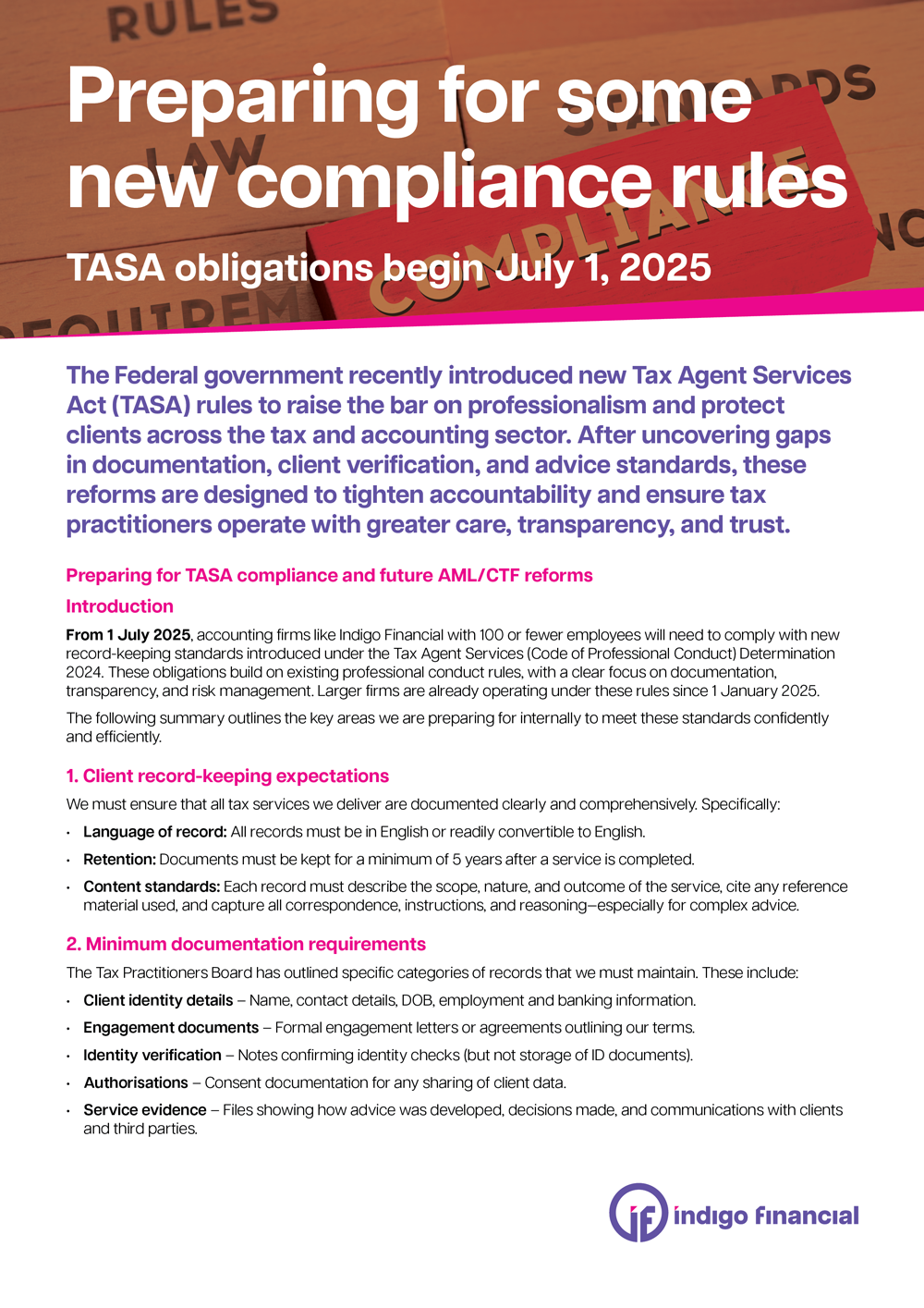
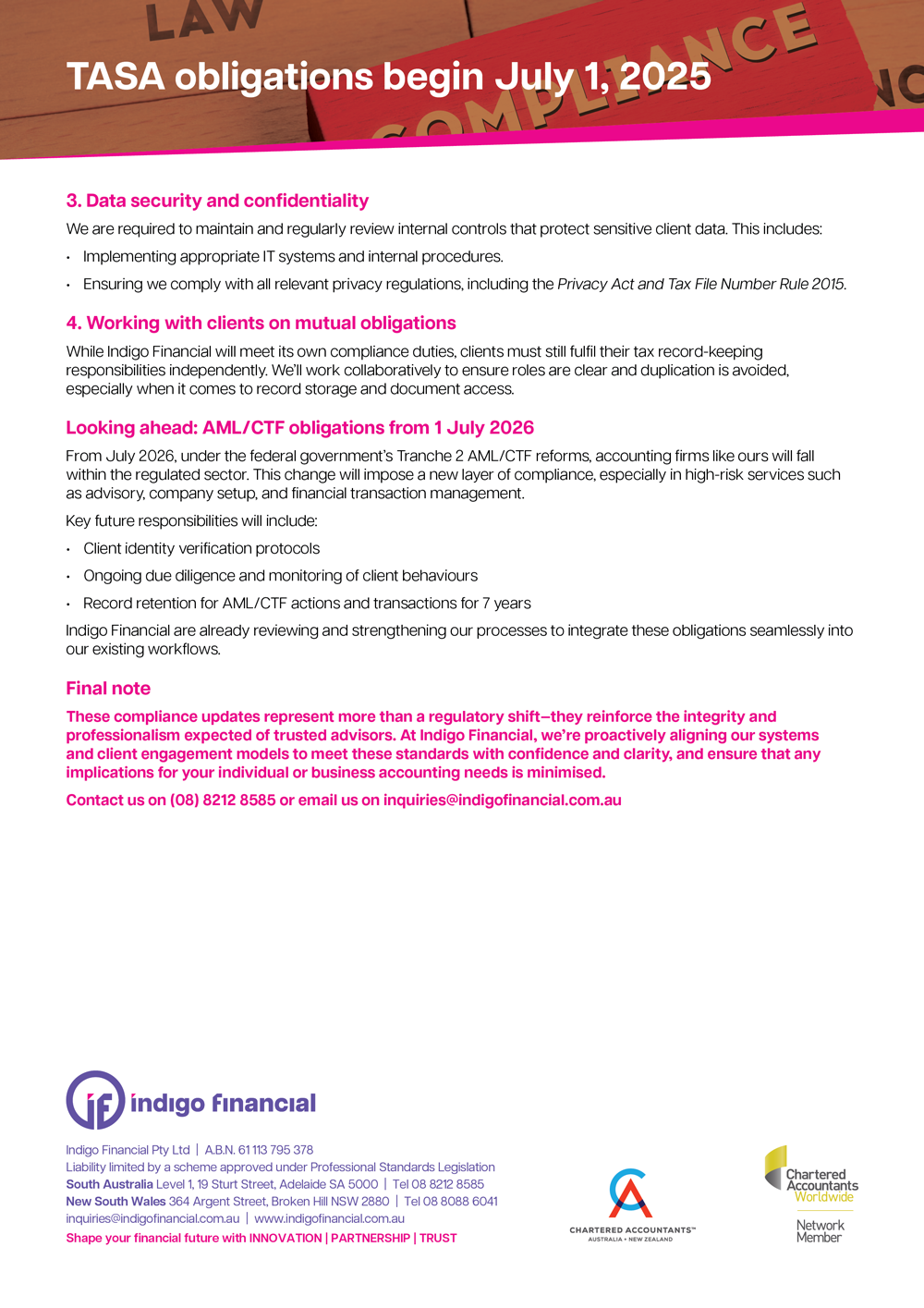
The Federal government recently introduced new Tax Agent Services Act (TASA) rules to raise the bar on professionalism and protect clients across the tax and accounting sector. After uncovering gaps in documentation, client verification, and advice standards, these reforms are designed to tighten accountability and ensure tax practitioners operate with greater care, transparency, and trust. Learn about the new rules on this fact sheet.
DOWNLOAD FACT SHEET: TASA obligations begin July 1, 2025 v1
With the 2025 tax season fast approaching the Australian Taxation Office (ATO) is reminding taxpayers to be careful when claiming work related expenses. This is in reaction to a spate of claims that didn’t quite pass the ‘pub test’. To give you a few examples of what didn’t get through…
- A mechanic attempting to claim an air fryer, microwave, two vacuum cleaners, TV, gaming console and gaming accessories as work related expenses
- A truck driver seeking to deduct swimwear purchased during transit due to hot weather
- A fashion industry manager attempting to claim over $10 000 in luxury branded clothing and accessories for work related events
These claims were deemed personal in nature and lacked a sufficient connection to income earning activities. The advice here would be – if in doubt leave it out or run it by us.
2025 priorities
The ATO is focusing on areas where frequent errors occur including:
- Work related expenses: as above, claims must have a clear connection to income earning activities and be substantiated with records including receipts or invoices. Even if an expense seems to relate to income earning activities, it can’t normally be claimed if it is a private expense. There are a wide range of common expenses that normally don’t qualify for a deduction.
- Working from home deductions: taxpayers must prove they incurred additional expenses due to working from home. The ATO offers two methods for calculating these deductions: the fixed rate method and the actual cost method (more detail below).
- Multiple income sources: all sources of income, including side hustles or gig economy work must be declared. Each source may have different deductions available.
Working from home deductions
For those working from home there are two methods to calculate deductions:
- Fixed rate method: claim 70 cents per hour for additional running expenses such as electricity, internet and phone usage even if you don’t have a dedicated home office. This method can only be used if you have recorded the actual number of hours you worked from home across the income year. A reasonable estimate isn’t enough.
- Actual cost method: claim the actual expenses incurred, with records to substantiate the claims. This method potentially enables a larger deduction to be claimed, but the record keeping obligations are more onerous.
It’s important to note that double dipping is not allowed. For instance, if you claim deductions using the fixed rate method you can’t separately claim a deduction for your mobile phone costs.
Contact Indigo Financial on (08) 8212 8585 if you need help understanding and planning your June 30 tax strategy, or any of your other accounting and taxation needs.
Note: The material and contents provided in this publication are informative in nature only. It is not intended to be advice and you should not act specifically on the basis of this information alone. If expert assistance is required, professional advice should be obtained.
Why ATO compliance matters
Staying compliant with the Australian Taxation Office (ATO) is more than just meeting deadlines—it’s about protecting your financial wellbeing and building long-term confidence in your financial operations. For individuals, it ensures you avoid penalties, access available deductions, and stay on track with super and retirement planning. For businesses, timely and accurate reporting helps maintain good standing with regulators, improves cash flow forecasting, and reinforces trust with lenders and partners. As the ATO increases its use of data-matching and real-time analytics, being proactive with your obligations is not just recommended—it’s essential.
Tax time is almost here so here are some tips
As 30 June approaches, now is the optimal moment to finalise your financial-year planning. Here’s our comprehensive rundown of actions to consider for tax minimisation, super optimisation, and avoiding last-minute stress.
Tax planning strategies
Writing off bad debts
Businesses should finalise deductions by writing off unrecoverable debts before 30 June.
If you’re owed money that’s unlikely to be recovered, you can write it off as a tax deduction—but only if it’s done before 30 June. The debt must have been previously declared as income, and you’ll need to show clear evidence that recovery efforts were made and the debt was formally written off in your books.
This simple step can help reduce your taxable income for the year and tidy up your balance sheet.
Bonuses & director fees
Ensure all staff or director bonuses are confirmed in writing and notified by 30 June—even if paid later—to secure the corresponding deductions.
Planning to pay staff or directors a bonus or fee? To claim a deduction this financial year, it must be formally committed to in writing by 30 June, even if the payment happens later.
Proper documentation—such as board minutes or letters of offer—is essential. Without it, the ATO may deny the deduction. We can help you get it right before EOFY.
Prepaying interest & expenses
Bring forward interest on investment loans (e.g. rental properties) and eligible operating costs—like insurance, subscriptions, or repairs—so they count in this FY.
Prepaying deductible expenses like investment loan interest, rent, insurance, or subscriptions before 30 June can bring forward a tax deduction into this financial year.
Individuals can generally prepay up to $1,000; small businesses may be able to prepay up to 12 months of expenses if their turnover is under $50M.
This strategy is most effective when you expect to be in a higher tax bracket this year and have the cash available. Timing and documentation are key—speak with us to ensure eligibility and maximise the benefit.
Stock & asset review
Write off obsolete stock and remove unused assets from depreciation schedules.
Now’s the time to review your inventory and asset list. Write off any obsolete or damaged stock to reduce taxable income, and check if unused assets can be removed from your depreciation schedule.
Small businesses may also benefit from the instant asset write-off (up to $20,000 per asset purchased after 1 July 2024, subject to eligibility). These actions help clean up your records and minimise your tax bill.
Electric vehicle considerations
Eligible for both depreciation and Fringe Benefits Tax concessions—but ensure proper documentation.
If your business uses electric vehicles (EVs), you may be eligible for tax deductions and Fringe Benefits Tax (FBT) exemptions—but only for qualifying models below the luxury car threshold.
Ensure you’ve kept logbooks, usage records, and purchase details to substantiate claims. With EV incentives changing, it’s important to check you’re capturing all available tax benefits correctly.
Income & capital timing
Defer invoicing or asset disposals to after 30 June to delay income recognition.
If you’re in a position to delay income—such as invoicing clients after 30 June—you may defer tax to the next financial year. Similarly, realising capital losses before year-end can offset gains and reduce tax.
Be careful with the ATO’s anti–wash-sale rules, which disallow losses from artificial asset sales and repurchases. Smart timing can make a big difference—just ensure the strategy is legitimate and documented.
PSI, company loans, trusts & logbooks
If you earn Personal Services Income (PSI), ensure you’re meeting ATO rules around income attribution and deductions.
For companies, review any Division 7A loans to shareholders—these must be properly documented or repaid to avoid being treated as unfranked dividends.
Trusts need to have trust distribution resolutions signed by 30 June to ensure correct tax treatment. And if you’re claiming vehicle expenses, make sure you’ve completed a valid 12-week logbook within the last five years or started a new one this year.
Insurance & private health review
EOFY is a great time to review your insurance cover—including life, income protection, and business policies—to ensure they still align with your needs.
Also check your private health insurance status. If your income is above the threshold and you don’t have appropriate cover, you could be hit with the Medicare Levy Surcharge. Prepaying premiums may also bring forward a tax deduction, depending on your circumstances.
Business structure check-up
As your business grows, your current structure—whether sole trader, partnership, trust, or company—might no longer be the best fit.
A structure review before 30 June can highlight opportunities to improve tax efficiency, manage risk, or plan for succession. The right setup can also better support super contributions, asset protection, and future expansion.
Superannuation considerations
Check contribution caps
Before making any super contributions, log in to myGov to check your concessional and non-concessional cap usage.
If you’re with an SMSF, be cautious—your balance may not reflect the latest transactions. We can help you get up-to-date figures so you don’t accidentally exceed your limits.
Deductible or salary-sacrifice contributions
You can contribute up to $30,000 in concessional (pre-tax) contributions this year. This includes employer super, salary sacrifice, and personal deductible contributions.
If making a personal contribution, submit a Notice of Intent to your fund and get acknowledgment before claiming a deduction on your tax return.
Carry‑forward (catch‑up) contributions
Haven’t used all your concessional cap in the past 5 years? If your total super balance was under $500,000 on 30 June 2024, you can make catch-up contributions and top up your super this year.
This is a great way to boost retirement savings and reduce tax if you’ve had fluctuating income.
Spouse contributions & tax offset
You may get a tax offset of up to $540 by making after-tax contributions into your spouse’s super fund, provided their income is under $40,000.
You can also consider splitting your own concessional contributions with a spouse to balance your retirement savings or improve your combined strategy.
Government co‑contribution
If you earn less than $60,400 and make an after-tax contribution of up to $1,000, you could receive a government co-contribution of up to $500.
It’s a simple way to grow your super if you’re a low- to middle-income earner.
Non‑concessional contributions & bring‑forward rule
You can contribute up to $120,000 in after-tax (non-concessional) contributions this year—or up to $360,000 using the 3-year bring-forward rule, if eligible.
Check your total super balance before contributing, as this affects your cap and eligibility.
Avoid Division 293 tax
If your income plus concessional contributions exceed $250,000, you may be hit with an extra 15% Division 293 tax on top of the standard 15%.
Strategic income and contribution timing can help avoid or minimise this.
Minimum pension payments
If you’re drawing a pension from your super, you must withdraw at least the minimum amount by 30 June to maintain tax-free earnings inside the fund.
Rates range from 4% to 14%, depending on your age. Don’t risk missing the deadline—it could cost your fund valuable tax concessions.
Why this all matters to Indigo clients
Taking these steps provides:
-
A clear path to legitimate tax deductions
-
Confidence that super contributions are maximised and structured
-
Assurance that all steps are compliant and aligned with current thresholds
Need help crystallising your strategy?
Our team is ready to guide you—whether you’re juggling PAYG, SMSF, or multiple structures, we’ll tailor these steps to your scenario and help you implement them effectively before the 30 June deadline.
Contact Indigo Financial on (08) 8212 8585 if you need help understanding and planning your June 30 tax strategy, or any of your other accounting and taxation needs.
Note: The material and contents provided in this publication are informative in nature only. It is not intended to be advice and you should not act specifically on the basis of this information alone. If expert assistance is required, professional advice should be obtained.
Working from home (WFH) has become the norm for many Australians, whether on a full-time or hybrid basis. While it offers flexibility and convenience, it also comes with important tax and compliance obligations — and getting it wrong can lead to penalties or missed deductions. This Fact Sheet outlines the key legal, tax and reporting responsibilities to be aware of when claiming working from home expenses, and how Indigo Financial can help.
DOWNLOAD FACT SHEET: Understanding Working from Home Obligations


The Australian Taxation Office (ATO) offers an instant asset write-off scheme, allowing eligible small businesses to immediately deduct the cost of certain assets. As of the 2024–25 financial year, businesses with an aggregated turnover of less than $10 million can claim an immediate deduction for assets costing less than $20,000, provided the asset is first used or installed ready for use between 1 July 2023 and 30 June 2025.
This measure is designed to improve cash flow and reduce compliance costs for small businesses by allowing them to instantly deduct the full cost of eligible assets, rather than depreciating them over several years. The $20,000 threshold applies on a per-asset basis, enabling businesses to claim multiple assets, each under the threshold.
However, the 2025–26 Federal Budget announced that the instant asset write-off threshold will revert to $1,000 from 1 July 2025, unless further legislative changes are made.
Despite the benefits, many small and medium-sized enterprises (SMEs) are not fully utilizing the instant asset write-off. A report by ScotPac found that 59% of SMEs planned to invest in their businesses in the six months to August 2025, but the uncertainty surrounding the write-off’s future has caused many to reconsider or delay their investment plans.
Several factors contribute to the underutilization of the instant asset write-off:
- Uncertainty and Legislative Delays: Frequent changes and delays in legislating the write-off thresholds create uncertainty, making it challenging for SMEs to plan their investments confidently.
- Cash Flow Constraints: Many SMEs face cash flow challenges, limiting their ability to make upfront investments, even with the promise of tax deductions.
- Lack of Awareness: Some business owners may not be fully aware of the eligibility criteria or the benefits of the instant asset write-off, leading to missed opportunities.
- Complexity of Tax Rules: Navigating the tax system and understanding the specific requirements of the write-off can be daunting, especially for businesses without dedicated financial advisors.
A recent online article by Rommel Lontayao in Mortgage Professional Australia suggested that only a small percentage of SMEs were actually accessing this opportunity…
Most SMEs missing out on tax deduction: study
OnDeck research shows only one in four small firms are claiming the instant asset write-off.
With the end of the financial year approaching, new research from OnDeck Australia indicates that a significant number of small businesses may be missing out on a valuable tax deduction.
According to the survey from the SME lender, only 26% of small enterprises nationwide are currently claiming the instant asset write-off (IAWO), a federal tax incentive designed to support small business investment.
The IAWO enables businesses with an annual turnover under $10 million to immediately deduct the cost of eligible assets costing up to $20,000, rather than spreading the deduction over several years.
Despite the potential tax benefits and improved cash flow, 36% of businesses said they are not using the deduction, while another 38% were unsure whether they were accessing the scheme.
“This should be a wake-up call for the nation’s small business community,” said Cameron Poolman, Chief Executive of OnDeck Australia. “With only weeks remaining in the current financial year, there is still time for eligible businesses to make a strategic purchase and reduce their taxable income. But the asset must be in place by June 30 this year to claim the IAWO.”
Poolman said that the IAWO can support productivity by encouraging investment in business equipment such as tools, vehicles, and office supplies. It may also help firms expand their service offerings or upgrade customer-facing facilities.
“Moreover, the IAWO reduces a small business’s taxable income, driving a reduction in the company’s annual tax bill,” he said. “This can free up funds for investment in other areas of the business such as marketing, research, or staff development.”
OnDeck’s earlier research suggests that access to finance could play a role in increasing uptake, with 18.3% of small business owners saying they would use extra funding to upgrade assets or facilities.
“With only weeks to go before June 30, I encourage small businesses to speak with their tax adviser to understand if they would benefit from the IAWO in the current financial year,” Poolman said.
Contact Indigo Financial on (08) 8212 8585 if you need help understanding and planning your instant asset write-off before June 30, or any of your other accounting and taxation needs.
Note: The material and contents provided in this publication are informative in nature only. It is not intended to be advice and you should not act specifically on the basis of this information alone. If expert assistance is required, professional advice should be obtained.
As the end of the financial year approaches, smart business owners take time to plan. Year-end tax planning isn’t just about reducing tax – it’s about getting your business into the best possible financial position. Here’s a practical checklist to help small and medium businesses prepare for 30 June and make the most of available opportunities.
DOWNLOAD FACT SHEET: Year-end tax planning checklist v2


With the rise of flexible working arrangements, many professionals are working from home. It’s essential to understand which home office expenses are deductible and which are not, ensuring compliance with the Australian Taxation Office (ATO) guidelines.
DOWNLOAD FACT SHEET: Home office expenses – What’s allowed v5


Effectively managing motor vehicle expenses is crucial for small to medium businesses aiming to optimise tax deductions. The Australian Taxation Office (ATO) mandates precise record-keeping to substantiate claims. Understanding the logbook method and its requirements can help ensure compliance and maximise your eligible deductions.
DOWNLOAD FACT SHEET: Motor Vehicle Expenses – Logbooks and Claims v5


The Australian Government has announced that cheques will be phased out by 30 September 2029. This reform is part of a broader effort to modernise the payments system and reduce reliance on outdated, costly methods of transaction. Cheque usage has dropped by over 90% in the past decade, and digital alternatives now offer faster, more secure ways to pay.
DOWNLOAD FACT SHEET: Phasing out cheques by 2029 v1