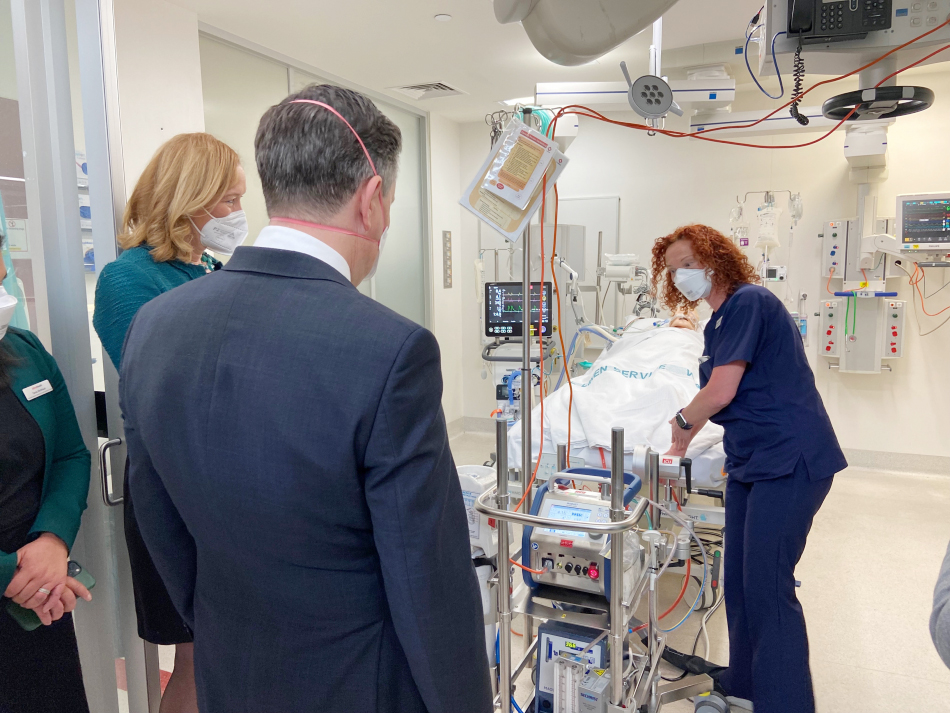
Imagine a Cardiothoracic surgeon having to take a scalpel and cut a 25mm diameter hole in your heart and sew a material washer into it while it’s still beating. Then connect a small magnetic levitation pump with a computer chip to the washer, punch a hole through your abdomen to feed an optical fibre line which connects to a control unit and two lithium-ion batteries. All this, and much more, to keep you alive because your heart has reached the point where it cannot function sufficiently to keep you alive.
This is the reality of a growing number of people who are suffering from a variety of cardiac conditions including dilated cardiomyopathy. It might sound brutal, but considering the random nature of a suitably matched heart becoming available in time, there is no alternative.
This incredible technology had its first successful human implant in 1982 in the United States where a male patient survived for 112 days. The first Australian implant didn’t take place until 2010 at Sydney’s St Vincent’s Hospital.
The device used to be called a Ventricular Assist Device (VAD) but was recently relabelled as a Mechanical Circulatory System (MCS) due to legislation introduced into State law in the last few years that refers to Voluntary Assisted Dying which had an identical acronym.
Patients requiring this surgery might have either one or two of these devices implanted depending on the circumstances of their heart failure.

Illustration of a heart with two Ventricular Assist Devices attached – called a Bi-VAD. Typically a device is attached to assist the left side heart function (LVAD) but in some case, both sides of the heart need a device for support.
Australia has four main heart transplant centres, with the Alfred Hospital in Melbourne and St Vincent’s Hospital in Sydney performing most of the MCS implantations and heart transplants and supported by the Fiona Stanley Hospital in Perth and Prince Charles Hospital in Brisbane.
Medical emergencies and health events can create significant hardship. They do not discriminate on the basis of age, gender, race, education, geography or bank balance.
The consequences can have profound effects on the individual experiencing the event as well as a cascading number of people around them, including family members, friends, work colleagues, businesses and recreational groups they are part of.
The individual experiencing the emergency or event will be impacted medically, physically, emotionally, psychologically and undoubtedly financially.
Those around them will have their own emotional, psychological and financial impacts.
One of our clients contracted a virus that attacked his heart muscle in 2010 which caused dilated cardiomyopathy and eventually led to him also experiencing kidney failure in 2016-2017. The impact of a failing heart and kidneys which were shutting down meant he was experiencing significant ongoing fluid retention which had to be dealt with by hospitalisation and IV diuretics.
His condition became dire in August 2017 and he was transferred to the Royal Adelaide Hospital (RAH) from a private hospital so that he could be prepared for medivac flight to the Alfred Hospital in Melbourne to undergo testing and evaluation to be listed for heart transplantation.
Our client and his wife were under the belief that they would be in Melbourne for a week of tests and discussion and then return home, with him being admitted back into the RAH for ongoing medical support.
With an adult child, a teenager and a dog at home there were a few things to plan around before leaving for Melbourne. Their other adult child, living independently, agreed to drop in and lend a hand. Just a week, it was under control.
The day after arriving at the Alfred, our client went into multiple organ failure and had to be placed into an induced coma and put on ECMO (life support machine). This was the beginning of the significant toll that would envelope the family over the next three years.

Our client underwent an MCS implantation during his 38 day stay in ICU which required his wife to authorise the surgery without his consent (he was in an induced coma). His wife was faced with the monumental task of authorising medical surgery and treatment, activating his income support protection in his Super policy, contacting his employer, contacting family and friends, contacting her own employer, navigating the SA Government Patient Assistance Transport Scheme (PATS) and Federal Government Centrelink Carer’s payment for some financial support, all the while having no understanding if the surgery and recovery was going to be successful and how long that might take.
Additionally, she had to arrange for their kids at home (one still at high school) to be self sufficient for the time being while she dealt with everything in Melbourne.
Their three children flew over as soon as they heard things had taken a serious turn for the worst. The in-laws followed soon after.
It’s surprising how quickly patients lose body mass and muscle during a hospital admission and our client’s initial inpatient stay at the Alfred lasted 91 days so he lost in the order of 28kg – some of that was fluid overload due to his kidneys not functioning because of the heart failure. He was discharged in a wheelchair, unable to walk, a machine inside him pumping blood around his body 24/7, significant muscle wasting and neuropathy in his legs and feet from being on ECMO for over 20 days. His feet, particularly his left foot was completely numb.
For the next 13 weeks he had to present to the Alfred for education, testing, treatment, physical rehabilitation and blood management (he had to use Warfarin to thin his blood to ensure the pump didn’t spin off a clot and risk a stroke).
This is where the financial impact of this experience started to become apparent.
Due to his lack of strength, balance and inability to walk yet, he and his wife had to stay close to the Alfred in order to keep the transportation costs to a minimum. As they didn’t have a car in Melbourne, taxis and Uber were the only options.
Apartments and hotel rooms in South Yarra are not cheap, particularly those with cooking and washing facilities as well as a lift. The government support from PATS was helpful without being overly generous. The cost of accommodation was significant over the 13 weeks of his outpatient rehabilitation.
Our client was the first patient with one of these devices to present to the new RAH after its relocation to the western end of North Terrace. A team of specialists from the Alfred Hospital flew to Adelaide to inform and educate the Cardiologist and heart failure clinicians who were to care for him on his return. The Cardiologist had done his Fellowship at the Alfred in the heart transplant space and was to become our client’s lifeline until he became transplanted.
To be more accurate, he has become our client’s lifelong specialist since his transplant and manages all of the implications of post transplant life – diet, immune suppressing medications, regular skin checks (some of the medications increase the risk of melanoma significantly), kidney function (yes they eventually woke up and are now relatively normal) and bone density (again the medications have an ongoing impact).
It took 19 months from the implantation of the mechanical heart pump to the time our client received a phone call from the Alfred that they had a suitable donor heart for him.
Thankfully our client had one of the older Super policies that gave him a period of five years protection at 70% of his income. His wife had to walk away from her long term employment as she had to become his full-time carer immediately after his mechanical heart pump surgery. This commitment lasted until after his heart transplant when his physical condition had improved significantly and became completely independent again.
The totality of this experience has been profound. And continues to be.
The message from this article is to be more aware of the vulnerability of the human body. Our client has connected with people ranging from 6 years old to 71 years old who have needed the support of a mechanical heart pump or heart transplant to sustain their life. He has met both females and males from all walks of life.
As part of his multi-year journey back to full time work, our client worked part time in the health system as a Consumer Advocate and regularly talks to patients needing stents, bypass surgery and other significant medical interventions. In the majority of cases people weren’t particularly focused on being ready for such an event to occur to them… until it did. And in every case, it has had a significant impact on their finances as well as broader aspects of their life and family.
To be out of the workforce for such a long period of time has had a significant impact on our client’s financial position. Even with income protection, he estimates that the combined impact on he and his wife’s finances is north of $200K.
There are many ways to be more ready for something like this to happen to you, it just needs you to accept that emergencies and the unexpected are life events that can happen at any time and require early planning and preparation
Some important things to keep in mind:
- Have access to savings in case of emergency – this cannot be stressed enough
- Investigate your Superannuation policy to see if you have built in some income protection and/or life insurance
- Investigate whether a life insurance policy is something that might work for you
- Be very clear where you stand with regards to sick leave, annual leave and other entitlements from your employer(s)
- Be very clear what your contractual obligations are with your employer(s) in case you are experiencing an emergency and are unable to give a definite timeframe for your return to work
- Have the important documentation about your life in one, accessible place (eg your will, power of attorney, enduring medical power of attorney, birth certificate, etc)
- Spend the time and money to create a professional will
- If you are married or in long term defacto relationships, ensure that services and utilities are in joint names so that your spouse or partner can access information and make decisions on your behalf
- If you are married or in long term defacto relationships, if possible, ensure assets (car, house, etc) are in joint names so that you spouse or partner can access information and make decisions on your behalf
- If you are married or in long term defacto relationships, consider who has access to your bank account(s) in case you are rendered unconscious for a period of time (eg induced coma)
- Consider having a written plan for emergencies which details what you wish to happen on a day-to-day basis (eg pets, watering the garden, mowing the lawn, paying bills, informing family and friends, informing your employer(s), who has access to keys for the car and house, etc). If you have a written plan, ensure it is communicated to a trusted person so that they can find it and passed onto other suitable people
- Consider writing down a list of all of the key contacts there are in your life (eg doctors, specialists, family, friends who might need to informed, employer(s), local council, utilities, etc) so that your spouse or partner has ready access
- Consider having your medical history (including medications, operations and allergies) written down so that if you are in an emergency, particularly if you are rendered unconscious, it can be passed onto the medical team treating you – this might save time, and your life, in an emergency.
The other perspective to consider is that of being a business owner and employer
Do you have the necessary structures in place in order for you to be absent, possibly at very short notice, from your business for an indefinite period of time?
Do you have a senior staff member who could step into your role to keep things afloat?
Do they have access to all the necessary decision-making tools to ensure your staff and creditors get paid?
These are very important responsibilities that can cause significant harm to your day-to-day operation and consequent reputational damage to you and your business.
Your staff depend on your attention to detail as an employer and put their trust in you that you have contingencies in place as part of your risk management plan.
Are you living up to those expectations or do you need to spend some time getting your plan in order while you can?
Speak to Indigo Financial today if you need assistance getting your business plan into shape in order to risk manage a significant event, health or otherwise, impacting your business. We know first hand how your life can change in an instant, so let us use that knowledge to help you plan for the future.
Call us on (08) 8212 8585
The Australian small business environment has fallen well below the long-term average, according to the Australian Small Business and Family Enterprise Ombudsman’s new ‘Small Business Pulse’.
The ‘Small Business Pulse’ recently launched by the Australian Small Business and Family Enterprise Ombudsman (ASBFEO) has shown that conditions over the last 12 months for small businesses have deteriorated by 3.5 per cent.

ASBFEO Bruce Billson (pictured) said the ‘Small Business Pulse’ is an innovative combination of non-traditional and traditional data to produce an indicator of small business health.
Billson said he designed the pulse to act as a ‘health check’ for the Australian economy.
“Small business is the beating heart of our communities and our economy,” he said.
“The Pulse is a world-leading index that provides an overall perspective of the challenges and opportunities for small businesses, drawing in sentiment, operating conditions, how business owners are responding to these conditions and the ability to transform or grow a business.”
The ‘Small Business Pulse’ captures three broad areas to reflect the small business environment for SME owners including sentiment, business transformation and business operations.
For August 2024 the pulse dropped by 0.6 per cent, the eighth consecutive fall.
According to the indicator, this is what resulted in the 3.5 per cent decrease in the last 12 months.
Billson said this fall was caused by the current economic climate, as well as post COVID-19 effects.
“This represents a modest decline over recent quarters after the stark deterioration caused by an end of covid-support and covid-amplified changes in the structure of the economy,” Billson said.
“Including inflationary pressures, skills shortages, supply chain challenges and pronounced margin squeeze and the series of interest rate increases.”
Higher interest rates impact small businesses in their costs of financing as well as implicating spending, preferences and confidence of customers.
All SMEs are aware there is no substitute for customers in determining business success, Billson said.
Results demonstrated the concerns for small business owners about their business viability have increased.
These include business owners who have recognised they’re in financial distress, as well as those who have already began considering their options.
Billson said a concerning number of small businesses are experiencing ‘crushing’ debt with insolvencies at a record high.
“It’s a real gamble, with the value of debts owned by small businesses increasing over the last year and around half of small business loans secured by the family home,” he said.
“Business insolvencies are rising and small businesses are increasingly concerned that other businesses that owe them money are insolvent.”
The Pulse also reflected payment disputes now account for 42 per cent of all small business disputes, which has risen from 36 per cent in the last financial year.
Results showed fewer small businesses are enquiring about expanding as they struggle to stay viable, as well as fewer enquires about advertising, hiring staff and expanding offerings.
Billson said these challenging conditions have affected optimism in various areas, however early indicators suggest that the next Pulse update due in November may improve.
“Queries from people considering taking the leap into business have remained relatively high since February,” Billson said.
“Similarly, there has been a rise in small business owners interested in growth ambitions and seeking business coaching and mentoring.”
Although optimism is rising in start-up businesses, the current economic market will continue to present challenges which will likely offset this positivity, according to the Pulse.
Give Indigo Financial a call to discuss how we can assist you to navigate these turbulent economic times and ensure your business is not just stable, but growing and flourishing. We are not just an accounting firm – we are a fully resourced advisory specialising in all aspects of business.
With over 200 years of collective professional experience, we are a small, but widely experienced team dedicated to working with small to medium enterprises (SMEs). We have the tools, resources, skills and coaching knowledge to help you achieve business performance excellence.
As well as taxation and accounting, we specialise in:
• Financial planning
• Business services
• Business development
• Superannuation
• Property advisory
• General insurance
• Lending
Call Indigo Financial on (08) 8212 8585
This article was originally published by: Imogen Wilson – Accountants Daily, 2 August, 2024
ABOUT THE AUTHOR – Imogen Wilson
Imogen Wilson is a graduate journalist at Accountants Daily and Accounting Times, the leading sources of news, insight, and educational content for professionals in the accounting sector. Previously, Imogen has worked in broadcast journalism at NOVA 93.7 Perth and Channel 7 Perth. She has multi-platform experience in writing, radio and TV presenting, as well as podcast production. Imogen is from Western Australia and has a Bachelor of Communications in Journalism from Curtin University, Perth.
The ongoing digitalisation of economies around the world affects almost all aspects of our daily lives, including the ways in which we pay.
In any small business, a lot of time is spent thinking about the product or service and how to get it into the hands of customers faster, better and more often. But all the hard work spent on making, marketing and moving the product or service can come undone at one crucial point in the customer experience: ensuring they pay.
The latest research by Xero, in their Xero Global Payments Report, has found that consumers and small businesses are worlds apart when it comes to the ways customers want to pay and how small businesses want to be paid. Their report aimed to uncover how consumers actually want to pay, and give small businesses and their advisors the insights and tools to help their customers pay that way.
Almost nine in ten consumers (86%) rely on credit and debit cards for their essential and discretionary spending. Yet around a third of small businesses still don’t offer this payment method.
Not having funds at the time is a top reason consumers give for not paying their bills on time. Yet many small businesses don’t provide alternative payment options like buy now, pay later (75%) or credit card (32%) that could give customers more flexibility over when they pay and prevent flow-on cash flow issues.
Payments are a crucial piece in the cash flow puzzle. The payments landscape is constantly evolving, which means it can be hard to keep up with changes in consumer demand and market trends when trying to do a million other things like making sales and finding customers.
While collecting payments from consumers is key to business growth, the other side to the cash-flow coin is managing the payments and bills that small business owners need to cover in order to keep their business running.
TREND #1
A mismatch exists between the payment methods small businesses offer and those consumers prefer.
Across all five countries surveyed, a vast majority (86%) of consumers use credit or debit cards to pay for goods and services. In contrast, 68% of small businesses offer credit or debit cards as a payment option. Other payment methods consumers commonly used include direct debit (66%) and bank transfer (62%), whereas the number of small businesses that offer these payments to customers today is again significantly lower at 38% and 49% respectively.
On the flip side, 43% of small businesses offer Apple Pay and/or Google Pay, compared to 30% of consumers who use these payment services.
The survey offers a couple of reasons for this mismatch, which we explore further in the third trend. One factor is the higher fee and set-up costs small businesses incur with credit cards and direct debit payments. Credit card processing fees can range between 1.3% and 3.5% per transaction, which can be a significant burden for small businesses with slim profit margins.

TREND #2
What you sell, and who you sell it to, influences how your customers want to pay
When shopping in-person, over half (57%) of consumers use physical bank cards, with 21% reporting that they only take their mobile phone with them, which they use for contactless payments through Apple Pay or Google Pay. Only 19% have cash readily available.
When looking at payment methods by industry, consumers prefer credit and debit cards for in- store purchases across all industries, with the exception of housing (rent, mortgage, bills) where 37% of consumers prefer to use direct debit.
However, cash is still a popular way of paying for some purchases, such as services like going to the hairdressers (35%) and using trades like electrical and plumbing (24%).
These preferences could reflect the nature of the transactions. In industries like hairdressing and trades, many transactions are relatively low in value, making cash a convenient option, compared to housing where consumers often need to make recurring payments or pay larger sums of money.
While more consumers prefer to use their credit or debit card to pay for online transactions, payment preferences differ across countries depending on the industry.
Australian consumers are the most likely to use bank transfers (27%) to pay for healthcare services, whereas American consumers are most likely to use credit or debit card (57%) to pay for healthcare.
Bank transfers are the most common way for New Zealanders to pay small businesses online in the trade (46%) and the housing (46%) space, significantly higher than other countries.
Consumer demographics also influence how they want to pay. Baby Boomers (aged 65 years and older), stick to more traditional payment methods: 92% use credit and debit cards (compared to Gen Z 84%, Millennials 85%, Gen X 85%), and nearly a third (29%) still write cheques to make payments (compared to Gen Z 18%, Millennials 11%, Gen X 17%).


TREND #3
Fees and security concerns are the top barriers across all countries, but so are cultural, market and economic dynamics
As explained above, there’s a disconnect between what payment options consumers want and what small businesses are offering, which can be explained by looking at the barriers small businesses face when it comes to adopting new or different customer payment methods.
Small businesses report expensive fees (33%) and security concerns (30%) as the top barriers that prevent them from offering their customers new or different payment methods. There is some variation across countries. Security is not as big a concern in Australia (19%) as the perceived fees associated with new payment methods (36%).
In Singapore, the biggest concern is payout times from payment service providers (36%), followed by the complexity and time to set up new payment methods (35%).
Consumers report similar themes, naming hidden fees or surcharges (66%) and security concerns (42%) as barriers when paying or managing payments. In fact, 37% of consumers said they would try to change their payment method to avoid paying a surcharge when making purchases. This is even higher in New Zealand, where one in two (51%) said they would try to change the payment method.
A vast majority (61%) of consumers have a low acceptance of paying a surcharge, even if the payment method is convenient for them. Almost one in three (29%) indicated they were not at all accepting of payment surcharges, despite the payment method being convenient to them.
Consumers in the UK report the lowest acceptance of paying surcharges, with almost two thirds (65%) of UK consumers indicating they have a low tolerance for paying surcharges. Consumers in Singapore have the highest acceptance of paying surcharges, with almost a quarter (23%) of consumers in Singapore saying they have a high tolerance for paying surcharges.
The different attitudes towards hidden payment fees and surcharges across countries may be explained by cultural, market and economic dynamics. For example, stricter regulations in the UK about pricing transparency might discourage the imposition of surcharges, so when they’re applied by businesses, they’re met with consumer resistance.
Small businesses could be sensitive to these consumer concerns, in addition to other macroeconomic factors. They report low transaction fees (55%), no payment surcharge fees (48%) and no set-up fees (39%) as factors when choosing new payment methods.
This could be why 42% of small businesses choose to build fees into the price of their goods and services, rather than charge separately. It helps them avoid any unpleasant repercussions.


Overview of Australian trends
Ongoing shifts in Australia’s payment landscape are influenced by a wide range of policy and regulatory issues. The Australian government, as well as the Reserve Bank of Australia (RBA), continue to introduce reforms and regulations to address changing payment behaviours and market trends. Most notable in 2024 are the buy now, pay later regulatory reforms, the payments system modernisation (regulation of payment service providers) consultation, and consultation on the draft legislation for regulating digital asset platforms.
These policy reforms, as well as the continued reductions in ATM withdrawals and cash transactions, are likely to play into consumer and small business payment trends in attitudes and behaviours towards payment methods.
Small businesses in SA and VIC more likely to foresee impacts in a cashless economy
Australia remains firmly decided in favour of using credit or debit cards to make payments (86%), with bank transfers (66%) and direct debit (63%) also popular options for consumers. However, only 55% of small businesses accept credit or debit card payments, and only 48% offer direct debit as a payment option.
Almost seven in ten (69%) of Australians say they use cash to make payments. However, only one in four (25%) say they rely on cash and cheque to buy products and services. More than two in five (41%) consumers say they rarely use cash and cheque payments, only when a business requires it.
Moving to a cashless economy would be felt by many small businesses, with 79% of small businesses believing that if cash and cheque disappeared tomorrow it would have some form of impact on their business. Almost half (49%) believe it would have a medium to high impact.
Interestingly, the younger the small business owner, the more likely they are to believe it would have an impact on their business (Gen Z 89%, Millennials 85%, Gen X 74%, Baby Boomers 69%).
Small businesses in SA and Victoria are the most likely to believe it would have an impact on their business (SA 85%, VIC 83%; cf. NSW/ACT 77%, TAS/NT 57%*, QLD 78%, WA 72%).
The popularity of mobile payments is growing in Australia, and it’s being driven by the younger generations. Almost one in four Australians (24%), driven by a significant proportion of Gen Z consumers (40%), use Apple Pay or Google Pay to make payments. One in four Australians (25%) typically only take their mobile phone to pay when going to a physical store. Again, Gen Z consumers bring up this percentage – one in two (52%) say they only take their mobile phones to the shops.

Hidden fees or surcharges are the most common frustration among consumers
Over one in four Australians (28%) would visit another business that accepts more payment options if a business didn’t offer at least one of their preferred ways to pay. This could explain why the most important factors to Australian small businesses when choosing new payment methods are ease of payment for their customers (58%) and low transaction fees (57%).
In Australia, hidden surcharges are banned. According to the Competition and Consumer Act 2010, businesses must clearly disclose all fees and charges associated with a transaction and the ACCC enforces these regulations. Despite this, over 7 in 10 Aussies (72%) name hidden fees or surcharges as the most common frustration when it comes to paying or managing payments.
Over one in two Australians (56%) have a low acceptance of paying a surcharge fee if the payment method is convenient to them, with older generations more likely to have low acceptance of paying a surcharge fee (Baby Boomers 62% and Gen X 65%, compared with Millennials 51% and Gen Z 41%). Over one in three Australians (35%) will try to change their method of payment to avoid paying a surcharge.
This could be why over one in two small businesses (54%) report no payment surcharge fees as one of the most important factors when choosing new payment methods. Nearly half (46%) of small businesses pass payment surcharge fees onto their customers by building them into the price of their goods and services.

Small businesses and consumers most terrified about implantable payment chips
When thinking about new or emerging payment methods, small businesses and consumers are the most troubled about using microchip implants in their hands to pay for products and services.
While implantable payment microchips are not yet commercially available in Australia, almost half (47%) of consumers and 37% of small businesses say ‘terrified’ best describes their feelings towards this payment method.
Small businesses and consumers are also on the same page when it comes to digital currencies, with over a quarter of consumers (26%) and small businesses (27%) feeling anxious about digital currencies like crypto. While the EU, UAE, Singapore, Canada and many other G20 and major financial hubs have introduced regulatory frameworks for crypto, Australia has yet to do so.
Small businesses and consumers in Australia are the most optimistic about biometric authentication (eg, fingerprints and facial recognition), with around a quarter of consumers (24%) and 29% of small businesses saying they’re optimistic about this payment technology.
Small businesses and consumers have mixed feelings about digital payment methods
When thinking about future or emerging payment methods, small businesses are most optimistic about biometric authentication (31%) and bartering marketplaces (27%). This is similar for consumers, who are also optimistic about biometric authentication (24%) and bartering marketplaces (24%).
As the Reserve Bank explores digital currencies, more than a quarter of small businesses (27%) and consumers (29%) say they feel anxious about this payment method, with around a quarter of small businesses (23%) and consumers (27%) saying they feel terrified about digital currencies.
Small businesses and consumers are the most terrified about implantable payment chips and implanted microchips as future or emerging payment methods, at 43% and 46% respectively.
Give Indigo Financial a call to discuss how we can assist you to understand the best payment methods for your needs and ensure your business is not just stable, but growing and flourishing. We are not just an accounting firm – we are a fully resourced advisory specialising in all aspects of business.
With over 200 years of collective professional experience, we are a small, but widely experienced team dedicated to working with small to medium enterprises (SMEs). We have the tools, resources, skills and coaching knowledge to help you achieve business performance excellence.
As well as taxation and accounting, we specialise in:
• Financial planning
• Business services
• Business development
• Superannuation
• Property advisory
• General insurance
• Lending
Call Indigo Financial on (08) 8212 8585
Words courtesy: XERO – I want to pay that way (A report into how consumers and small businesses around the world feel about payments).
Registrations have been very strong in the 6 weeks since we launched our next Global Business Camp from 24-26 February, 2025 at Crowne Plaza Hotel, Surfers Paradise. And as we were putting a little bit of extra pressure on our clients to get their tax documents organised before 30 June, we decided to extend the Early Bird discount available to our valued Indigo clients a little longer. As long as you register BEFORE 30 September you can still SAVE $1100.
 That’s right, all you have to do is register BEFORE 30 September and you STILL qualify for an Indigo Early Bird discount.
If you’re serious about your business, then you should be seriously considering saving yourself a serious amount of money!
IMPORTANT: If you are registering before 30 September, use the Coupon Code VIP1 in the “Payment” section on the registration page on the Global Business Camps website to reduce the price you are paying to take advantage of the $1100 Early Bird discount. If you are having trouble with the payment, ring Kathy from GBC on 08 8423 6177 for assistance.
You don’t even have to pay the full amount just yet, as long as you REGISTER before 30 September, pay a small deposit per person and then the balance later (see registration form on the Global Business Camps website for details).
This event is all about giving you the tools to launch your business to new levels of growth, profitability and success.
CLICK HERE TO DOWNLOAD A BROCHURE ABOUT THE 2025 CAMP
CLICK HERE TO REGISTER FOR THE 2025 CAMP NOW
The main residence exemption exempts your family home from capital gains tax (CGT) when you dispose of it. But, like all things involving tax, it’s never that simple.
As the character of Darryl Kerrigan in The Castle said, “It’s not a house. It’s a home,” and the Australian Taxation Office’s (ATO) interpretation of a main residence is not fundamentally different. A home is generally considered to be your main residence if:
- It’s where you and your family live
- Your personal belongings have been moved into the dwelling
- It is where your mail is delivered
- It’s your address on the electoral roll
- You have connected services such as telephone, gas and electricity (in your name); and
- It is your intention for the home to be your main residence.
The length of time you have lived in the home is important, but there are no hard and fast rules. Your intention takes precedence over time spent as every situation is different.
When does the main residence exemption apply?
In general, CGT applies to the sale of your home unless you have an exemption, partial exemption, or you can offset the tax against a capital loss.
If you are an Australian resident for tax purposes, you can access the full main residence exemption when you sell your home if:
- Your home was your main residence for the whole time you owned it (see Can the main residence apply if you move out?); and
- You did not use your home to produce any income (see Partial exemption below), and
- The land your home is on is 2 hectares or less. If your home is on more than 2 hectares, for example on farmland, the exemption can apply to the home and up to 2 hectares of adjacent land.
Partial exemption
If you have used your home to produce income, you won’t normally be able to claim the full main residence exemption, but you might be able to claim a partial exemption. Common scenarios impacting your main residence exemption include:
- Running a business from home (working from home is ok), and
- Renting the home or part of the home.
In these scenarios, from the time you started to use the home to generate income, that part of the home is likely to be subject to CGT. And, a word of caution here, as of 1 July 2023, platforms such as Airbnb must report all transactions to the ATO every 6 months. This data will be used to match against the income reported on income tax returns.
Foreign residents and changing residency
Foreign residents cannot access the main residence exemption even if they were a resident for part of the time they owned the property.
If you are a non-resident at the time you enter into the contract to sell the property, you are unlikely to be able to access the main residence exemption. Conversely, if you are a resident at the time of the sale, and you meet the other eligibility criteria, the rules should apply as normal even if you were a non-resident for some of the ownership period. For example, an expat who maintains their main residence in Australia could return to Australia, become a resident for tax purposes again, then sell the property and if eligible, access the main residence exemption.
It’s important to recognise that the residency test is your tax residency, not your visa status. Australia’s tax residency rules can be complex. If you are uncertain, please contact us and we will work through the rules with you.
Can the main residence apply if you move out?
You might have heard about the ‘absence rule’. This rule allows you to continue to treat your home as your main residence for tax purposes:
- For up to 6 years if the home is used to produce income, for example you rent it out while you are away; or
- Indefinitely if it is not used to produce income.
When you apply the absence rule to your home, this normally prevents you from applying the main residence exemption to any other property you own over the same period. Apart from limited exceptions, the other property is exposed to CGT.
Let’s say you moved overseas in 2020 and rented out your home while you were away. Then, you came back to Australia in 2023 and moved back into your house. Then in early 2024, you decided it is not your forever home and sold it. You elected to apply the absence rule to your home and didn’t treat any other property as your main residence during that same period. In this case, you should be able to access the full main residence exemption assuming you are a resident for tax purposes at the time of sale.
The 6 year period also resets if you re-establish the property as your main residence again, but later stop living there. So, if the time the home was income producing is limited to six years for each absence, it is likely the full main residence exemption will be available if the other eligibility criteria are met.
Timing
Your home normally qualifies as your main residence from the point you move in and start living there. However, if you move in as soon as practicable after the settlement date of the contract, that home is considered your main residence from the time you acquired it.
If you buy a new home but haven’t yet sold your old home, you can treat both properties as your main residence for up to six months without impacting your eligibility to the main residence exemption. This applies if the old home was your main residence for a continuous period of 3 months in the 12 months before you disposed of it and you did not use your old home to produce income in any part of that 12 months when it was not your main residence.
If the sale takes more than six months and if eligible, the main residence exemption could apply to both homes only for the last six months prior to selling the old home. For any period before this it might be possible to choose which home is treated as your main residence (the other becomes subject to CGT). If your new home is being rented to someone else when you purchase it and you cannot move in, the home is not your main residence until you move in.
If you cannot move in for some unforeseen reason, for example you end up in hospital or are posted overseas for a few months for work, then you still might be able to access the main residence exemption from the time you acquired the home if you move in as soon as practicable once the issue has been resolved. Inconvenience is not a valid reason and you will need to ensure that you have documentation to support your position.
Can a couple have a main residence each?
Let’s say you and your spouse each own homes that you have separately established as your main residences.
The rules don’t allow you to claim the full CGT exemption on both homes. Instead, you can:
- Choose one of the dwellings as the main residence for both of you during the period; or
- Nominate different dwellings as your main residence for the period.
If you and your spouse nominate different dwellings, the exemption is split between you:
- If you own 50% or less of the residence chosen as your main residence, the dwelling is taken to be your main residence for that period and you will qualify for the main residence exemption for your ownership interest;
- If you own greater than 50% of the residence chosen as your main residence, the dwelling is taken to be your main residence for half of the period that you and your spouse had different homes.
The same rule applies to your spouse.
The rule applies to each home that the spouses own regardless of how the homes are held legally, i.e., sole ownership, tenants in common or joint tenants.
What happens in a divorce?
Assuming the home is transferred to one of the spouses (and not to or from a trust or company), both individuals used the home solely as their main residence over their ownership period, and the other eligibility conditions are met, then a full main residence exemption should be available when the property is eventually sold.
If the home qualified for the main residence exemption for only part of the ownership period for either individual, then a partial exemption might be available. That is, the spouse receiving the property may need to pay CGT on the gain on their share of the property received as part of the property settlement when they eventually sell the property.
The main residence exemption looks simple enough but it can become complex quickly. You will need more than a ‘vibe’ to work with the exemption. In the words of the character of Dennis Denuto in The Castle, “it’s the vibe of it. It’s the constitution. It’s Mabo. It’s justice. It’s law. It’s the vibe and ah, no that’s it. It’s the vibe. I rest my case.”
Will 2024-25 be another year of volatility or a return to stability?
Personal tax & super
As you would be aware (at least we hope so after a $40m public education campaign), the personal income tax cuts came into effect on 1 July 2024. At the same time, the superannuation guarantee (SG) rate increased by 0.5% to 11.5%.
For employers, it’s critically important to ensure that your payroll system, and all interactions with it, like salary sacrifice agreements, are assessed and updated. Your PAYG withholding will also be impacted.
While we are on the topic of obligations, the ATO have recently warned employers to be vigilant about their super guarantee obligations:
- Are you paying super guarantee to the right people? The definition of an employee for SG purposes is broad and, in some cases, extends beyond typical classifications. Temporary residents, backpackers, and some company directors working in the business, family members working in the business, and some contractors must be paid SG. Check your classifications are correct for SG purposes.
- Check the fund details are correct for the employee and the employee’s tax file number has been provided to the super fund. It’s the employer’s obligation to ensure that SG for the employee is directed to the correct super fund account.
- Ensure SG is paid into the employee’s fund by the quarterly due date (next SG payments are due by 28 July). If your business misses the deadline, the super guarantee charge applies (even if you pay the outstanding amount quickly after the deadline). The SG charge (SGC) is particularly painful for employers because it is comprised of the outstanding SG, 10% interest p.a. from the start of the quarter, and an administration fee. And, unlike normal SG contributions, SGC amounts are not deductible.
Wages
On 1 July 2024, the national minimum wage increased by 3.75% ($24.10 per hour, or $915.90 per week). The increase applies from the first full pay period starting on or after 1 July 2024. Traditionally, there is no correlation between an increase in minimum wages and inflation.
Annual wage growth in the private sector fell slightly to 4.1% in the March quarter 2024 from 4.2% in December 2023 – the first fall since September quarter 2020, suggesting that wages growth is starting to even out.
Interest rates and cost of living
Reserve Bank of Australia (RBA) Governor Michelle Bullock has stated on several occasions that inflation, not interest rates, are at the heart of cost of living pressures. Interest rates are the RBA’s “blunt instrument” to bring inflation under control. With inflation easing more slowly than anticipated, the RBA is not ruling anything out because the path of interest rates is determined by the actions required to bring inflation to target.
Inflation has reduced from its peak of 7.8% in December 2022 to 3.6% in the March quarter, but increased again in May to 4% dampening expectations of an interest rate reprieve.
Business confidence
The latest NAB business survey is not happy reading with business confidence falling back into negative territory in May as conditions continued to gradually soften. Having experienced eight consecutive months of forward order declines, businesses are understandably circumspect over the outlook. GDP grew marginally in the March quarter and consumption per capita continued to decline.
However, labour market conditions are strong with unemployment at 4% for May. Treasury forecasts that economic growth (GDP) will marginally improve to 2% in 2024-25. Not exciting but credible.
Migration & labour
Always a controversial topic. Post pandemic, Australia’s migration levels surged with the return of international students, working holiday makers, and an influx of temporary skilled labour to meet shortages.
In the year ending 30 June 2023, overseas migration contributed a net gain of 518,000 people to Australia’s population – the largest net overseas migration estimate since records began.
The 2024-25 Federal Budget estimates that net migration will fall to 260,000. While demand pressures from migration have been well publicised, particularly on housing, the positive impact was the impact on supply. Post COVID, Australia faced crippling labour shortages that impeded the return and growth of supply.
From 1 January 2025, student visa numbers will be capped, and according to the University of Melbourne Deputy Vice-Chancellor Professor Michael Wesley, student visa grants are already down 34% in March 2024 compared to the same time in 2023.
The Government’s focus is on skilled migration. Employer sponsored places will rise by 7,175, however skilled independent visas will reduce by 13,475.
The minimum salary requirement to sponsor an employee (Temporary Skilled Migration Income Threshold) will also increase to $73,150 on 1 July 2024.
What now?
Businesses fail (or fail to thrive) for a myriad of reasons, but the precursor is often a failure to understand what is occurring within the business and what to monitor. Strategically, managers need to be on top of their numbers to identify and manage problems before they get out of hand. If you do not know what the key drivers of your business are, then it’s time to find out (we can help you with that).
A lack of profit will erode your business, but not enough cash will kill it stone dead. Businesses often fail because they don’t manage their cash position. Plan, track, and measure your cashflow. This not only means closely monitoring your debtor collections and inventory but also running a rolling three month cashflow position. This should provide an early warning of any brewing problems.
Cash flows, operating budgets, cost control and debt management all need to be part of your business management. The more in control you are the lower your risk position.
Many small businesses also tend to absorb increasing costs. Putting up your prices during difficult times is not an act of social betrayal. If the cost of doing business has increased, you should flow these through unless you are comfortable making less for the same amount of effort, or you are in an industry that is so price sensitive you have no choice but to follow the lead of larger businesses.
Speak to us as we specialize in all of the above areas.
We also recommend you register for the upcoming Global Business Camp. It is the best 3 day event in Australia to supercharge your business.
Words by Victoria Devine (Sydney Morning Herald) with our thoughts for context
The start of the new financial year is here and we are off and running again.
While it’s usually about this time of year we dust off the shoebox stuffed full of receipts and cross fingers and toes for a healthy return from the Australian Taxation Office (ATO), another consideration should be front of mind before you lodge your return this time around: artificial intelligence.
Each year, the ATO outlines a handful of areas they’ll be paying closer attention to than usual. In particular for the 2023-24 financial year, they’ll be aiming to address capital gains from cryptocurrency and other major assets, undeclared or under-declared gains from the sharing economy (think Uber, Airbnb, Stayz, and Airtasker), rental property deductions, claims for work-related clothing, claims relating to the $300 receipt-free threshold and record-keeping more generally.
But perhaps even more so than the aforementioned, the focus this year will be addressing an $8.7 billion elephant in the room, which is the shortfall between what Australian individuals are expected to pay in tax and the tax we’re actually paying.
According to the ATO, the lion’s share of these billions relates to work-related expenses claims, which understandably ballooned during the height of COVID-19 as many of us worked from home full-time for long stretches. Despite more Australians returning to the office either part-time or permanently, the claims have continued to roll in.
Last financial year, the ATO introduced a fixed rate of 67¢ an hour for working from home deductions, designed to act as a catch-all and simplify claims in this area.
If you’ve been prone to grandiose expense claims in the past, you might want to think twice this time around.
This year, it’s important to note that if your working from home claims are hefty (ie 100 per cent of your home internet or mobile phone bill as well as the 67¢-an-hour rate), you might be asked to provide a verified record of your hours at home through timesheets, rosters or a diary.
This is also where the ATO’s focus on record-keeping comes in. Some of us have become much more lax with this of late, but this year there will be a focus on providing proof for the purchases you’re claiming.
With a lot more companies offering email receipts, too, the crumpled up piece of paper at the bottom of your bag is, thankfully, becoming a thing of the past.
The bad news, though, as I mentioned earlier, is AI.
If you’re someone who has historically fallen into that category of being lax with record-keeping, or claiming 100 per cent of your home internet bill, or 100 per cent of a holiday despite only working for 40 per cent of the time, you could be among the estimated 2 million people set to be audited by the ATO.
Over the past few years, the ATO has ramped up its use of AI to spot anomalies and discrepancies in claims and filings, scanning huge data sets to notice things that might slip through the cracks otherwise.
This includes things such as, for example, comparing Airbnb’s annual report with individual tax return data and spotting if you haven’t claimed what you should have, or spotting that you haven’t declared income from Airbnb, despite payments from the company appearing in your bank account.
In the process, this modelling has collected hundreds of billions of owed tax dollars and identified where fraud (or attempted fraud) is occurring, and also found unpaid superannuation that’s owed to people who had the misfortune of working for dodgy employers who tried to avoid paying what is rightfully and legally owed.
In 2022, for example, with the help of AI scanning large data sets, the ATO was able to take compliance action against more than 53,000 people and prevented about $2.5 billion in fraudulent GST returns being paid.
That same year, uncollected and undisputed tax debt hit $44.8 billion, rising from $26.5 billion in 2019.
In 2023, the same AI tools successfully identified more than $530 million in unpaid tax bills.
Using the 11.5 million files from the leaked Panama Papers in 2016, the ATO’s AI tools were able to analyse the documents and find liabilities and owed debts from Australians who had been using the Panamanian law firm, Mossack Fonseca, to avoid tax.
As of the end of last year, the ATO had collected more than $60 million of owed taxes, completed more than 535 audits relating solely to Mossack Fonseca clients, and raised more than $242 million in liabilities — money that wouldn’t be in our economy and put towards public services if it wasn’t for large-scale data models that were able to scan and spot anomalies that would take human auditors decades.
If you’re worried that this all sounds a bit Black Mirror and dystopian government overreach, rest assured there are many checks and balances in place and a healthy amount of human staff in the building.
It does mean, though, that if you’ve been prone to grandiose expense claims in the past, you might want to think twice this time around. And please, for everyone’s sake, hold onto the receipt.
Not sure if you noticed in a previous article “The best investment decision you will ever make!” (April 2024), but we talked about the launch of a new Global Business Camp at Crowne Plaza in Surfers Paradise on 24-26 February 2025.
One of the key points was the opportunity to SAVE over $1000 by registering BEFORE June 30, 2024. That’s right, all you have to do is register before June 30 and you qualify for an Early Bird discount. If you’re serious about your business, then you should be seriously considering saving yourself a serious amount of money!
You don’t even have to pay the full amount just yet, as long as you REGISTER before June 30 and pay a small deposit, you can pay in instalments for the balance.
This event is all about giving you the tools to launch your business to new levels of growth, profitability and success.
Global Business Camps have been running these business development camps for over 20 years and have assisted thousands of people reach their goals.
It’s a great atmosphere working ON your business and networking with other like-minded small to medium sized business people for 3 days away from the day-to-day pressures of working IN your business.
The success of previous camps has seen a large number of participants coming again, camp after camp. This allows them to reconnect with others, reinforce the skills and tools they are exposed to and bring their own clients and staff to learn how to be successful in business.
There are so many benefits, but two of the most important are: team cohesion when you bring your own staff where you can model what success looks like by showing them how other businesses conduct themselves as well as client connection where you can spend a few days together learning how to do business better together.
CLICK HERE to REGISTER TODAY and take advantage of the EARLY BIRD discount!
The great wealth transfer from the baby boomer generation has begun and home ownership is the catalyst.
The average price of a home in NSW is $1,184,500, the highest in the country. Canberra is next at $948,500, followed by Victoria at $895,000, with the Northern Territory the lowest at $489,200. With the target cash rate expected to remain steady at a 12 year high of 4.35% over 2024, the pressure is on parents and family to help the younger generation become homeowners.
Over the last 15 years, home ownership has fallen from 70% to 67% of the population. Over time, declining home ownership will increase the wealth gap in Australia as for many, home ownership is a significant factor in wealth accumulation. According to the Actuaries Institute, wealth inequality is significantly higher now than in the 1980s, with the wealthiest 20% of households currently having six times the disposable income of the lowest 20%.
The Domain’s First Home Buyer Report 2024 estimates the time for a couple aged between 25 and 34 to save a 20% deposit for an entry level home to be 6 years and 8 months in Sydney, and 5 years and 5 months in Melbourne (the Australian average is 4 years and 9 months). In that time, they are begrudgingly paying rent (or staying with Mum and Dad).
So, should you help your children buy a home? If they can, many parents would prefer to assist their children when they need it most, rather than benefiting from an inheritance later in life. However, it’s essential that any support does not risk your financial security, and that means looking at what support you can afford to provide.
The downside of cash gifts
A cash gift towards a deposit or mortgage is a simple and effective method of helping a family member. However, there are a few downsides:
- Where the gift forms all or a significant portion of the deposit, lenders may want to ensure that the loan is serviceable and may require verification of the source of the funds to ensure the amount is not a loan and does not require repayment (i.e., a gift letter).
- In the event of a divorce or separation, the gift may not overtly benefit your child, and instead form part of the property pool to be divided.
For income tax purposes, gifts from a family member out of natural love and affection are not normally taxed.
The ‘Bank of Mum & Dad’
If you provide a loan to your child to purchase a home, it’s essential that the terms of the loan are documented, preferably by a lawyer.

There are many ways to structure the loan depending on what you’re trying to achieve. For example, the loan might mimic a bank loan with interest and regular payments, require repayment when the property is sold or ownership changes, and/or managed by your estate in the event of your death (treated as an asset of the estate, offset against the child’s share of the estate, or forgiven).
There is a lot to think about before lending large amounts of money; what should happen in a divorce, if your child remortgages the property, if you die, if your child dies, if the relationship becomes acrimonious, etc. As always, hope for the best but plan for the worst.
Providing security to lenders
A family guarantee can be used to support a loan in part or in full. For example, with some lenders you can use your security to contribute towards your child’s deposit to avoid lender’s mortgage insurance (which ranges between 1% to 5% of the loan).
When you act as a guarantor for a loan, you provide equity (cash or often your family home) as security. In the event your child defaults, you are responsible for the amount guaranteed. If you have secured your child’s loan against your home and you do not have the cashflow or capacity to repay the loan, your home will be sold.
If you are contemplating acting as guarantor for your child, you need to look at the impact on your finances and planning first. Your retirement should not be sacrificed to your child’s aspirations. And, where you have more than one child, look at equalising the impact of the assistance you provide in your estate.
Co-ownership
There are two potential structures for buying property with your children:
- Joint tenants – the property is split evenly and in the event of your death, the property passes to the other owner(s) regardless of your will.
- Tenant-in-common – the more popular option as it allows for proportions other than 50:50 (i.e., 70:30). If you die, your share is distributed according to your will.
Regardless of ownership structure, if the property is mortgaged and the other party defaults on the loan, the loan might become your responsibility. It is vital to consider this before loan arrangements are entered into.
It’s also essential to have a written agreement in place that defines how the co-ownership will work. For example, what happens if your circumstances change and you need to cash out? What if your children want to sell and you don’t? Will the property be valued at market value by an independent valuer if one party wants to buy the other one out? It’s not uncommon for children to assume that they will only need to pay the original purchase price to buy your share with no recognition of tax, stamp duty or interest. And, what happens in the event of death or dispute?
If you are not living in the home as your primary residence, then it is likely that capital gains tax (CGT) will apply to any increase in the market value of the property on disposal of your share (not the price you choose to sell it for). And, you will not benefit from the main residence exemption. In these situations, it is essential to keep records of all costs incurred in relation to the property to maximise the CGT cost base of the property and reduce any capital gain on disposal.
Utilising a family trust
A more complex option is to purchase a property in a family trust where you or a related company acts as trustee. This strategy is often used for asset protection purposes. Typically, at some point in the future, you would pass control of the trust to your child and it might be possible to do this without triggering material CGT or stamp duty liabilities, although this would need to be checked. On the eventual sale of the property, CGT will apply to any increase in value of the property and the main residence exemption cannot be used to reduce the tax liability, even if the child was living in the home.
Be wary of state tax issues. For example, in some states, owning property through a trust will mean that the tax-free land threshold will not apply, increasing any land tax liability. Also, if the trust has any foreign beneficiaries, this could result in higher rates of stamp duty.
Reduced or rent free property
Buying a house and allowing your child to live in the house rent-free or at a reduced rent enables you to put a roof over their heads but adds no value to your child’s ability to secure a loan or utilise the equity of the property to build their own wealth.
If you intend to treat the property your child is living in as an investment property and claim a full deduction for expenses relating to the property, then rent needs to be paid at market rates. If rent is below market rates, the ATO may deny or reduce deductions for losses and outgoings depending on the discount provided. Any rental income received is assessable to you. In addition, CGT will be payable on any gain when the property is sold, or ownership is transferred.
If the intention is to provide this property to your child in your estate, ensure your will is properly documented to support this intent.
« Previous Page — Next Page »