
The Federal Government recently wrapped up a consultation process on supermarket unit pricing. While it might sound like a purely consumer issue, the changes could have significant commercial impacts for businesses that supply products into the grocery sector.
On 1 September 2025, Treasury opened consultation on strengthening the Retail Grocery Industry (Unit Pricing) Code of Conduct. Submissions closed just a few weeks later, on 19 September 2025, marking the end of a very short window for stakeholders to have their say.
A quick recap
Unit pricing allows shoppers to compare costs per standard measure (for example, $/100g or $/litre) across different pack sizes and brands. Since 2009, large supermarkets have been required to display this information to help customers identify better value.
Until now, compliance costs have been relatively low and penalties limited. However, the Government’s review signals that tighter and more enforceable rules may soon be introduced.
Why now?
The Australian Competition and Consumer Commission (ACCC) recently conducted a supermarket inquiry that highlighted ongoing issues with transparency. While unit pricing helps consumers make better choices, there are still gaps.
The major concern is shrinkflation — when pack sizes quietly reduce while prices stay the same or even increase. With cost-of-living pressures dominating headlines, the Government is keen to rebuild consumer trust through clearer and fairer pricing.
What might change?
Proposals considered in the consultation paper include:
- Shrinkflation alerts – supermarkets may need to clearly flag when a product becomes smaller without a corresponding price reduction.
- Clearer displays – requiring larger, more prominent unit prices both in-store and online.
- Wider coverage – expanding the rules beyond major supermarkets to smaller retailers and online sellers.
- Standardised measures – eliminating confusing “per roll” versus “per sheet” comparisons.
- Civil penalties – introducing financial penalties for non-compliance.
The commercial impact
For suppliers, packaging decisions could soon come under closer scrutiny. For retailers, costs may arise from updating shelf labels, software, or e-commerce systems.
However, there are also opportunities. Businesses that embrace transparency and proactively adjust pricing and labelling systems may strengthen customer trust and stand out in a competitive market.
What you should do
Now that the consultation period has closed, Treasury will review submissions and the Government is expected to announce its response later this year.
Businesses in food, grocery, and household goods should remain alert — the final shape of the reforms could affect pricing, packaging, and compliance obligations across the sector.
At Indigo Financial, we can help you model potential compliance costs, assess financial impacts, and prepare for regulatory changes before they take effect.
Contact Indigo Financial on (08) 8212 8585 if you need help with any of your accounting and taxation needs.
Note: The material and contents provided in this publication are informative in nature only. It is not intended to be advice and you should not act specifically on the basis of this information alone. If expert assistance is required, professional advice should be obtained.
Leaving debts outstanding with the ATO is now more expensive for many taxpayers.
As we explained in the July edition of our newsletter, the Australian Taxation Office (ATO) general interest charge (GIC) and shortfall interest charge (SIC) will no longer be tax-deductible from 1 July 2025. This change applies regardless of whether the underlying tax debt relates to past or future income years.
With GIC currently at 11.17%, this is now one of the most expensive forms of finance in the market — and unlike in the past, you won’t get a tax deduction to offset the cost. For many taxpayers, this makes relying on an ATO payment plan a costly and inefficient debt strategy.
Refinancing ATO debt
Businesses can sometimes refinance tax debts with a bank or another lender. Unlike GIC and SIC amounts, interest on these loans may be tax-deductible if the borrowing is connected to business activities.
While tax debts often relate to income tax or capital gains tax (CGT) liabilities, interest could also be deductible where money is borrowed to pay other tax debts associated with a business, such as:
- GST
- PAYG instalments
- PAYG withholding for employees
- Fringe benefits tax (FBT)
However, before taking any action to refinance ATO debt, it’s important to carefully consider whether you will be able to deduct the interest expenses.
Individuals
If you are an individual with a tax debt, the deductibility of interest expenses on a loan used to pay that debt depends on whether the debt arose from a business activity.
-
Sole traders: If you are genuinely carrying on a business, interest on borrowings used to pay tax debts from that business is generally deductible.
-
Employees or investors: If your tax debt relates to salary, wages, rental income, dividends, or other investment income, the interest is not deductible. Refinancing may still reduce overall interest costs depending on the loan rate, but it won’t generate a tax deduction.
Example: Sam is a sole trader who runs a café. He borrows $30,000 to pay his tax debt, which arose entirely from his café profits. The interest should be fully deductible.
However, if Sam also earns salary or wages from a part-time job and some of his tax debt relates to employment income, only a portion of the interest would be deductible. If $20,000 of the tax debt relates to his business and $10,000 relates to employment income, then only two-thirds of the interest expenses would be deductible.
Companies and trusts
If a company or trust borrows to pay its own tax debts (such as income tax, GST, PAYG withholding or FBT), the interest will usually be deductible if it can be traced back to a debt that arose from carrying on a business.
However, if a director or beneficiary borrows money personally to cover those debts, the interest would not normally be deductible to them.
Partnerships
The position is more complex for partnerships. If the borrowing is at the partnership level and relates to a tax debt that arose from a business carried on by the partnership, the interest should normally be deductible.
However, if a partner personally borrows money to pay their share of the partnership tax debt, the ATO treats that interest as a personal expense — even if the partnership itself is carrying on a business activity.
Practical takeaway
Leaving debts outstanding with the ATO is now more expensive than ever because GIC and SIC will no longer be deductible from 1 July 2025.
Refinancing your ATO tax debt may provide a potential tax deduction and could also give you access to lower interest rates, depending on your circumstances. The key is to distinguish between tax debts that relate to business activities and those that don’t. For mixed situations, you may need to apportion the deduction.
If you’re unsure how this applies to you, contact Indigo Financial for tailored tax and finance advice. With the right strategy, you can manage tax debts more effectively and avoid costly surprises.
Contact Indigo Financial on (08) 8212 8585 if you need help with any of your accounting and taxation needs.
Note: The material and contents provided in this publication are informative in nature only. It is not intended to be advice and you should not act specifically on the basis of this information alone. If expert assistance is required, professional advice should be obtained.
What is Profit?
Profit is what is left over after you’ve paid all your expenses.
The important thing to note is that profit is “what’s left over.” In other words, profit is a residual. It is the consequence of what happens in and to your business.
Some of these things are within your control, and some are outside your control. If you’re going to affect your profit, you have to focus on those things over which you have control… so, what are they?
To answer this question, it’s helpful to understand that only four specific factors determine your profit:
- The price you charge for the products and/or seervices you sell
- The quantity (or volume) of products and/or services you sell
- The costs you incur directly in producing or buying the products and services you sell. (We call these variable costs because they increase or decrease as your sales increase or decrease).
- The costs you incur whether or not you make any sales. (These are best described as fixed costs because they do not change with changes in sales volume – at least not on a day-to-day basis).
Let’s put these four things together. And for simplicity, we’ll assume you have only a single product. (Our conclusions apply whether your have 1 product of 1,000).
Suppose you sell a thing called a widget.
The widget costs you $60, and you sell it for $100.
- What you sell the widget for is the price.
- What you pay for it is a variable cost.
If you sell 100 widgets, your total variable costs are $6,000. And if you sell 50 widgets, the total variable cost is only $3,000. (It varies directly with your sales volume).
Now, if you sell a widget for $100 and it costs you $60, you have made a profit of $40 on each sale.
We call this the gross profit or gross margin.
We use this term to remind us that we still have to meet our fixed costs before we end up with a net profit.
If you sell 100 widgets and make a gross margin on each one of $40, your total gross margin is $4,000.
And if your fixed costs for such things as rent, leases, wages and insurance amount to $3,000, you end up with a net profit of $1,000.
On the other hand, if your fixed costs are more than $4,000, you incur a loss.

To read the full story about profitability, download our booklet by clicking here.
And if you need some help with the profitability of your business, then give us a call, we’d love to assist making your business the best and most profitable it can be!
Contact Indigo Financial on (08) 8212 8585 if you need help with any of your accounting and taxation needs.
Note: The material and contents provided in this publication are informative in nature only. It is not intended to be advice and you should not act specifically on the basis of this information alone. If expert assistance is required, professional advice should be obtained.
At the Indigo Financial Group, we combine deep financial expertise, innovative business development programs, and a strategic approach to wealth creation to help our clients achieve sustainable growth and long-term prosperity.

Our Group comprises four specialist entities:
- Indigo Financial
- IFP Advisory
- Global Business Camps
- Global Business Edge
Each of these businesses deliver exceptional value in its own field, yet work seamlessly together, under the guidance of our Managing Director, John Tsoulos.
At Indigo Financial Group we are well equipped and well resourced to deliver a complete range of strategic business services – not just your tax and accounting – to help improve profitability and grow your business into the future.
Welcome to the Group
Indigo Financial – More than accounting
Indigo Financial is not just an accounting firm — we are a fully resourced business advisory practice with over 200 years of collective professional experience. We work closely with small to medium enterprises (SMEs) to improve profitability, grow wealth, and protect assets.
From accounting and taxation through to strategic business planning, superannuation, property advisory, lending, and insurance solutions, our team offers a complete, fixed-price, client-focused service. We partner with clients to work on their business as much as they work in it, driving measurable performance improvements and building value for the future.
IFP Advisory – Wealth through property
IFP Advisory specialises in helping clients build profitable, strategically managed property portfolios. Led by Qualified Property Investment Adviser (QPIA) John Tsoulos, we combine in-depth market knowledge, access to the ASPIRE Property Advisor Network, and rigorous analysis to identify high-performing investment opportunities.
Our structured approach covers goal setting, finance capacity, tax considerations, acquisition strategies, and ongoing performance review — enabling clients to invest with confidence, protect their wealth, and move closer to financial independence.
Global Business Camps – Transforming SMEs in just 3 days
Global Business Camps delivers dynamic three-day business improvement events that equip owners and managers with practical tools, proven strategies, and the confidence to grow their businesses.
Centred around our proprietary 6 Secrets™ to Business Success, the program blends interactive workshops, keynote presentations, and strategic planning sessions in a distraction-free environment. Participants leave with actionable growth plans, improved business acumen, and renewed motivation.
Over 20+ years, we have helped thousands of businesses across Australia, New Zealand, and beyond to achieve stronger growth, increased profitability, and long-term sustainability.
Global Business Edge – Lead smarter. Grow stronger. Gain freedom.
You didn’t start your business to become its bottleneck. We help small to medium business owners build high-performing teams, install systems and scale – without the chaos. Build a business that runs without you!
Why choose Indigo Financial Group?
- Holistic approach – We address all aspects of business and personal wealth, ensuring strategies work together rather than in isolation.
- Proven track record – Decades of results across diverse industries and investment markets.
- Education-driven – We empower clients with knowledge so they can make informed, confident decisions.
- Trusted relationships – Long-standing partnerships built on integrity, transparency, and measurable results.
At Indigo Financial Group, our mission is simple:
- To help our clients create lasting wealth, achieve business excellence, and enjoy the freedom to live life on their own terms.
- We build relationships withour clients that become partnerships.Success is built on trust and connection.
- With over 30 years in practice, and over 20 years leading Indigo Financial, John has built a significant network of professional associates, including: Finance brokers and bankers; General insurance brokers; Financial planners; Quantity surveyors; Registered company auditors; as well as Valuers and Risk advisory specialists.
The power of an integrated Group
The strength of the Indigo Financial Group lies in our ability to combine the specialised expertise of four distinct but interconnected businesses:
- Shared leadership – Guided by John Tsoulos’ three decades of experience in accounting, investment and business structuring, and business development.
- Cross-disciplinary collaboration – Financial, property, and business improvement specialists working together for client outcomes.
- End-to-end solutions – From compliance and tax strategy to investment acquisition, operational efficiency, and leadership development.
- Proven frameworks – Using tested methodologies such as the 6 Secrets™ to Business Success and tailored property investment strategies.
- Ongoing support – Providing both the big-picture strategy and the practical, step-by-step guidance to make it happen.
When a client engages with one business in our Group, they gain the collective insight and resources of them all — meaning broader perspectives, faster results, and more sustainable success. From tax & accounting, property to business growth and leadership performance… we help you succeed at every turn.
One group. Many solutions.
Partner with us to secure your future!
Contact points
Indigo Financial: Phone 08 8212 8585 | www.indigofinancial.com.au
IFP Advisory: Phone 8423 6176 | www.ifpadvisory.com.au
Global Business Camps: Phone 08 8423 6177 | www.globalbusinesscamps.com.au
Global Business Edge: Phone 08 8423 6177 | www.globalbusinessedge.com.au
On 1 July 2025 the superannuation guarantee rate increased to 12% which is the final stage of a series of previously legislated increases. Employers currently need to make superannuation guarantee (SG) contributions for their employees by 28 days after the end of each quarter (28 October, 28 January, 28 April and 28 July). There is an extra day’s allowance when these dates fall on a public holiday.
To comply with these rules the contribution must be in the employee’s superannuation fund on or before this date, unless the employer is using the ATO small business superannuation clearing house (SBSCH).
The ATO has been applying considerable compliance resources in this space in recent years which can have an impact on both employees and employers.
Employers
To be eligible to claim a tax deduction on SG contributions the quarterly amount must be in the employee’s super account on or before the above quarterly due dates. The only exception to this is where the employer is using the ATO SBSCH. In that case a contribution is considered made provided it has been received by the SBSCH on or before the due date.
Employers using commercial clearing houses should be mindful of turnaround times. Commercial clearing houses collect and distribute employee contributions and may be linked to accounting / payroll software or provided by some superannuation platforms. Anecdotally it seems that turnaround times for some clearing houses could be up to 14 days, so it is recommended that employers allow sufficient time before the quarterly deadlines when processing their employee SG contributions.
If these deadlines are missed (yes even by a day!) that will trigger a superannuation guarantee charge (SGC) requirement which will result in a loss of the tax deduction and other penalties. The SGC requirements are outlined in the ATO link below:
The super guarantee charge | Australian Taxation Office
Employers do have the option to make SG payments more frequently than quarterly and this is something that employers will need to become used to if the proposed ‘payday’ superannuation reforms become law. This change is proposed to commence from 1 July 2026 and would require SG to be paid at the same frequency as salary or wages. There is some discussion on the payday super proposal at this link (noting that this is not yet law). The SBSCH will close at this time so employers using this service should start to consider transitioning to a commercial clearing house, please let us know you would like assistance with this.
Employees
It is recommended that you regularly check your superannuation fund statements and reconcile employer contributions to the amounts listed on your pay slips.
Where SG contributions are not received on time (or at all!) employees are encouraged to discuss this first with their employer. Should this not result in a satisfactory conclusion, employees can consider bringing this to the attention of the ATO.
There is some helpful discussion on this process at the following link.
Contact Indigo Financial on (08) 8212 8585 if you need help with any of your accounting and taxation needs.
Note: The material and contents provided in this publication are informative in nature only. It is not intended to be advice and you should not act specifically on the basis of this information alone. If expert assistance is required, professional advice should be obtained.
In support of young Australians and in response to the rising cost of living, the Australian Government has passed legislation to reduce student loan debt by 20% and change the way that loan repayments are determined. This should help students significantly more than the advice from outside of Parliament – cut down on the smashed avo.
20% reduction in student debt
The reduction is expected to benefit more than 3 million Australians and remove over $16 billion in outstanding debt. The 20% reduction will be automatically applied to anyone with the following student loans:
- HELP loans (eg, HECS-HELP, FEE-HELP, STARTUP-HELP, SA-HELP, OS-HELP)
- VET Student loans
- Australian Apprenticeship Support Loans
- Student Start-up Loans
- Student Financial Supplement Scheme.
The reduction will be based on the loan balance at 1 June 2025, before indexation was applied. Indexation will only apply to the reduced balance. The ATO will apply the reduction automatically on a retrospective basis and will adjust the indexation that is applied. No action is needed from those with a student loan balance and the Government has indicated that you will be notified once the reduction has been applied.
If you had a HELP debt showing on your ATO account on 1 April 2025 but you paid the debt off after 1 June 2025 then the reduction will normally trigger a credit to your HELP account. If you don’t have any other outstanding tax or other debts to the Commonwealth, then the credit should be refunded to you.
The HELP debt estimator is a useful tool to get an idea of the reduction amount, please reach out if you need any help in working out eligibility.
Changes to repayments
The Government has also modified the way that HELP and student loan repayments operate, primarily by increasing the amount that individuals can earn before they need to make repayments.
The minimum repayment threshold for the 2025-26 year is being increased from $56,156 to $67,000. The threshold was $54,435 for the 2024-25 year.
Under the new repayment system an individual will only need to make a compulsory repayment for the 2025-26 year if their income is above
$67,000. The repayments will be calculated only against the portion of income that is above $67,000.
Repayments will still be made through the tax system and will typically be determined when tax returns are lodged with the ATO.
For many people the change in the rules will mean they have more disposable income in the short term, but it will take longer to pay off student loans. The main exception to this will be when an individual chooses to make voluntary repayments.
Contact Indigo Financial on (08) 8212 8585 if you need help with any of your accounting and taxation needs.
Note: The material and contents provided in this publication are informative in nature only. It is not intended to be advice and you should not act specifically on the basis of this information alone. If expert assistance is required, professional advice should be obtained.
Super guarantee rate now 12%: what it means for employers
From 1 July 2025, the superannuation guarantee (SG) rate officially rose to 12% of ordinary time earnings (OTE). This is the final step in the gradual increase legislated under previous reforms.
- Old rate: 11.5% (up to 30 June 2025)
- New rate: 12% (from 1 July 2025)
This increase affects cash flow, payroll accruals and employment contracts, especially where total remuneration includes superannuation.
- Update payroll software: ensure systems are calculating 12% SG correctly from 1 July 2025 pay runs
- Review employment agreements: if contracts are set to inclusive of super, the take-home pay of employees may reduce unless renegotiated or the employer decides to bear the cost of the increased SG rate
- Budget for higher super contributions: consider possible cash flow impacts
- Remember that significant penalties can be imposed for late or incorrect SG payments, including loss of deductions, interest and other administration charges.
Personal superannuation contributions
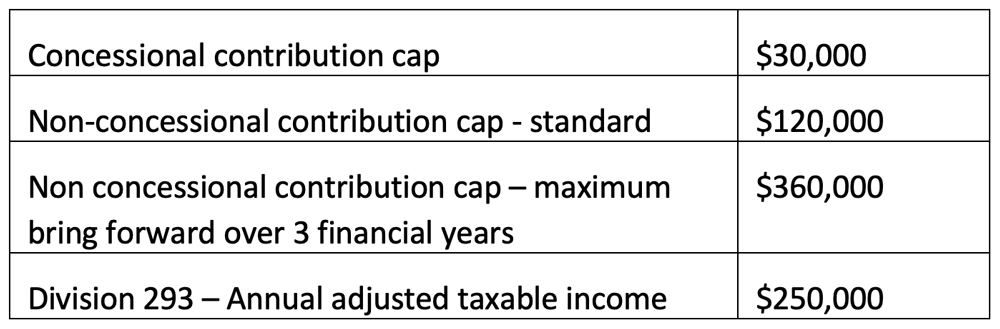
The annual concessional contribution cap will remain at $30,000 for the 2025/2026 financial year. The annual non-concessional contribution (NCC) cap is set at four times the concessional contribution cap meaning it will also remain at $120,000.
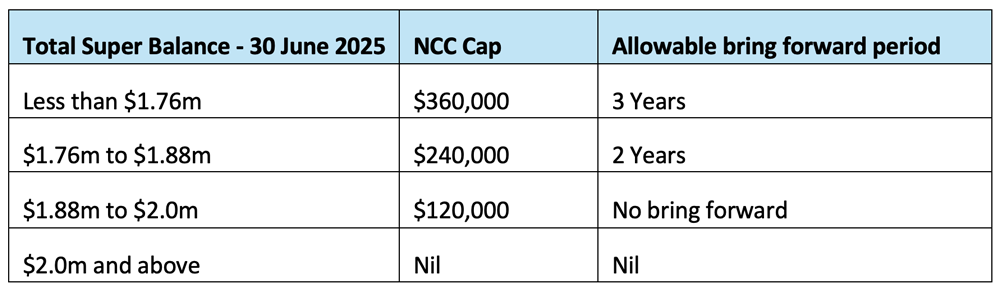
Although the annual NCC cap has not changed, NCCs can now be made by individuals with a total super balance (TSB) of less than $2,000,000 on 30 June 2025 (assuming they have not reached the age 75 deadline and any prior bring forward periods are considered). This is due to the fact that the upper TSB limit links to the general transfer balance cap (TBC) which has increased to $2,000,000.
The relevant TSB amounts for NCCs in the 2025/2026 financial year are summarised in the table below:
Personal deductible contributions
A superannuation fund member may be able to claim a deduction for personal contributions made to their super fund with personal after-tax funds. A member will normally be eligible to claim a deduction if:
The member makes an after-tax contribution to their superannuation fund in the relevant financial year
They are aged under 67 or 67 to 74 and meet a work test or work test exemption
They have provided the superannuation fund with a valid notice of intent to claim
The super fund has provided the member with acknowledgement of the notice of intent to claim
If the member is eligible and would like to claim a deduction, then they must notify their super fund that they intend to claim a deduction.
The notice must be valid and in the approved form – Notice of Intent to Claim or vary a deduction for personal super contributions (NAT 71121).
The tax legislation provides a notice of intent to claim will be valid if:
- The individual is still a member of the fund
- The fund still holds the contribution
- It does not include all or part of an amount covered by a previous notice
- The fund has not started paying a super income stream using any of the contribution
- The contributions in the notice of intent have not been released from the fund that the individual has given notice to under the FHSS scheme
- The contributions in the notice of intent don’t include FHSSS amounts that have been recontributed to the fund.
The member must provide the notice of intent to claim to the fund by the earlier of:
- The day the individual lodges their income tax return for the relevant financial year; or
- 30 June of the following financial year in which the individual made the contribution.
However, if a super fund member provides a notice of intent after they have rolled over their entire super interest to another fund, withdrawn the entire super interest (paid it out of super as a lump sum), or commenced a pension with any part of the contribution, the notice will not be valid.
This means the individual will not be able to claim a deduction for the personal contributions made before the rollover or withdrawal.
Updated superannuation and tax thresholds: 2025/2026
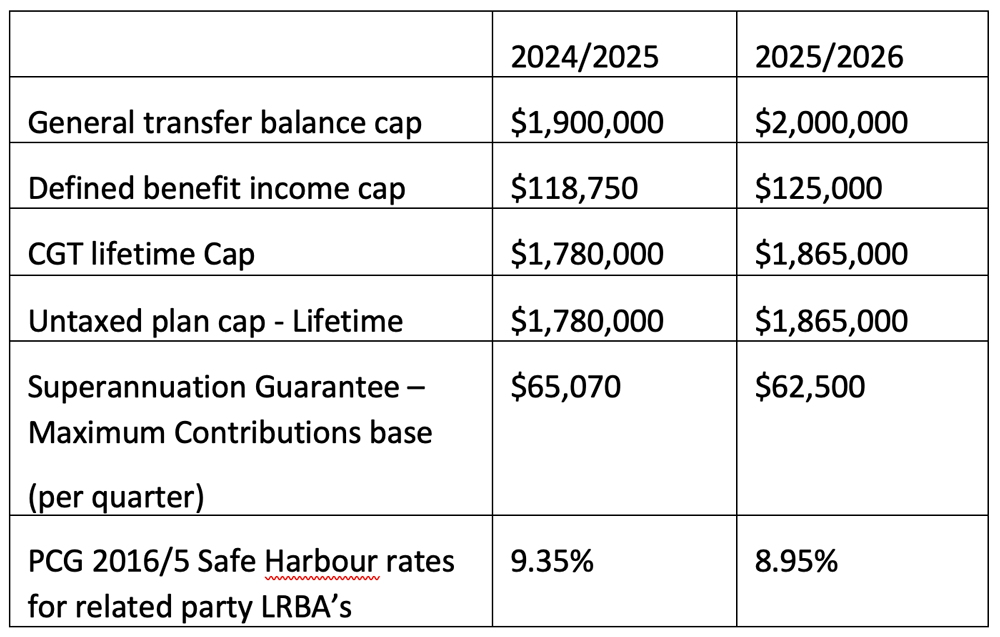
The following thresholds will remain unchanged for the 2025/2026 financial year.
Contact Indigo Financial on (08) 8212 8585 if you need help with any of your accounting and taxation needs.
Note: The material and contents provided in this publication are informative in nature only. It is not intended to be advice and you should not act specifically on the basis of this information alone. If expert assistance is required, professional advice should be obtained.
With the purchasing of luxury vehicles on the rise it’s important to be aware of some specific features of the tax system that can impact on the real cost of purchase. Often the tax rules provide taxpayers with a worse tax outcome if the car will be used for business or other income producing purposes compared with a non-luxury car, but this depends on the situation.
Let’s take a look at the key features of the tax system dealing with luxury cars and the practical impact they can have on your tax position.
Depreciation deductions and GST credits
Normally when someone purchases a motor vehicle which will be used in their business or other income producing activities there will be an opportunity to claim depreciation deductions over the effective life of the vehicle. Rather than claiming an immediate deduction for the cost of the vehicle, you will typically be claiming a deduction for the cost of the vehicle gradually over a number of years.
Likewise, a taxpayer who is registered for GST might be able to claim back GST credits on the cost of purchasing a motor vehicle that will be used in their business activities.
However, when you are dealing with a luxury car the tax rules will sometimes limit your ability to claim depreciation deductions and GST credits, impacting on the after-tax cost of acquiring the car.
How does it work?
Each year the ATO publishes a luxury car limit which is $69,674 for the 2025-26 income year. If the total cost of the car exceeds this limit, then this can impact the GST credits or depreciation deductions that can be claimed.
Let’s assume that Alice buys a new car for $88,000 (including GST) in July 2025. To keep things simple, let’s say Alice uses the car solely in her business activities and is registered for GST.
The first issue for Alice is that rather than claiming GST credits of $8,000, her GST credit claim will be limited to $6,334 (ie, 11th x $69,674).
We then subtract the GST credits that can be claimed from the total cost, leaving $81,666. As this still exceeds the luxury car limit, Alice’s depreciation deductions will be capped as well.
While she actually spent $89,000 on the car, she can only claim depreciation deductions based on a deemed cost of $69,674.
The end result is that Alice has missed out on some GST credits and depreciation deductions because she bought a luxury car.
Exceptions to the rules
There are some important exceptions to these rules.
The rules only apply to vehicles which are classified as ‘cars’ under the tax system. That is, the car limit doesn’t apply if the vehicle is designed to carry a load of at least one tonne or it is designed to carry at least 9 passengers.
The rules only apply if the vehicle was designed mainly for carrying passengers. The way we determine this depends on the nature of the vehicle and whether we are dealing with a dual cab ute or not.
For example, let’s assume Steve buys a ute which is designed to carry a load of at least one tonne. This isn’t classified as a car for tax purposes so Steve won’t miss out on GST credits or depreciation deductions.
However, let’s assume Jenny has bought a dual cab ute which is designed to carry a load of less than one tonne and fewer than 9 passengers. This is classified as a car and the luxury car limit will apply unless we can show that it wasn’t designed mainly to carry passengers. As we are dealing with a dual cab ute, we multiply the vehicle’s designed seating capacity (including the driver’s) by 68kg. If the total passenger weight determined using this formula doesn’t exceed the remaining ‘load’ capacity, we should be able to argue that the ute wasn’t designed mainly for the principal purpose of carrying passengers, which means that Jenny should be able to claim depreciation deductions based on the full cost of the vehicle.
The approach would be different if we were dealing with something other than a dual cab ute, such as a four-wheel drive vehicle.
Luxury car lease arrangements
Normally when someone enters into a lease arrangement for a car and they use the car in their business or employment duties there’s an opportunity to claim deductions for the lease payments, adjusted for any private usage.
However, if the value of the car exceeds the luxury car limit then the tax rules apply differently. Basically, what happens is that the taxpayer is deemed to have purchased the car using borrowed money. Rather than claiming a deduction for the actual lease payments, instead we will be claiming deductions for notional interest charges and depreciation, subject to the luxury car limit referred to above.
Luxury car tax
Cars with a luxury car tax (LCT) value which is over the LCT threshold for that year are subject to LCT, which is calculated as 33% of the amount above the LCT threshold.
The LCT thresholds for the 2025-26 income year are:
- $91,387 for fuel-efficient vehicles
- $80,567 for all other vehicles that fall within the scope of the LCT rules
From 1 July 2025 the definition of a fuel-efficient vehicle has changed, meaning that a car will only qualify for the higher LCT threshold if it has a fuel consumption that does not exceed 3.5 litres per 100km (this was 7 litres per 100km before 1 July 2025).
Buying a car or other motor vehicle can be a complex process and there will be a range of factors to consider. If you need assistance with the tax side of things please let us know before you jump in and sign any agreements.
Contact Indigo Financial on (08) 8212 8585 if you need help with any of your accounting and taxation needs.
Note: The material and contents provided in this publication are informative in nature only. It is not intended to be advice and you should not act specifically on the basis of this information alone. If expert assistance is required, professional advice should be obtained.
This tax season, we’ve seen a surge in questions about whether interest on a loan can be claimed as a tax deduction. It’s a great question as the way interest expenses are treated can significantly affect your overall tax position. However, the rules aren’t always straightforward. Here’s what you need to know.
The purpose of the loan
The most important thing when looking at the tax treatment of interest expenses is to identify what the borrowed money has been used for. That is, why did you borrow the money?
For interest expenses to be deductible you generally need to show that the borrowed funds have been used for business or other income producing purposes. The security used for the loan isn’t relevant in determining the tax treatment.
Let’s take a very simple scenario where Harry borrows money to buy a new private residence. The loan is secured against an existing rental property. As the borrowed money is used to acquire a private asset the interest won’t be deductible, even though the loan is secured against an income producing asset.
Redraw v offset accounts
While the economic impact of these arrangements might seem somewhat similar, they are treated very differently under the tax system. This is an area to be especially careful with.
If you have an existing loan account arrangement, you’ve paid off some of the loan balance and you then use a redraw facility to access those funds again, this is treated as a new borrowing. We then follow the golden rule to determine the tax treatment. That is, what have the redrawn funds been used for?
An offset account is different because money sitting in an offset account is basically treated much like your personal savings. If you withdraw money from an offset account you aren’t borrowing money, even if this leads to a higher interest charge on a linked loan account. As a result, you need to look back at what the original loan was used for.
Let’s compare two scenarios that might seem similar from an economic perspective:
Example 1: Lara’s redraw facility
Lara borrowed some money five years ago to acquire her main residence. She has made some additional repayments against the loan balance. Lara redraws some of the funds and uses them to acquire some listed shares. Lara now has a mixed purpose loan. Part of the loan balance relates to the main residence and the interest accruing on this portion of the loan isn’t deductible. However, interest accruing on the redrawn amount should typically be deductible where the funds have been used to acquire income producing investments.
Example 2: Peter’s offset account
Peter also borrowed money to acquire a main residence. Rather than making additional repayments against the loan balance, Peter has deposited the funds into an offset account, which reduces the interest accruing on the home loan. Peter subsequently withdraws some of the money from the offset account to acquire listed shares. This increases the amount of interest accruing on the home loan. However, Peter can’t claim any of the interest as a deduction because the loan was used solely to acquire a private residence. Peter simply used his own savings to acquire the shares.
Parking borrowed money in an offset account
We have seen an increase in clients establishing a loan facility with the intention of using the funds for business or investment purposes in the near future. Sometimes clients will withdraw funds from the facility and then leave them sitting in an existing offset account while waiting to acquire an income producing asset. This can cause problems when it comes to claiming interest deductions.
First, even if the offset account is linked to a loan account that has been used for income producing purposes, this won’t normally be sufficient to enable interest expenses incurred on the new loan from being deductible while the funds are sitting in the offset account.
For example, let’s say Duncan has an existing rental property loan which has an offset account attached to it. Duncan takes out a new loan, expecting to use the funds to acquire some shares. While waiting to purchase the shares, he deposits the funds into the offset account, which reduces the interest accruing on the rental property loan. It is unlikely that Duncan will be able to claim a deduction for interest accruing on the new loan because the borrowed funds are not being used to produce income, they are simply being applied to reduce some interest expenses on a different loan.
To make things worse, there is also a risk that parking the funds in an offset account for a period of time might taint the interest on the new loan account into the future, even if money is subsequently withdrawn from the offset account and used to acquire an income producing asset.
For example, even if Duncan subsequently withdraws the funds from the offset account to acquire some listed shares, there is a risk that the ATO won’t allow interest accruing on the second loan from being deductible. The risk would be higher if there were already funds in the offset account when the borrowed funds were deposited into that account or if Duncan had deposited any other funds into the account before the withdrawal was made. This is because we now can’t really trace through and determine the ultimate source of the funds that have been used to acquire the shares.
To do
It’s worth reaching out to us before entering into any new loan arrangements. In this area, mistakes are often difficult to fix after the fact, which can lead to poor tax outcomes. That’s why getting advice from a tax professional before committing to a loan is essential. We can work alongside you and your financial adviser to ensure your loan is structured in a way that makes financial sense and protects your tax position.
Contact Indigo Financial on (08) 8212 8585 if you need help with any of your accounting and taxation needs.
Note: The material and contents provided in this publication are informative in nature only. It is not intended to be advice and you should not act specifically on the basis of this information alone. If expert assistance is required, professional advice should be obtained.
« Previous Page — Next Page »