As a small business owner, you are always on the lookout for new ways to grow and develop your business. But that isn’t always easy to do.
Most people get caught up and consumed by the little details on a day-to-day basis. We call that working in your business and not working ON your business. Doing that is not going to empower your team, and it’s going to rob you of the time and focus that you should be expending on strategic thinking. Strategy is the engineering work for scale.
Businesses cannot work well without strategy no matter the size of any business.
Employing the right people consistently will not happen in a business that has no strategy. You might be lucky and fluke it and hire a few of the right people. But in the long run if you haven’t put the time into thinking about what constitutes ‘right’ for your business or the process by which you arrive at recruiting those people, then you will get it wrong more often than right. Getting the right people in your business and getting them in the right seats is hard work. But without good people your business will not work and your clients, customers or patients will not get what they want and need and in turn neither will you. If you have hired the right people, you shouldn’t have to micro-manage them; in fact, if they are the right people, they won’t stand for your micro-management!
If you focus your day as a leader of an organisation around the strategic things you can be working through – whether it’s people and culture, new growth opportunities, revenue streams or new markets etc, you are giving your business the best opportunity for success.
Strategy and scale go hand in hand.
Your operational people should be implementing your strategy, putting structures and processes in place. Not you.
However, you are still going to get asked about operational matters. You’ll find yourself constantly getting drawn into the organisation by your team, because they want your help. After all you are the guru. You know all about the operational matters in your business and you would be seen as the go to person. The reality is you need to have the consistency and discipline to say, “No, I know you guys can handle this and I’m actually going to focus on the strategic decisions that make a difference.”
This is a great way to think about it. Your operational people are not going to do the strategy work. That is not what they do, they do the operational work. Then if you are not doing the strategy work because you’re bogged down in operations; who’s doing the strategy?
“Most of us go into business with big aspirations and in time we forget what they were.” Tom O’Toole, Beechworth Baker
When the business is starting out or it is early on this might work ok, as initially it is all hands on deck to get whatever needs doing done. But even in the earliest stages of growth you need to be working on your strategy to take things to the next level.
Strategy doesn’t happen magically. It is crucial work that you need to do.
Talk to us about how we can help implement a plan with you to ensure you have a strategy and it’s a sound one.
Complaints happen. That is part of life and part of business. But deal with them well and you can turn an unhappy customer into a fan even a raving fan.
What is critical for every business is happy customers. The question is how do smart businesses deal with complaints and keep customers happy and satisfied?
First thing you must do is have a way (a system) where people can make their complaint easily and have it resolved promptly. You could call this system “our customer feedback channel” or “giving our valued customers what they want”. Another simple system is to follow people up after they have dealt with you and your business to find out what they thought about how we did. This is something that can also be done at regular intervals. You can ask them “how was your experience in dealing with us”?
The key to remember:
When it comes to problems or defects, the customer will remember the satisfying outcome, not the original error. Studies conducted by the Marriott on guest return rates found the following astonishing results:
- If there was no problem with their stay, the return rate was 89%.
- If there was a problem and it was not corrected the return rate dropped to 69%.
- However, this is where it gets really interesting. If there was a problem and it was solved to the guests satisfaction the return rate jumped to 94%.
So the moral of the story is constantly speak to your customer, patients, clients and find out how you are doing as a business. Find out are you serving their needs, are you adding value to them. Are they having a positive experience when they are coming to deal with you.
As you can see from the Marriott example if there are issues and problems and they are rectified then the relationship actually can get stronger. That does not mean that we should go out of our way to create problems so we can fix them. It means that when they do crop up do not blame the customer, fix them and the relationship will be stronger than before.
This stuff is very important for the relationship. Relationships as we all know are based on trust. The more people know they can trust us to do the right thing the more they will want to work with us. They will also refer friends, relatives and associates. If you ignore the problem it will not go away, it will just get worse. Customers will lose trust and our business will suffer.
I have seen many instances out there were that happens and the owners of the business do not look at themselves and their systems (or lack of them). They just blame the economy or the economic conditions. The funny thing is that the economy is only about 12.4% of the reasons why businesses fail. The other 87.6% of why businesses fail is due to the people in the business. They are not looking after the customer, not managing cash flow, not training and keeping their team focused and motivated.
MasterChef Australia judge, celebrity chef, restauranter – George Colambaris says: “People come to his restaurants to put joy in their lives, so if they’re not happy he wants to know about it”. We should all operate with this philosophy and then we can reduce or eliminate one of the areas (customer happiness) that can lead to business failure.
“’Key’ means main/important; ‘Performance’ – how are we doing?; ‘Indicators’ – as in a warning system. They are critical to every business and not having them is like driving a car with no fuel gauge, you never know if you are about to run out of petrol.
KPIs should allow us to make informed business decisions
KPIs help you measure the success of your business that way you know what’s going well and what needs improving. They are different for each business but the basic principle is the same – to understand the important aspects of your business so you can make effective, strategic and informed decisions and your business remains in good health.
Choosing what to measure and identifying key areas
KPIs can be financial and non financial. Here are a few things below to consider.
Key area number 1: Cash flow
To get a clear idea of your cash flow you need to start measuring and managing it. You must focus on your cash flow and you should look at things like: debtor days, average margins, stock turn, lock up days and net profit percentages.
Key area number 2: Repeat customers
It’s great having new customers coming into your business. But it’s even more powerful actually knowing who is coming back time and time again, how often they are coming back, what they’re spending and on what. This way you understand your ability to generate recurring revenue. KPI’s to consider: Net % of attrition in customers, $ sales per customer, number of repeat customers, total value of customer returns.
Key area number 3: Monthly tracking of your sales to budget
Having a budget and comparing actual sales to budgeted sales is truly a powerful tool and measuring monthly revenue allows you to calculate how well your business is growing.
Key area number 4: What type of website traffic do you get?
Reviewing what areas of your website are being visited and collecting valuable data from people is important. A great way to collect data from people that visit your website is to have a free e-book. People will then have to provide name and e-mail to be able to receive it. What can you write about to really help your customers and potential customers?
Key area number 5: Referrals
Customer referrals are probably the most important KPI you’re not measuring. This indicator is important for a number of reasons, especially given that customer referrals and social media sharing have become a major driver of revenue for online and offline brands. Some KPI’s you should be looking at here are: Number of new customers per month, Customer satisfaction surveys, Number of customer complaints.
Once you have set goals and selected KPIs, monitoring those indicators should become an everyday exercise.
Contact us to find out how we can help you set KPIs up and monitor them on an ongoing basis.
SME owners are working up to 80 hour weeks, are losing sleep about cash flow and almost one in four are predicting revenue to decline, according to results of the Scottish Pacific SME Growth Index released recently. Since September 2014, a six monthly poll of 1200 small to medium enterprise leaders across all states and key industries has revealed the following:
- It highlights that SME confidence has taken a hit despite the resilience of the sector, which according to ABS statistics employs almost half of the 10.7 million Australians in the workforce.
- For the first time since the Index began, SMEs forecasting positive growth (48.4 percent) are outnumbered by SMEs forecasting negative growth or no change (51.6 percent).
- The top three concerns were cash flow (72.5 percent), not having enough time to get things done (55.2 percent) and customer or supplier issues (39 percent). 17.3 percent were worried about disruption of their business model, and 13.3 percent cited staff issues. “SMEs nominated cash flow as the most stressful element of business. They cited credit conditions as a key barrier to growth,” Langham said. “With the Index highlighting that cash flow keeps 72.5 percent of respondents awake at night, it’s crucial for these leaders to find the right funding to support their business.
- SME owners putting in long hours – A 50+ hour week is standard for most SMEs (88.8 percent). Almost half of SME owners and senior managers (43.7 percent) are spending 60 to 80 hours a week working on their business, which equates to 12+ hour days, six days a week.
- Almost half of SMEs (44.6 percent) believe mobile and digital technology has had a negative impact on their work/life balance. Only 15.7 percent of small businesses believe it has led to better work hours or flexible working conditions.
We can help you put strategies in place to minimise and avoid the above issues. We must be proactively thinking and working at how we can improve our businesses. If any of the above rings true for you, contact us to discuss how we can help.
Here are some amazing free ways that you can really push your business to new heights.
#1. Google My Business: Create a business profile with your hours, location and other information so customers can easily find you on the world’s biggest search engine. The more detail you provide, the higher you’ll rank!
#2. MailChimp: You need to stay in touch with your customers, let them know about special offers and make sure that they’re thinking of you. MailChimp is one of the best email marketing tools around. Using their templates you can easily include text, images and links to send up to 12,000 personalised emails to 2,000 subscribers.
#3. Docracy: We all know that legal services can be expensive. To get you started with basic contracts and agreements without the burden of the cost on your new business, check out the templates on Docracy. Customise them and when you’re a little further along you can worry about getting a lawyer to look over them!
#4. Canva: Be your own brand manager, graphic designer and visual marketing genius with Canva. You can easily create dazzling designs and infographics for social media, blogs, emails, pamphlets and so on. The sky’s the limit! They’ll look professional without costing you a cent and you can quickly make any edits with their mobile app.
#5. Kickstarter: If you want to kickstart a new product’s development consider a Kickstarter campaign. It’s free to create a campaign but the platform does take a small percentage if you reach your goal. It is also a great marketing tool and can help you reach a new audience, often in overseas markets like the U.S, Canada and Europe.
#6. WordPress: Blogging is a great way for people to get to know your brand and business story. WordPress allows you to get off to a running start for free. You can choose from a range of customisable templates and begin posting immediately.
#7. Skype: Keep your phone bill low and eliminate the cost of calls with Skype. You can use it to make voice and video calls anywhere you have an internet connection.
Now that is pretty neat – seven free online tools that will allow you to grow your business and keep your costs down.
Australian small business are not planning sufficiently for retirement, with new research from MYOB revealing that over one third of SMEs are currently not contributing to their superannuation.
The latest SME Snapshot from MYOB, found that business operators tend to prepare for retirement after 50 years of age, with over half of those aged under 50 years having done no retirement planning at all. “Our research shows that SMEs believe they will need around $1 million to retire comfortably, yet 54 percent of respondents will not have saved enough when the time comes,” said Tim Reed, CEO of MYOB.
Of those who are self-employed, the statistics are even more alarming. Recent research by the Association of Superannuation Funds of Australia (ASFA) revealed almost one quarter of self-employed people do not have superannuation. Only 27 percent of this group in their 60s were found to have more than $100,000 in superannuation. “It’s surprising to see that superannuation is not top of mind for all small business operators, given many contribute regularly to their employees super,” said Reed.
We can help you with your planning and wealth creation for now and for your future. Due to demand from our valued clients we have now established Indigo Financial Advisers to help people with all of their financial planning, wealth creation, super etc needs. Please contact us to discuss how we can help you.
As small business owners there is always something that requires our attention. The problem with that is that we end up getting inundated (working IN our business) and not having time to plan and move the business forward to where we want it to go.
We tell people and we believe this is the best way, and that is – ‘You should sit down and think about a picture of how you want your business and life to be’. We believe that the clearer the picture you have, the more specific you are with both the vision you have and the way you articulate your goals, the more exact will be your outcome.
As Tom Watson Snr (ex IBM CEO) put it: “IBM is what it is today because at the very beginning I had a picture of what IBM would become and look like”. Then they fashioned the current position to be like that picture. He goes on with “We then went to work each day to build a business not just to do what the business did”.
Now that is really cool. The scary thing is that most people in business do not do that, they fail to plan. They either feel it isn’t important to do that, they don’t know how to do it or they are just too busy (in their eyes). At Indigo Financial we truly believe that the only way to really succeed in business is to plan and we work with clients on a monthly, quarterly or ad hoc basis to achieve that. This is one of our most valuable service that we offer.
Once you’ve been in business for a while and have got some results, it’s not unusual to hit a bit of a plateau that you feel like you are stuck on and struggling to get off. You might be able to look up and see the next level you want to get to, but can’t see a clear path to get there. The thinking, actions and tactics that have built your business to where it is, no longer seem to be helping you to grow your business to the level of income you really want.
 “We can not solve our problems with the same thinking we used to create them.” – Albert Einstein
The key to reaching your potential as a business owner, is to think differently and therefore take different actions to get different results. But how do you do that? Well here are a few ideas to get you started:
- Step back from your business: When you are working in the trenches day in day out, it’s easy to get lost in the whirlwind and because of this you are unable to focus on anything else. Take some time away from your business so you can clear your head and start to look at the situation more objectively. The way we do this with people is either through our Global Business camp event or through full day strategy sessions. With both of those options you get to focus on your business and look at what you want it to look like and feel like. We can then help you implement the plans so you can achieve your goals.
- Connect with other business owners: Get to know other business owners who are further ahead in their journey than you are. Be super curious and ask them what they did to get where they are and consider how you can take similar, appropriate action to move your business forward. The way we can help you do this is either through our Global Business camp events or through our other varied events and seminars. With both of those options you get to network and speak to like minded people just like you. Please look out for our invitations that come out during the year. There are also other avenues you can consider to connect with other business owners.
- Get clear on where your business is now: Carry out a review of where your business is right now. Be honest with yourself and consider asking for a second opinion from someone your know and trust. Gathering feedback from customers and suppliers on how they perceive you is also helpful too. Consider what your strengths, weaknesses, opportunities and threats are and where you need to challenge yourself to do better. We can help you do this through our strategic questionnaires and then followed by our full day strategy/planning sessions. By doing this we work with you to look at where your business is at and what we need to do together to help you get it to where you want it to go. We can then help you implement the plans so you can achieve your goals.
- Get really clear on where you want your business to go: Without a clear understanding of where you want to go, it’s very hard to get there. It’s like getting in your car and going for a ride without knowing the end destination. Create some compelling vision and mission statements for your business and then set 90 day, 1 year and 3 year goals to help you achieve them. We can help you do this through our strategic questionnaires and then followed by our full day strategy/planning sessions. By doing this we work with you to ensure you can document and articulate where you want to go and we help you get your business to where you want it to go. We can then help you implement the plans so you can achieve your goals.
- Be a life long learner: Learning is not something we do at school, Uni, trade school etc and then think you are then equipped for life. We have to learn new skills all the time. That is exceptionally true for business owners because in order to grow their businesses they must continually upgrade their knowledge and understanding of everything from what’s going on in their market to technology trends, to the latest marketing techniques and much, much more. Get involved in attending things that will allow you to learn and network. As we stated above our Global Business Camp is a great way to do that as are our other varied events that we hold during the year.
- Take action even without all of the facts: One of the biggest stumbling blocks for many business owners is being ok with taking action before they know what the outcome is. It’s impossible to have all the information before you take action though. You must make a rough plan, take action, assess if it’s worked or not, then either keep doing it or take corrective action and go again. If you are waiting for the perfect plan or the perfect timing you won’t do anything because perfect does not exist.
- Find someone to support you: Putting into place all of the above without someone there to support and guide you can be challenging. Often as business owners it’s like we are standing in the dark, pointing our torch into one place in a room, over and over again; so to us it seems like there is nothing else but that one patch. When we work in isolation, we often don’t realise that if we just moved the torch a bit we’d see there’s a whole load of other stuff going on in that room. When we get support from someone else, whether it be a coach, mentor or another business owner, it helps us to see the abundance of other possibilities out there and it helps to keep us accountable for the new action we have decided to take. We have many clients that we work with on this basis where we act as a mentor, board member or a coach. The benefit is that you have someone else that can provide you with thoughts, ideas and also hold you accountable. We find that the rate of success is higher with a mentor involved.
Here are some results form a recent study conducted from 6 countries:
- People who have written goals were 50% more likely to achieve them than those without written goals.
- Even more importantly, those who had written goals accompanied by written action commitments AND who submitted a weekly progress report to a mentor or coach were 78% more likely to achieve their goals than those who were simply asked to think about what they would like to achieve.
Regularly review your progress
Take the time to regularly step away from your business to check in on your progress. When you make any change you must take the time to assess how it’s going and if it’s giving you the outcome you want. Meeting with us on regular basis will ensure you will hit your outcomes.
Don’t get stuck working IN your business and having your business and your life stagnate, change your thinking to change your results!
Here is a great example:
 Zuckerberg’s 10-Year Plan — speaking of third waves, recently Facebook’s founder/CEO announced his next BHAG — “give everyone the power to share anything with anyone” (he literally means all 7+ billion people). He stated that it is supported by three pillars:
- Artificial intelligence, which will help Facebook better sift through and understand all the photos, videos and updates people post to Facebook;
- Connectivity, the goal of making Facebook and the internet available everywhere and to everyone through lasers and drones;
- Virtual and augmented reality, which Zuckerberg says one day will bring friends together even if they are on other sides of the planet through a pair of “normal-looking” glasses that can overlay digital elements on the physical world and become “the most social platform.”
Now that is planning at it’s best. They are looking out 10 years and they have a picture of what they believe they need to be doing to keep being successful. How many small businesses are doing that is the question?
The healthily paranoid assumption at Google is that if they aren’t meeting that (user’s) need, there are two girls in a garage who will meet it tomorrow. Their motto is: “If we continue to do the right thing by our users, they will reward us for it over time”. I believe we should all be following that mantra. No matter the business and no matter the industry. If we keep doing the same thing today that we have been doing in the past we are falling behind.
They go on and say the following: “There is also the expectation that every single quarter when you assess what you delivered versus your plan, the assumption is that you will have failed. And if you deliver more than about two-thirds of your plan, you obviously did not have an ambitious enough plan”. This is a different environment from where failure is not an option. At google the environment is one where failure is expected. What a great way to motivate the team and allow them to express themselves. And so the way I see Google managing innovation is this combination of obsessive focus on the user and having culture where failure is expected. The only real negative that can happen when you fail is if you haven’t learnt from it.
We have to make sure that we have got the skills in our businesses and in Australia to rewire us to win going forward.
A key point is: Unless the leaders put innovation at the heart of what we do, I’m worried we’re going to be left behind.
THE NEED FOR INNOVATION
Innovation not only requires curiosity but, fundamentally, innovation requires people who are rule breakers and risk takers. And if we look at what Australia has somehow allowed itself to become at the most senior levels, whether it be our boards, senior management or government, we have become a nation that is excelling in no rules being broken and risk aversion.
The latest report on where Australia ranks on innovation shows we have slipped yet another spot. Some of the markers around Asia are really moving forward. We should be concerned and we should take action, now.
We’ve got about 70 years of disruption or change ahead of us, so you cannot white-knuckle your way through it. The blunt message of Malie Carnegie, a 23 year veteran of the Procter & Gamble “leadership factory” who is now running Google’s Australia and New Zealand arm is the following:
He says, “access to the internet unlocks ideas, provides education and generates wealth in a community.
Look at the role that small businesses play in Australia. They are a huge part of our economy – they employ almost half of the population and more than that, they’re also the social fabric of society.
There is only about 16 per cent of them that are fully utilising the internet, yet all the data shows that small businesses that are really leveraging the internet are twice as likely to be growing. They are four times as likely to be hiring people”.
Wow, if that doesn’t make us sit up and take notice I am not sure what will.
We must spend time thinking about how and where our businesses need to go in the future. Please talk to us about our planning days and how we can help you get to where you want to go.
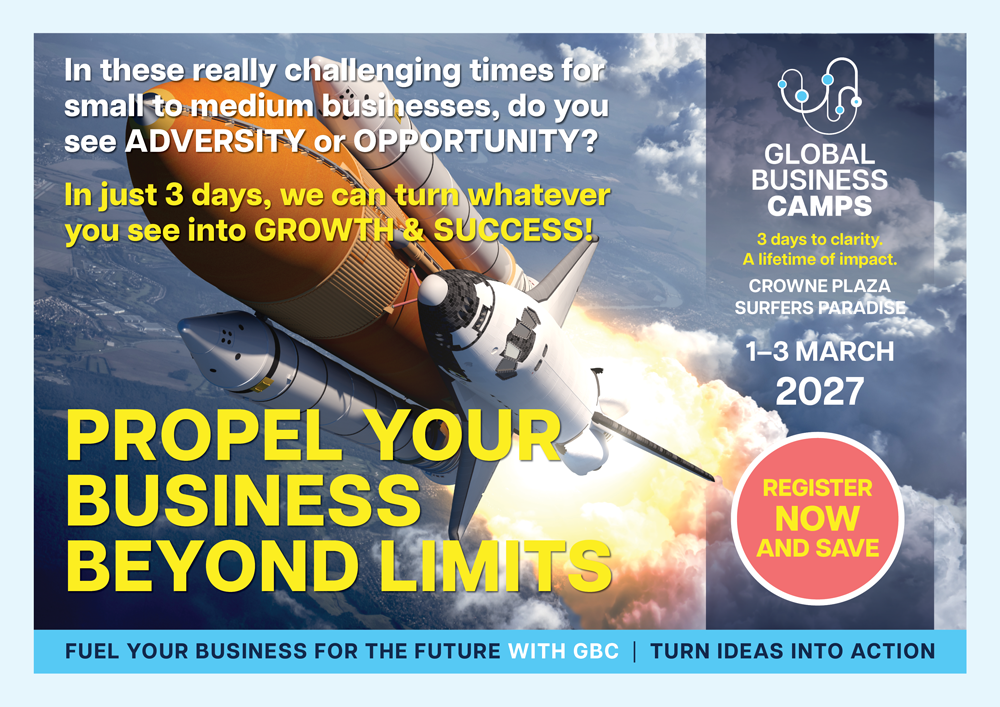
Another way of starting the process of Innovation is our proprietary business camp concept. We currently have 20 of our valued clients signed up and looking forward to joining us on the Gold Coast.
We only have a few seats left for Indigo Financial clients and friends available and they are still at $2,200pp (VIP rate). The current rate is $2,970pp so take advantage of this very special offer and join us at the QT on the Gold Coast. The best part is that each table of valued clients has an accountant with them for the 3 days working with them.
The things we will be working through and sessions we have planned:
- We will work though the 6 Secrets™ to any business over the 3 days. They include 1. Beginning with the end in mind, 2. Planning for success, 3. Growing your business, 4. Managing your business, 5. Valuing your business and 6. Freedom.
- HR and employment risk session included – David Bates (Workforce Guardian).
- Leadership session – Andrew Geddes (Geddes Consulting).
- Understanding the outcome of every business decision made and the impact of the 1% changes with proprietary software, cash flow story – Mark Holton (Smithink).
- Technology session highlighting the age of prediction and look at the importance and outcomes of websites, social media, cloud technology, applications, google adwords, search engine optimisation, multimedia, big data and 3D printing (this is the next revolution) and more – David Smith (Smithink).
- Steven Bradbury will also be there during the dinner on the Tuesday night to share his story, which will be great.
See you there.
Building sustainable relationships with existing customers should sit at the core of a business model.
In the drive to grow a successful business, it can be tempting to focus on attracting new customers. Yet it is just as important to retain customers and digital adaptation can go along way to shifting the focus from ‘convert’ to ‘keep’.
It costs 6 times more to get a new customer to deal with you than getting an existing customer to keep dealing with you. Wow, 6 times more. This information is valuable to know.
Modern technology has given those of us in business, better tools to serve our customer’s needs. To make the most of them, it’s worth understanding how the same technology has shaped significant changes in customer behaviour.
Today’s customer is value hungry and digital technology makes it very easy to discover where the best deals are to be found. Further, the ability to shift providers has been enhanced, so the better informed, self- directed customer comfortable with self-sufficiency poses both challenges and opportunities for today’s financial services provider.
Retaining customers you have to connect with digitally calls for a continued focus on customer service excellence.
Call us to discuss how we can help you get ready and keep moving and evolving with the changing times. We can help you plan and strategise on how to address the issues that need to be addressed. We also have experts in the area of technology that we work with that can also get involved.
Also, another great way to really see what is going on with technology, customer service, strategy and much more is by attending our Global Business Camp event on the Gold Coast. Not only will you get away from your business for a few days you will also get an 100% tax deduction and a 100% money back guarantee. Come along and if you do not pick up at least 1 idea that will pay for the program 5 times over we will refund your money. The key is that you must implement the idea (s). Thousands of business people have attended our business camps in the past and everyone that has taken action has seen massive improvements in their business.
« Previous Page — Next Page »