“’Key’ means main/important; ‘Performance’ – how are we doing?; ‘Indicators’ – as in a warning system. They are critical to every business and not having them is like driving a car with no fuel gauge, you never know if you are about to run out of petrol.
KPIs should allow us to make informed business decisions
KPIs help you measure the success of your business that way you know what’s going well and what needs improving. They are different for each business but the basic principle is the same – to understand the important aspects of your business so you can make effective, strategic and informed decisions and your business remains in good health.
Choosing what to measure and identifying key areas
KPIs can be financial and non financial. Here are a few things below to consider.
Key area number 1: Cash flow
To get a clear idea of your cash flow you need to start measuring and managing it. You must focus on your cash flow and you should look at things like: debtor days, average margins, stock turn, lock up days and net profit percentages.
Key area number 2: Repeat customers
It’s great having new customers coming into your business. But it’s even more powerful actually knowing who is coming back time and time again, how often they are coming back, what they’re spending and on what. This way you understand your ability to generate recurring revenue. KPI’s to consider: Net % of attrition in customers, $ sales per customer, number of repeat customers, total value of customer returns.
Key area number 3: Monthly tracking of your sales to budget
Having a budget and comparing actual sales to budgeted sales is truly a powerful tool and measuring monthly revenue allows you to calculate how well your business is growing.
Key area number 4: What type of website traffic do you get?
Reviewing what areas of your website are being visited and collecting valuable data from people is important. A great way to collect data from people that visit your website is to have a free e-book. People will then have to provide name and e-mail to be able to receive it. What can you write about to really help your customers and potential customers?
Key area number 5: Referrals
Customer referrals are probably the most important KPI you’re not measuring. This indicator is important for a number of reasons, especially given that customer referrals and social media sharing have become a major driver of revenue for online and offline brands. Some KPI’s you should be looking at here are: Number of new customers per month, Customer satisfaction surveys, Number of customer complaints.
Once you have set goals and selected KPIs, monitoring those indicators should become an everyday exercise.
Contact us to find out how we can help you set KPIs up and monitor them on an ongoing basis.
SME owners are working up to 80 hour weeks, are losing sleep about cash flow and almost one in four are predicting revenue to decline, according to results of the Scottish Pacific SME Growth Index released recently. Since September 2014, a six monthly poll of 1200 small to medium enterprise leaders across all states and key industries has revealed the following:
- It highlights that SME confidence has taken a hit despite the resilience of the sector, which according to ABS statistics employs almost half of the 10.7 million Australians in the workforce.
- For the first time since the Index began, SMEs forecasting positive growth (48.4 percent) are outnumbered by SMEs forecasting negative growth or no change (51.6 percent).
- The top three concerns were cash flow (72.5 percent), not having enough time to get things done (55.2 percent) and customer or supplier issues (39 percent). 17.3 percent were worried about disruption of their business model, and 13.3 percent cited staff issues. “SMEs nominated cash flow as the most stressful element of business. They cited credit conditions as a key barrier to growth,” Langham said. “With the Index highlighting that cash flow keeps 72.5 percent of respondents awake at night, it’s crucial for these leaders to find the right funding to support their business.
- SME owners putting in long hours – A 50+ hour week is standard for most SMEs (88.8 percent). Almost half of SME owners and senior managers (43.7 percent) are spending 60 to 80 hours a week working on their business, which equates to 12+ hour days, six days a week.
- Almost half of SMEs (44.6 percent) believe mobile and digital technology has had a negative impact on their work/life balance. Only 15.7 percent of small businesses believe it has led to better work hours or flexible working conditions.
We can help you put strategies in place to minimise and avoid the above issues. We must be proactively thinking and working at how we can improve our businesses. If any of the above rings true for you, contact us to discuss how we can help.
Here are some amazing free ways that you can really push your business to new heights.
#1. Google My Business: Create a business profile with your hours, location and other information so customers can easily find you on the world’s biggest search engine. The more detail you provide, the higher you’ll rank!
#2. MailChimp: You need to stay in touch with your customers, let them know about special offers and make sure that they’re thinking of you. MailChimp is one of the best email marketing tools around. Using their templates you can easily include text, images and links to send up to 12,000 personalised emails to 2,000 subscribers.
#3. Docracy: We all know that legal services can be expensive. To get you started with basic contracts and agreements without the burden of the cost on your new business, check out the templates on Docracy. Customise them and when you’re a little further along you can worry about getting a lawyer to look over them!
#4. Canva: Be your own brand manager, graphic designer and visual marketing genius with Canva. You can easily create dazzling designs and infographics for social media, blogs, emails, pamphlets and so on. The sky’s the limit! They’ll look professional without costing you a cent and you can quickly make any edits with their mobile app.
#5. Kickstarter: If you want to kickstart a new product’s development consider a Kickstarter campaign. It’s free to create a campaign but the platform does take a small percentage if you reach your goal. It is also a great marketing tool and can help you reach a new audience, often in overseas markets like the U.S, Canada and Europe.
#6. WordPress: Blogging is a great way for people to get to know your brand and business story. WordPress allows you to get off to a running start for free. You can choose from a range of customisable templates and begin posting immediately.
#7. Skype: Keep your phone bill low and eliminate the cost of calls with Skype. You can use it to make voice and video calls anywhere you have an internet connection.
Now that is pretty neat – seven free online tools that will allow you to grow your business and keep your costs down.
Australian small business are not planning sufficiently for retirement, with new research from MYOB revealing that over one third of SMEs are currently not contributing to their superannuation.
The latest SME Snapshot from MYOB, found that business operators tend to prepare for retirement after 50 years of age, with over half of those aged under 50 years having done no retirement planning at all. “Our research shows that SMEs believe they will need around $1 million to retire comfortably, yet 54 percent of respondents will not have saved enough when the time comes,” said Tim Reed, CEO of MYOB.
Of those who are self-employed, the statistics are even more alarming. Recent research by the Association of Superannuation Funds of Australia (ASFA) revealed almost one quarter of self-employed people do not have superannuation. Only 27 percent of this group in their 60s were found to have more than $100,000 in superannuation. “It’s surprising to see that superannuation is not top of mind for all small business operators, given many contribute regularly to their employees super,” said Reed.
We can help you with your planning and wealth creation for now and for your future. Due to demand from our valued clients we have now established Indigo Financial Advisers to help people with all of their financial planning, wealth creation, super etc needs. Please contact us to discuss how we can help you.
As small business owners there is always something that requires our attention. The problem with that is that we end up getting inundated (working IN our business) and not having time to plan and move the business forward to where we want it to go.
We tell people and we believe this is the best way, and that is – ‘You should sit down and think about a picture of how you want your business and life to be’. We believe that the clearer the picture you have, the more specific you are with both the vision you have and the way you articulate your goals, the more exact will be your outcome.
As Tom Watson Snr (ex IBM CEO) put it: “IBM is what it is today because at the very beginning I had a picture of what IBM would become and look like”. Then they fashioned the current position to be like that picture. He goes on with “We then went to work each day to build a business not just to do what the business did”.
Now that is really cool. The scary thing is that most people in business do not do that, they fail to plan. They either feel it isn’t important to do that, they don’t know how to do it or they are just too busy (in their eyes). At Indigo Financial we truly believe that the only way to really succeed in business is to plan and we work with clients on a monthly, quarterly or ad hoc basis to achieve that. This is one of our most valuable service that we offer.
Once you’ve been in business for a while and have got some results, it’s not unusual to hit a bit of a plateau that you feel like you are stuck on and struggling to get off. You might be able to look up and see the next level you want to get to, but can’t see a clear path to get there. The thinking, actions and tactics that have built your business to where it is, no longer seem to be helping you to grow your business to the level of income you really want.
 “We can not solve our problems with the same thinking we used to create them.” – Albert Einstein
The key to reaching your potential as a business owner, is to think differently and therefore take different actions to get different results. But how do you do that? Well here are a few ideas to get you started:
- Step back from your business: When you are working in the trenches day in day out, it’s easy to get lost in the whirlwind and because of this you are unable to focus on anything else. Take some time away from your business so you can clear your head and start to look at the situation more objectively. The way we do this with people is either through our Global Business camp event or through full day strategy sessions. With both of those options you get to focus on your business and look at what you want it to look like and feel like. We can then help you implement the plans so you can achieve your goals.
- Connect with other business owners: Get to know other business owners who are further ahead in their journey than you are. Be super curious and ask them what they did to get where they are and consider how you can take similar, appropriate action to move your business forward. The way we can help you do this is either through our Global Business camp events or through our other varied events and seminars. With both of those options you get to network and speak to like minded people just like you. Please look out for our invitations that come out during the year. There are also other avenues you can consider to connect with other business owners.
- Get clear on where your business is now: Carry out a review of where your business is right now. Be honest with yourself and consider asking for a second opinion from someone your know and trust. Gathering feedback from customers and suppliers on how they perceive you is also helpful too. Consider what your strengths, weaknesses, opportunities and threats are and where you need to challenge yourself to do better. We can help you do this through our strategic questionnaires and then followed by our full day strategy/planning sessions. By doing this we work with you to look at where your business is at and what we need to do together to help you get it to where you want it to go. We can then help you implement the plans so you can achieve your goals.
- Get really clear on where you want your business to go: Without a clear understanding of where you want to go, it’s very hard to get there. It’s like getting in your car and going for a ride without knowing the end destination. Create some compelling vision and mission statements for your business and then set 90 day, 1 year and 3 year goals to help you achieve them. We can help you do this through our strategic questionnaires and then followed by our full day strategy/planning sessions. By doing this we work with you to ensure you can document and articulate where you want to go and we help you get your business to where you want it to go. We can then help you implement the plans so you can achieve your goals.
- Be a life long learner: Learning is not something we do at school, Uni, trade school etc and then think you are then equipped for life. We have to learn new skills all the time. That is exceptionally true for business owners because in order to grow their businesses they must continually upgrade their knowledge and understanding of everything from what’s going on in their market to technology trends, to the latest marketing techniques and much, much more. Get involved in attending things that will allow you to learn and network. As we stated above our Global Business Camp is a great way to do that as are our other varied events that we hold during the year.
- Take action even without all of the facts: One of the biggest stumbling blocks for many business owners is being ok with taking action before they know what the outcome is. It’s impossible to have all the information before you take action though. You must make a rough plan, take action, assess if it’s worked or not, then either keep doing it or take corrective action and go again. If you are waiting for the perfect plan or the perfect timing you won’t do anything because perfect does not exist.
- Find someone to support you: Putting into place all of the above without someone there to support and guide you can be challenging. Often as business owners it’s like we are standing in the dark, pointing our torch into one place in a room, over and over again; so to us it seems like there is nothing else but that one patch. When we work in isolation, we often don’t realise that if we just moved the torch a bit we’d see there’s a whole load of other stuff going on in that room. When we get support from someone else, whether it be a coach, mentor or another business owner, it helps us to see the abundance of other possibilities out there and it helps to keep us accountable for the new action we have decided to take. We have many clients that we work with on this basis where we act as a mentor, board member or a coach. The benefit is that you have someone else that can provide you with thoughts, ideas and also hold you accountable. We find that the rate of success is higher with a mentor involved.
Here are some results form a recent study conducted from 6 countries:
- People who have written goals were 50% more likely to achieve them than those without written goals.
- Even more importantly, those who had written goals accompanied by written action commitments AND who submitted a weekly progress report to a mentor or coach were 78% more likely to achieve their goals than those who were simply asked to think about what they would like to achieve.
Regularly review your progress
Take the time to regularly step away from your business to check in on your progress. When you make any change you must take the time to assess how it’s going and if it’s giving you the outcome you want. Meeting with us on regular basis will ensure you will hit your outcomes.
Don’t get stuck working IN your business and having your business and your life stagnate, change your thinking to change your results!
Here is a great example:
 Zuckerberg’s 10-Year Plan — speaking of third waves, recently Facebook’s founder/CEO announced his next BHAG — “give everyone the power to share anything with anyone” (he literally means all 7+ billion people). He stated that it is supported by three pillars:
- Artificial intelligence, which will help Facebook better sift through and understand all the photos, videos and updates people post to Facebook;
- Connectivity, the goal of making Facebook and the internet available everywhere and to everyone through lasers and drones;
- Virtual and augmented reality, which Zuckerberg says one day will bring friends together even if they are on other sides of the planet through a pair of “normal-looking” glasses that can overlay digital elements on the physical world and become “the most social platform.”
Now that is planning at it’s best. They are looking out 10 years and they have a picture of what they believe they need to be doing to keep being successful. How many small businesses are doing that is the question?
The healthily paranoid assumption at Google is that if they aren’t meeting that (user’s) need, there are two girls in a garage who will meet it tomorrow. Their motto is: “If we continue to do the right thing by our users, they will reward us for it over time”. I believe we should all be following that mantra. No matter the business and no matter the industry. If we keep doing the same thing today that we have been doing in the past we are falling behind.
They go on and say the following: “There is also the expectation that every single quarter when you assess what you delivered versus your plan, the assumption is that you will have failed. And if you deliver more than about two-thirds of your plan, you obviously did not have an ambitious enough plan”. This is a different environment from where failure is not an option. At google the environment is one where failure is expected. What a great way to motivate the team and allow them to express themselves. And so the way I see Google managing innovation is this combination of obsessive focus on the user and having culture where failure is expected. The only real negative that can happen when you fail is if you haven’t learnt from it.
We have to make sure that we have got the skills in our businesses and in Australia to rewire us to win going forward.
A key point is: Unless the leaders put innovation at the heart of what we do, I’m worried we’re going to be left behind.
THE NEED FOR INNOVATION
Innovation not only requires curiosity but, fundamentally, innovation requires people who are rule breakers and risk takers. And if we look at what Australia has somehow allowed itself to become at the most senior levels, whether it be our boards, senior management or government, we have become a nation that is excelling in no rules being broken and risk aversion.
The latest report on where Australia ranks on innovation shows we have slipped yet another spot. Some of the markers around Asia are really moving forward. We should be concerned and we should take action, now.
We’ve got about 70 years of disruption or change ahead of us, so you cannot white-knuckle your way through it. The blunt message of Malie Carnegie, a 23 year veteran of the Procter & Gamble “leadership factory” who is now running Google’s Australia and New Zealand arm is the following:
He says, “access to the internet unlocks ideas, provides education and generates wealth in a community.
Look at the role that small businesses play in Australia. They are a huge part of our economy – they employ almost half of the population and more than that, they’re also the social fabric of society.
There is only about 16 per cent of them that are fully utilising the internet, yet all the data shows that small businesses that are really leveraging the internet are twice as likely to be growing. They are four times as likely to be hiring people”.
Wow, if that doesn’t make us sit up and take notice I am not sure what will.
We must spend time thinking about how and where our businesses need to go in the future. Please talk to us about our planning days and how we can help you get to where you want to go.
Another way of starting the process of Innovation is our proprietary business camp concept. We currently have 20 of our valued clients signed up and looking forward to joining us on the Gold Coast.
We only have a few seats left for Indigo Financial clients and friends available and they are still at $2,200pp (VIP rate). The current rate is $2,970pp so take advantage of this very special offer and join us at the QT on the Gold Coast. The best part is that each table of valued clients has an accountant with them for the 3 days working with them.
The things we will be working through and sessions we have planned:
- We will work though the 6 Secrets™ to any business over the 3 days. They include 1. Beginning with the end in mind, 2. Planning for success, 3. Growing your business, 4. Managing your business, 5. Valuing your business and 6. Freedom.
- HR and employment risk session included – David Bates (Workforce Guardian).
- Leadership session – Andrew Geddes (Geddes Consulting).
- Understanding the outcome of every business decision made and the impact of the 1% changes with proprietary software, cash flow story – Mark Holton (Smithink).
- Technology session highlighting the age of prediction and look at the importance and outcomes of websites, social media, cloud technology, applications, google adwords, search engine optimisation, multimedia, big data and 3D printing (this is the next revolution) and more – David Smith (Smithink).
- Steven Bradbury will also be there during the dinner on the Tuesday night to share his story, which will be great.
See you there.
Building sustainable relationships with existing customers should sit at the core of a business model.
In the drive to grow a successful business, it can be tempting to focus on attracting new customers. Yet it is just as important to retain customers and digital adaptation can go along way to shifting the focus from ‘convert’ to ‘keep’.
It costs 6 times more to get a new customer to deal with you than getting an existing customer to keep dealing with you. Wow, 6 times more. This information is valuable to know.
Modern technology has given those of us in business, better tools to serve our customer’s needs. To make the most of them, it’s worth understanding how the same technology has shaped significant changes in customer behaviour.
Today’s customer is value hungry and digital technology makes it very easy to discover where the best deals are to be found. Further, the ability to shift providers has been enhanced, so the better informed, self- directed customer comfortable with self-sufficiency poses both challenges and opportunities for today’s financial services provider.
Retaining customers you have to connect with digitally calls for a continued focus on customer service excellence.
Call us to discuss how we can help you get ready and keep moving and evolving with the changing times. We can help you plan and strategise on how to address the issues that need to be addressed. We also have experts in the area of technology that we work with that can also get involved.
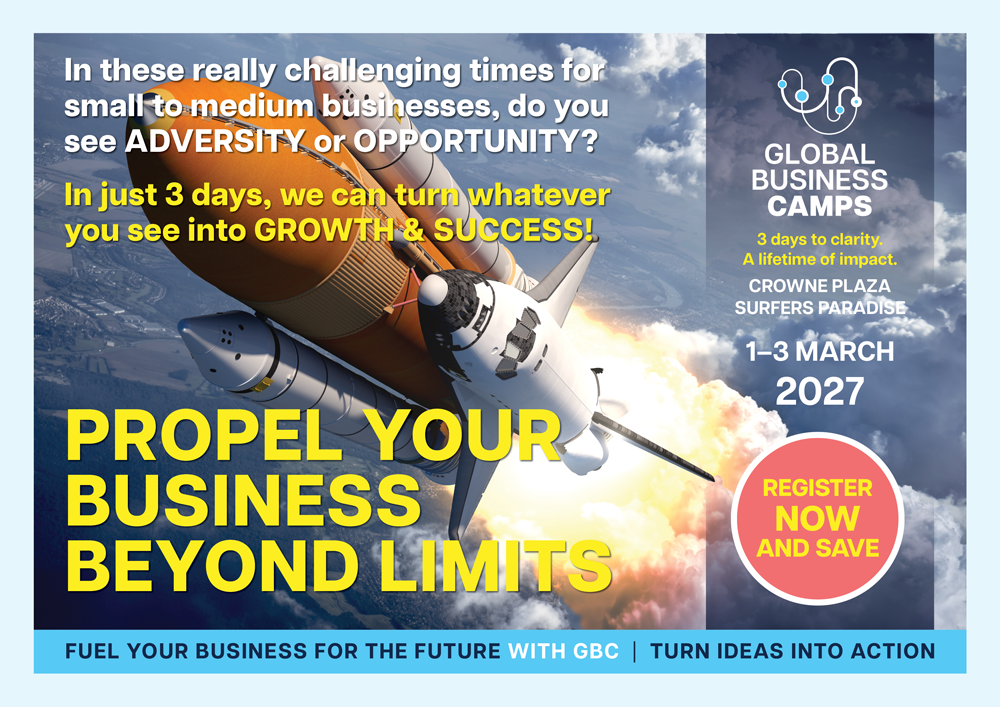
Also, another great way to really see what is going on with technology, customer service, strategy and much more is by attending our Global Business Camp event on the Gold Coast. Not only will you get away from your business for a few days you will also get an 100% tax deduction and a 100% money back guarantee. Come along and if you do not pick up at least 1 idea that will pay for the program 5 times over we will refund your money. The key is that you must implement the idea (s). Thousands of business people have attended our business camps in the past and everyone that has taken action has seen massive improvements in their business.
There are so many changes out there for people in business and leaders in business must act now. I’ll just talk on technology for now. It almost feels like some people in business have got this belief that they can white knuckle their way through what is going to be a five year change. Whereas virtually everyone I know who is working in the technology industry, their assumption is that we’ve got about 70 years of disruption or change ahead of us, so you cannot white knuckle your way through it.
You cannot look at something and say, “I just need to get over this mobile thing and then the world going to go back to this happy calm place”, because as soon as we’re over the mobile, there will be wearables, there will be cloud finally really kicking in”.
Sweating the Mall Stuff
Everyone in retail knows that the internet is changing their business. But how will this wave of change play out? A recent Global Total Retail Survey sees four forces disrupting the industry:
- Smarter Shops: It argues retailers need to do more to keep customers coming back. It suggests stores can become “experimental venues” where customers can see and touch the product. Or they can just add convenience. Turkey’s Migros supermarket chain has kiosks where customers can browse and buy items not physically in stock.
- Mobile Appraisal: Consumers are buying via smartphone more than ever before. But retailers also pointed to the stock-checking. Store-finding and other purchase activity happening through smartphones, even when people buy in the store.
- Social Media: Although it has a way to go, the use of social chat during purchasing is on the rise. The survey points to Stylinity, whose apps let customers photograph themselves wearing items in store, scan the barcode to upload details, then share the images with friends.
- Demographics: The new wave of customers aged 18-24 has never known the world without the internet, and smartphones and social media are their natural communication channels. While e-commence lets us shop from home 24/7, it’s unlikely to replace the physical store anytime soon. Customers still need a physical store to try on merchandise. And most online product research still ends with a visit to a bricks-and-mortar outlet. Or will it? The survey also reports that Russian fashion retailer Lamoda delivers to homes, allows customers to try on clothes, then takes away what they don’t want. There’s a lot of retail’s future still to come.
The key question is what are we doing to address this massive shift in how consumers are now thinking and how business will be run in the future.
Your business will not be immune to this shift. Don’t be left behind.
Janine Allis became a household name with her appearance on Channel 10’s Shark Tank, here are some of her thoughts on leadership and business management. Ranked one of the nation’s most successful female entrepreneurs and winner of Telstra’s 2004 Business Woman of the Year award, Janine Allis founded Boost Juice Bars in 2000.
“Success and leadership will come if you just focus on the customer and never do things for the short-term”.
“Planning well ahead will help prevent you from burning people along the way and ensure your reputation is upheld, people who want to make their mark should remember it’s a long journey, not a sprint,” she says. “You may make less money along the way but it’ll be sustainable and a bigger bucket at the end if you do it the right way”.
According to Janine, organisation is essential when running a business and she makes sure she starts the week well-prepared. “One of the things that I make sure I do every Sunday is clear up everything for the week because I need to start the week fresh,” she says. “If I don’t, I’m all out of sorts for a while”.
Holding staff accountable is also a must for people looking to have a successful business, Janine says.
“I’m a very big communicator and will make sure that what I require is very clear. My staff do week-in-progress reports so we know where we are, where I can help, where I can clear the freeway for them to achieve what they set out to achieve.”
Janine runs a tight ship and advises other leaders or aspiring entrepreneurs to do the same. “I just want people to do what they say they’re going to deliver,” she says. “You tell me that you’re going to deliver at 3 o’clock, I don’t want it there at 3:01.”
Her goals for the future include continuing to develop innovative ideas, as well as mentoring aspiring entrepreneurs.
On creating and running a business, Janine says hard work and determination will conquer all and bring great rewards. “Everyday a problem or challenge occurs and you need to have that dedication to make sure the customers are first, second and third”.
Now that is great advice from Janine.
The above are key areas that we focus on with our Global Business camp event (next one is from the 14th to the 16th of March, 2016). We work through:
- Why customers leave and what to do about it.
- How you can differentiate your business from your competitors. If you don’t do this you will be just like the other ‘me to’ businesses out there. The key is being able to stand out.
- HR and employment risk and how to engage your staff and minimize the risk.
- Understanding the outcome of every business decision made and the impact of 1% changes in your business
- Technology, highlighting the age of prediction and look at the importance and outcomes of websites, social media, cloud technology, applications, google adwords, search engine optimisation, multimedia, big data and 3D printing (this is the next revolution) and more.
- Leadership and determine the type of leader you are and can be.
- Business management and accountability.
- Customer experience and how to offer exceptional customer service.
- Planning and organising what to do next.
- Setting goals for the future and working out how they will be achieved.
- And much more.
The business camp is an event not to be missed. It is especially important in the current age.
Find out more about the 3 day event at globalbusinesscamps.com.au
« Previous Page — Next Page »