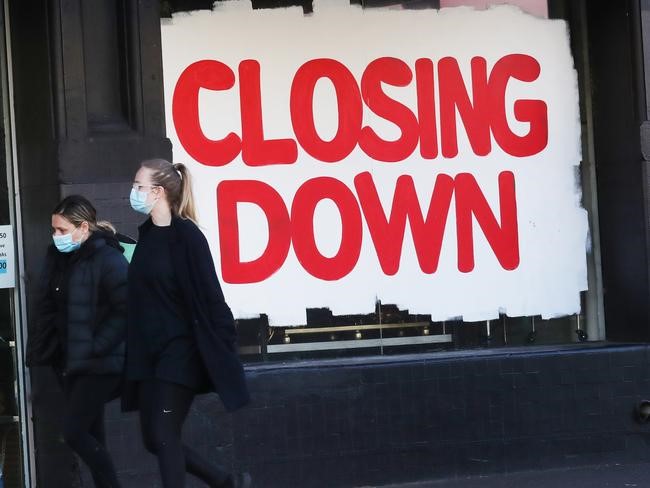
Victorian government announces $282.5m cash boost for struggling businesses
Source: The Australian
The Andrews government has announced a further $282.5m cash boost for businesses struggling during Victoria’s fifth lockdown. Picture: NCA NewsWire / David Crosling
Industry Support and Recovery Minister Martin Pakula said the cash injection would provide “some comfort” over the next few days and ensure businesses get another $2800 under the Business Cost Assistance Program.
“For businesses who received earlier rounds of the grants, the top-up payments would be automatic”, he said.
“Those businesses that either didn’t choose to apply during the May-June lockdown or had been ineligible or has since become eligible … their applications will be considered outside of that automatic top-up process,” Mr Pakula told reporters on Wednesday afternoon.
Alpine businesses will receive an additional $3000 on top of the other grants, while eligible public events and public events suppliers affected by the lockdown will receive support of up to $25,000 and $10,000 respectively through an extension of the Impacted Public Events Support Program.
Another round of Live Performance Support was announced, with up to $7000 for presenters and $2000 for suppliers.
Community sport and recreation organisations will also receive $2000 grants for events that have been cancelled or postponed.
Victorian businesses have been hit hard, plunged into a fifth lockdown since the pandemic begun. Picture: NCA NewsWire/ David Crosling
Victorians have been living under a fifth lockdown since last Friday.
The Victorian government has provided almost $7bn in economic support for businesses during the pandemic, including more than $500m through the May-June lockdown.
About $180m was paid over the past two days to more than 86,000 Victorian eligible businesses for the first five days of the current lockdown.
Victoria recorded 22 cases on Wednesday – 16 of those infections were quarantining during their infectious period.
More information about businesses support is available at business.vic.gov.au.
Cash Support for Victorian Businesses During Lockdown https://www.premier.vic.gov.au/cash-support-victorian-businesses-during-lockdown
Workers affected by the public health restrictions are now eligible for the same payments afforded by the Commonwealth to New South Wales and South Australian workers:
- Payments of $600 will be made to Victorians that lose 20 hours or more of work during the period of the lockdown
- Payments of $375 will be made to individuals that lose between 8-20 hours of work during the period of the lockdown
- There is no liquid assets test applied to receive these payments
If you would like any additional information on the grants above for SA, Vic or NSW please don’t hesitate to contact us.
Tens of thousands of South Australian businesses that have been forced to close over the lockdown are eligible for a $3000 emergency cash grant from the State Government, while workers stood down across regional and metropolitan SA will receive up to $600 a week in compensation.
Premier Steven Marshall has stated that the State Government would match the Federal Government’s lump-sum disaster payments, to ensure workers stood down in regional South Australia would receive the same amount of compensation as those in metropolitan Adelaide.
Under the state and federal government funding packages, workers across SA who lose between eight hours and 20 hours of work during the first week of lockdown will be eligible for a $375 back payment from next Wednesday.
Those who lose more than 20 hours will be eligible for $600 in income relief from next Wednesday.
All compensation will be processed through Services Australia, regardless of whether the payments are funded by the state or federal governments.

Treasurer Rob Lucas at this morning’s press conference. Photo: Tony Lewis/InDaily
The State Government has also announced that it will provide cash grants of $3000 to small to medium-sized businesses that have been impacted by the lockdown.
The support package is worth about $100 million and is estimated to support 50,000 businesses across the state, to help employers cover the costs of rent, power bills, supplier and raw material costs, and other fees.
Cash grants of $1000 will be made available for sole traders.
Businesses are eligible for the payments if they have a payroll of less than $10 million, with an annual turnover of $75,000 or more in 2020-21 or 2019-20.
They must prove that their turnover will be reduced by at least 30 per cent over the seven-day lockdown from July 20.
They must also be located in South Australia, employ South Australians and have a valid Australian Business Number.
Larger businesses will not receive any funding support.
The funding package is based on similar schemes in Victoria, New South Wales and Western Australia.
Lucas said if the lockdown extended beyond seven days, the Government would consider providing further funding to support businesses.
He said the Government would also consider giving targeted support to industries that are significantly impacted by the lockdown.
The Government has broadened the eligibility criteria for businesses compared to last year’s lockdown funding package and it anticipates a “significantly larger” number of businesses will receive funding support.
“If you’re COVID-impacted, then you’re entitled to be eligible for the grant.”
The Detail:
COVID-19 Business Support Grant – July 2021
The South Australian Government has announced a July 2021 COVID-19 Business Support Grant Program to support thousands of South Australian small and medium-sized businesses that suffer a significant loss of income or have been forced to close as a result of the restrictions imposed from 20 July 2021.
Grants of $3,000 for employing businesses and $1,000 for non-employing businesses are available for eligible businesses whose turnover has declined by 30% or more as a result of the COVID‑19 health restrictions in the week commencing 20 July 2021.
To be eligible for the $3,000 grant a business must meet all criteria listed below, at the start of the restriction period of 12:01am Tuesday 20 July 2021:
- Be located within South Australia.
- Have an annual turnover of $75,000 or more in 2020-21 or 2019-20, and be registered for GST.
- Have a valid and active ABN (Australian Business Number).
- Must employ people in South Australia.
- Have an Australia-wide payroll of less than $10 million in the 2019-20 financial year.
- Experienced at least a 30 per cent reduction in turnover in the week of Tuesday 20 July 2021 – Monday 26 July 2021 (inclusive) (compared to the prior week) due to restricted trading conditions.
Applications for the Business Support Grant must be submitted by 11:59pm, 30 September 2021.
To be eligible for the $1,000 grant, non-employing businesses will be subject to the eligibility criteria outlined above, excluding the requirement to employ people.
Where multiple non-employing businesses meeting the eligibility criteria are controlled by one individual, company, partnership, or trustee, funding will be restricted to one grant for all non-employing businesses controlled by the individual, company, partnership, or trustee.
Non-employing businesses are not eligible to apply if persons associated with the business, and who derive income from it, have applied for, or are receiving, the Commonwealth COVID-19 Disaster Payment.
Businesses will be required to declare that they have experienced a loss or reduction in turnover due to restricted trading conditions. They will not be required to provide any supporting information at the time of application but will be required to retain supporting information for 12 months that could be made available for audit and compliance purposes such as:
- Turnover comparison data for the week prior to the assessment period
- Emails or texts to or from clients or suppliers detailing cancelled orders or appointments
- Receipts for refunds provided
- Invoices or delivery dockets
- Appointment/scheduling platform, demonstrating cancelled appointments or bookings
- Screenshots of cancelled events
Applications for a Business Support Grant will close at 11:59pm on 30 September 2021.
Treasury will contact via email successful grant recipients from the 2020 Rounds 1 and 2 of the Small Business Grant (SBG) through the email address submitted by the business as part of the SBG application process, to advise them of the new Business Support Grant. The applications process for these businesses will be fast tracked and payments expedited where business details have not changed.
Official grant guidelines and an application portal will be made available shortly. In the interim, register here, to receive a notification that applications are open.
If you would like any additional information on the grants above for SA, Vic or NSW please don’t hesitate to contact us.
We hope this finds you well and we are aware this newsletter will not apply to everyone. Just like last year we will update you with as much information as we can, as and when we get it.
Stay safe and please see below as to what is available.
CLICK BELOW TO READ:
https://www.indigofinancial.com.au/wp-content/uploads/2021/07/COVID-19-Updatedlockdownsupport.pdf
CLICK HERE – July Special Edition
Australia has had its fair share of disasters over the last few years – drought, bushfires and floods – that have ramped up the volume of insurance claims. Most people would assume that if and when they need to claim on their insurance, the insurance payout covers the damage and is not income assessed for tax purposes – but this is not always the case.
Insurance payouts for damaged or destroyed personal items are generally not taxed. For example, any insurance payout you receive for your family home won’t necessarily be taxed. But, the rules are different if you have used your home to produce an income, for example, you have used part of your home as a home business or you have rented out part of your home.
The rules are also different if the item is a personal asset costing more than $10,000 or if the asset is a collectible that cost more than $500. Where the insurance proceeds exceed the original cost of the asset, that is, the asset appreciated in value, then capital gains tax might apply.
And, if the asset damaged is related to a business or an income producing asset like a rental property, the rules are also different.
Business premises, trading stock and depreciating assets
For businesses that have had trading stock damaged or destroyed, any insurance payout is taxable. For example, the payouts on claims coming through from the enforced lockdowns for spoiled perishable stock would need to be included in the business’s tax return. This is because the insurance premiums would have been claimed by the business as an expense. It is just a question of how the insurance is taxed.
If your business premises are damaged and the insurance covers repairs, then the amount you receive is generally taxed as income if you can claim a deduction for the repair costs. Where the premises are damaged or destroyed, then we’ll need to work with you to identify if you have made a taxable gain or loss.
When it comes to depreciating assets like machinery, then it starts getting more complex. In general, if the insurance payout exceeds the written down value, then the payout is included in the business’s assessable income, and if less, you can claim a deduction for the difference. However, there are also special rules for work cars, small businesses, and where a replacement item is purchased.
Rental properties
A rental property is an income producing asset and, in most cases, the cost of insurance policies relating to the property would have been claimed as an expense. For example, if you receive a payout for your rental property as a result of a disaster, generally, you will need to include at least part of this amount as income in your tax return. This could include insurance payouts for loss of rental income, repairs, replacements of destroyed assets, or money received from a relief fund.
The treatment of the insurance proceeds depends on what the payout is for, how the insurance is used, and whether the rental property was vacant or in use.
A recent case before the Administrative Appeals Tribunal (AAT) shows how tricky this area of the tax rules can be. In this case, the taxpayer initially received insurance proceeds of $24,000 for lost rental income after their property sustained storm and flood damage. The taxpayer had declared this amount as income. All good so far.
Then, the taxpayer received an additional $250,000 from the insurer with the payment described as “in consideration of the taxpayer releasing the insurer from all liability past, present and future under the insurance policy”. The taxpayer did not believe this money was for him to repair his property so did not claim it in his tax return. But, he did claim a deduction for repair costs totalling $130,000 in two income years.
The ATO subsequently audited the taxpayer and issued an assessment for the full $250,000. The AAT agreed with the ATO even though the taxpayer had only claimed $130,000 in repairs. It’s possible this case will go to appeal but it serves as a warning that any lump sum payouts need to be very carefully assessed and dealt with.
If you have been impacted by a disaster and are uncertain of how any insurance proceeds will be taxed, please talk to us and we can work with you to help you understand your position.
We’ve summarised the key 1 July 2021 changes and their implications.
Super guarantee rate increase to 10%
On 1 July 2021, the Superannuation Guarantee (SG) rate will rise from 9.5% to 10% – the first rise since 2014. It will then steadily increase each year until it reaches 12% on 1 July 2025.
The 0.5% increase does not mean that everyone gets an automatic pay increase, this will depend on your employment agreement. If your employment agreement states you are paid on a ‘total remuneration’ basis (base plus SG and any other allowances), then your take home pay might be reduced by 0.5%. That is, a greater percentage of your total remuneration will be directed to your superannuation fund. For those paid a rate plus superannuation, then your take home pay will remain the same, but your superannuation fund will benefit from the increase. If you are used to annual increases, the 0.5% increase might simply be absorbed into your remuneration review.
Employers will need to ensure that they pay the correct SG amount in the new financial year to avoid the superannuation guarantee charge. Where employee salaries are paid at a point other than the first day of the month, ensure the calculations are correct across the month (i.e., for staff paid on the 15th of the month they are paid the correct SG rate for June and July in their pay and not just the June rate).
Superannuation salary packaging arrangements will also need to be reviewed – employers should ensure that the calculations are correct and the SG rate increase flows through.
Annual superannuation guarantee rate changes
| SG rate | |
| 1 July 2020 – 30 June 2021 | 9.5% |
| 1 July 2021 – 30 June 2022 | 10% |
| 1 July 2022 – 30 June 2023 | 10.5% |
| 1 July 2023 – 30 June 2024 | 11% |
| 1 July 2024 – 30 June 2025 | 11.5% |
| 1 July 2025 – 30 June 2026 | 12% |
When someone has multiple funds, it often erodes their balance through unnecessary fees and often insurance. And, as at 30 June 2020, there was $13.8 billion of lost and unclaimed superannuation in accounts across Australia.
Currently, when an employer hires a new staff member, the employee is provided with a Choice of Fund form to identify where they want their superannuation to be directed. If the employee does not identify a fund, the employer directs their superannuation into a default fund.
New stapled superannuation employer obligations for new staff
From 1 July 2021, where an employee does not identify a fund, legislation before Parliament will require the employer to link the employee to an existing superannuation fund. That is, an
employee’s superannuation fund will become ‘stapled’ to them. An employer will not simply be able to set up a default fund, but instead will be required to request that the ATO identify the employee’s stapled fund. If the ATO confirms no other fund exists for the employee, contributions can be directed to the employer’s default fund or a fund specified under a workplace determination or an enterprise agreement (if the determination was made before 1 January 2021).
Legislation enabling this measure is currently before the Senate.
Indexation increases contribution caps and the transfer balance cap
Indexation ensures that the caps on superannuation that limit how much you can transfer into super and how much you hold in a tax-free retirement account, remain relevant by making pre-determined increases in line with inflation. To trigger indexation, the consumer price index (CPI) needed to reach 116.9. Australia reached 117.2 in December 2020 triggering increases to the contribution and transfer balance caps from 1 July 2021. The next increase will occur when a December quarter CPI reaches 123.75.
Concessional and non-concessional contribution caps
From 1 July 2021, the superannuation contribution caps will increase enabling you to contribute more to your superannuation fund (assuming you have not already reached your transfer balance cap).
The concessional contribution cap will increase from $25,000 to $27,500. Concessional contributions are contributions made into your super fund before tax such as superannuation guarantee or salary packaging.
The non-concessional cap will increase from $100,000 to $110,000. Non-concessional contributions are after tax contributions made into your super fund.
The bring forward rule enables those under the age of 65 to contribute three years’ worth of non-concessional contributions to your super in one year. From 1 July 2021, you will be able to contribute up to $330,000 in one year. Total superannuation balance rules will continue to apply. However, if you have utilised the bring forward rule in 2018-19 or 2019-20, then your contribution cap will not increase until the three year period has passed.
Transfer balance cap – why you will have a personal cap
The transfer balance cap (TBC), as the name suggests, limits how much money you can transfer into a tax-free retirement account. From 1 July 2021, the general TBC will increase from $1.6m to $1.7m but not everyone will benefit from the increase.
From 1 July 2021, there will not be a single cap that applies to everyone. Instead, every individual will have their own personal TBC of between $1.6 and $1.7 million, depending on their circumstances.
If your superannuation is in accumulation phase before 1 July 2021, that is, you have not started taking an income stream (pension), then your cap will be the fully indexed amount of $1.7m.
However, if you have started taking an income stream – you have retired or are transitioning to retirement – then your indexed TBC will be calculated proportionately based on the highest ever balance of your account between 1 July 2017 and 30 June 2021. The closer your account is to the $1.6m cap, the less impact indexation will have. For anyone who reached the $1.6m cap at any time between 1 July 2017 and 30 June 2021, indexation will not apply and your cap will continue to be $1.6m. For example, if you are transitioning to retirement and drawing a pension, and your highest ever balance in your retirement account was $1.2m, then indexation only applies to $400,000 (the $1.6m cap less your highest very balance). In this case, your new personal TBC will be $1,625,000 after indexation.
| My super is… | TBC to 30 June 2021 | TBC from 1 July 2021 |
| In accumulation phase | $1.6m | $1.7m |
| In retirement phase I reached the $1.6m cap limit between 1 July 2017 & 30 June 2021 | $1.6m | $1.6m |
| In retirement phase I have never reached the $1.6m cap at any time between 1 July 2017 & 30 June 2021 | $1.6m | $1.6m plus indexation on the amount between your highest ever balance and the $1.6m cap. |
The total super balance caps to utilise the spouse contribution offset and the government co-contribution will also be lifted to $1.7m in line with indexation.The Australian Taxation Office (ATO) will calculate your personal TBC based on the information lodged with them (this will be available from your myGov account linked to the ATO). If your superannuation is in retirement phase, it will be very important to ensure that your Transfer Balance Account compliance obligations are up to date. For Self-Managed Superannuation Funds (SMSFs), it is essential that you let us know about any changes that impact on your transfer balance account, for example if a member of your fund retires.
Minimum superannuation drawdown rates
The Government has announced an extension of the temporary reduction in superannuation minimum drawdown rates for a further year until 30 June 2022.
| Age | Default minimum drawdown rates | 2019-20, 2020-21 & 2021-22 reduced rates |
| Under 65 | 4% | 2% |
| 65-74 | 5% | 2.5% |
| 75-79 | 6% | 3% |
| 80-84 | 7% | 3.5% |
| 85-89 | 9% | 4.5% |
| 90-94 | 11% | 5.5% |
| 95 or more | 14% | 7% |
Single touch payroll reporting
Single touch payroll will apply to most businesses from 1 July 2021, this will include small businesses (those with 19 or fewer staff) and businesses with closely held employees (e.g., directors of family companies, salary and wages for family employees of businesses). No further extensions will be granted.
For employers with closely held employees, there are some concessions on how reporting is managed with the option to report one of three ways: reporting actual payments in real time, reporting actual payments quarterly or reporting a reasonable estimate quarterly. These concessions allow a level of flexibility in relation to determining and making payments to closely-held payees. However, if your business is impacted, it will be important to plan throughout the year to prevent problems occurring at year end.
If you worked from home during lockdown and spent money on work related items that were not reimbursed by your business, you might be able to claim some of these expenses as a deduction – but not everything you purchase can be claimed.
The ATO has stated that it is looking very closely at work related deductions that are being claimed. If you are claiming your expenses, there are three methods you can use
- An 80 cents per hour short-cut method (you will need to have evidence of hours worked like a timesheet or diary)
- The 52 cents per hour method (which excludes phone, internet, or the decline in value of equipment which are all claimed separately), or
- The actual expenses method.
The ATO has highlighted four ineligible expenses that are being claimed:
- Personal expenses such as coffee, tea and toilet paper
- Expenses related to a child’s education, such as online learning courses or laptops
- Claiming large expenses up-front (instead of claiming depreciation for assets), and
Occupancy expenses such as rent, mortgage interest, property insurance, and land taxes and rates, that cannot generally be claimed by employees working from home.
A recent case before the AAT shows how determined the ATO is to crackdown on work related deductions being claimed where there is not a satisfactory nexus between the expense being claimed and the taxpayer’s work. In this case, the taxpayer had claimed car and clothing expenses, and home internet and mobile phone costs. The ATO conceded the car costs but on a reduced deduction. When it came to clothing expenses the ATO conceded that a deduction could be claimed for gloves and a beanie on the basis that the taxpayer worked in cold conditions and that these were protective clothing needed for the job. However, the AAT refused to allow a deduction for the cost of a pair of socks on the basis that they were not protective in nature in their own right – yes, it really does get this detailed.
The taxpayer had also claimed 100% of his home internet expenses but the ATO reviewed this claim and reduced the deductible amount to $50 – a record of the family’s home internet usage demonstrated the internet was used to browse Facebook amongst other non-work related sites.
One of the other issues to come out of this case was the importance of record keeping. If you are going to claim work related expenses, then ensure you have the records to prove your claim.
We have had a great response to the 19 – 21 July GBC event to be held at the Hilton Surfers Paradise.
This will be a truly amazing event and we are keen to get as many of our clients and friends there as possible. This is a great opportunity while others sit and wait and hope for things to get better for us to get pro-active and actually make things better.
You can even look at bringing some of your key team along as well and we have no doubt you will take a lot out of the 3 days to further improve your business.
Also, a few extra things/gifts to mention:
- Just in case you are wondering. If the event is not able to be run due to Covid we will fully refund people’s course investment (for those who would like a refund) or hold it in credit (if that is what they prefer) until the event is run. We believe however that the event will go ahead as planned.
- For each one of you that attends we have organized a Free Aussie Luxury Holiday (accommodation only is covered and there are minor Govt daily fees to be paid) worth up to $1,000 (drive or fly 3 night luxury holiday). That is a nice gift from us. So not only is all of your investment 100% tax deductable, you will get a massive amount of ideas and strategies and you will also get a holiday.
- Our Money Back Guarantee still stands. If you come along and one idea does not pay for the course investment 10X over we will refund your course investment in full (so we are guaranteeing $20,000 in value!).
- Special offer – FREE trial of our business coaching. We have noticed over the years that post business camp people sometimes do not do all of the things that they planned to do. We find that people get caught up with the day to day and cannot focus on the key things that they need to do. We have therefore developed a structured process to help you get more from the camp.
- Our clients and friends receive very special pricing (we subsidise your investment). Special price is $1,980 pp and is fully tax deductable.
As mentioned above the camp will run from 19-21 July 2021 – we have already booked the first run of flights for around $388 return (direct with Virgin) and we have a deal with the Hilton for $169 per night (single share) or $189 per night (twin share) which includes breakfast each day.
At the moment we have 7 advisors from Indigo attending including myself with quite a number of confirmed clients. Find out more – https://www.globalbusinesscamps.com.au/camp-information/.
At the conclusion of the course we will work with each attendee to create a quick wins, 90 day and 180 day strategy to keep you accountable and ensure everything is implemented.
We look forward to you joining us at the business camp.
Any questions please come back to us.
Finally if you think someone you know may benefit from this opportunity, please feel free to forward this email and let me know!
Quote of the month“You can’t ask customers what they want and then try to give that to them. By the time you get it built, they’ll want something new.” Steve Jobs |
The amount you can contribute to super will increase and bring forward rule
Indexation will increase the concessional and non-concessional contribution caps from 1 July 2021. These caps are indexed by average weekly ordinary time earnings (AWOTE).
| Cap | Current cap | Cap from 1 July 2021 |
| Concessional contributions cap | $25,000 | $27,500 |
| Non-concessional contributions cap | $100,000 | $110,000 |
The bring forward rule
The bring forward rule enables you to contribute up to three years’ worth of non-concessional contributions in the one year. That is, from 1 July 2021, you could contribute up to $330,000 to your superannuation in one year. You can use the bring forward rule if you are 64 or younger on 1 July of the relevant financial year of the contribution and the contribution will not increase your total super balance by more than your transfer balance account cap.
If you utilised the bring forward rule in previous years, your non-concessional cap will not change. You will need to wait until your three years has expired before utilising the new cap limit.
| 1 July 2017 – 30 June 2021 | After 1 July 2021 | ||
| Total Super Balance (TSB) | Contribution and bring forward available | Total Super Balance (TSB) | Contribution and bring forward available |
| < $1.4m | $300,000 | <$1.48m | $330,000 |
| $1.4m -$1.5m | $200,000 | $1.48m – $1.59m | $220,000 |
| $1.5m – $1.6m | $100,000 | $1.59m – $1.7m | $110,000 |
| $1.6m+ | Nil | $1.7m+ | Nil |
* excludes withdrawals made under the COVID 19 relief measures.
Please contact us should you have questions regarding superannuation contributions.
« Previous Page — Next Page »