
Budget 2026-27 at a glance
On Tuesday 12 May 2026 the Treasurer Jim Chalmers handed down the 2026-27 Federal Budget, framing some of the more significant announcements as part of a broader plan to help young Australians access the property market.
While acknowledging that the key to housing affordability is supply, the Government clearly sees changes to negative gearing and the capital gains tax (CGT) discount as being important pieces in the housing affordability puzzle.
The Government has called this its most ambitious budget and if the proposed measures are implemented, the impact will be felt directly by a wide cross-section of Australian society, including individual taxpayers, investors, businesses, employers and those suffering from a disability.
The year’s budget has been released against a backdrop of significant economic challenges, including global fuel price shocks, persistent inflation, rising interest rates and growing concerns around housing affordability. These themes are reflected in the measures that have been announced by the Treasurer.
While the Government has announced some significant changes to the tax system, the superannuation system looks to have been left alone this year.
Key initiatives include:
Housing
- Changes to the tax system to reduce existing concessions for property investors.
- Extending the temporary ban on foreign purchases of established dwellings until 30 June 2029.
- An investment of $2 billion to help local governments and state utilities build infrastructure to support new housing.
Health
- Medicare Urgent Care Clinics will receive additional funding to ease the pressure on GPs and hospitals.
- Funds are allocated to list new medicines on the Pharmaceutical Benefits Scheme, including treatments for cystic fibrosis, kidney disease and various cancers.
- An additional $25 billion in funding for public hospitals.
- Reforms to the NDIS are expected to save $37.8 billion over the next four years. The scheme will be more focused on those with permanent and severe disabilities.
- Private health insurance subsidies for Australians over 65 are being cut, with savings being used to fund aged care and dementia care units.
Defence
- The defence budget will be increased by $53 billion over the next ten years.
Fuel
- A $14.8 billion package will be used to help Australia strengthen fuel supply.
- A reduction in the fuel excise and heavy vehicle road user charge will continue to apply for three months from 1 April 2026.
Important: Unless otherwise noted, the measures discussed below are only announcements at this stage. There is no guarantee that they will be implemented as per the Government’s announcements (or at all). We will keep you up to date with key developments as things progress.

Budget 2026-27 in detail
INDIVIDUALS AND FAMILIES
A new tax offset
Start date: 1 July 2027
The Government will provide a $250 ‘Working Australians Tax Offset’ from the 2027–28 income year.
The offset will be a permanent feature of the tax system and is aimed at taxpayers who derive income from work, such as employees who receive salary or wages and sole traders who carry on a business.
The offset basically operates to increase the effective tax-free threshold for income derived from work by nearly $1,800 to $19,985 (or up to $24,985 for workers eligible for the Low Income Tax Offset).
Resources: New tax cuts for Australian workers
$1,000 instant tax deduction for workers
Start date: 1 July 2026
During the 2025 federal election campaign the Labor party committed to introduce a $1,000 instant tax deduction for work-related expenses. On 20 April 2026 Treasury released draft legislation on this proposal for public consultation.
The key feature of the proposal is that Australian residents will be able to claim a standard deduction from the 2026-27 income year onwards for work-related expenses, with the deduction being capped at the lower of $1,000 and the individual’s assessable labour income. The normal substantiation rules would not apply when claiming the standard deduction.
Charitable donations, union fees and fees relating to professional association memberships would be claimed on top of the standard deduction.
Taxpayers who have incurred more than $1,000 in qualifying work-related expenses can instead choose to claim their actual expenditure as a deduction, but will need to substantiate these expenses.
The draft legislation contains some other proposed changes to the tax system including:
- Depreciating assets that are mainly used to generate labour income won’t qualify for the low-value pooling rules.
- Modified rules will apply to determine the tax impact on the sale of assets used in producing labour income.
- An FBT exemption that currently applies when certain work-related items are provided to employees under a salary packaging arrangement will be removed.
Resources: $1,000 instant tax deduction to deliver, simpler taxes for 6.2 million workers and Instant tax deduction–exposure draft
Income tax cuts
Start date: 1 July 2026
Legislation has already been passed to ensure that the 16% tax rate on taxable income between $18,201 and $45,000 will drop to 15%. The rate will then drop to 14% from 1 July 2027.
This was announced in the 2025-26 Federal Budget.
Resources: Tax cut calculator
Medicare levy thresholds increased
Start date: 1 July 2025
The Government will increase the Medicare levy low‑income thresholds for singles, families, and seniors and pensioners.
The threshold for singles will be increased from $27,222 to $28,011.
The family threshold will be increased from $45,907 to $47,238.
For single seniors and pensioners, the threshold will be increased from $43,020 to $44,268.
The family threshold for seniors and pensioners will be increased from $59,886 to $61,623.
The family income thresholds will increase by $4,338 for each dependent child or student, up from $4,216.
INVESTORS
Limits on negative gearing
Start date: 1 July 2027
The term ‘negative gearing’ refers to the situation where a rental property owner claims deductions for expenses associated with holding the property that exceed the rental income that is received in the relevant income year.
The loss that is generated from a rental property can typically be offset against other income (including salary, wages and net capital gains) to reduce overall taxable income or create a tax loss that can be carried forward to future years.
However, the parameters around negative gearing for residential property are set to change with the Government announcing that existing negative gearing rules will only be available in connection with new builds from 1 July 2027.
From this date onwards, losses from established residential properties that are acquired from 7:30pm (AEST) on 12 May 2026 will only be deductible against rental income or capital gains from residential properties. Excess losses will be carried forward to be offset against residential property income in future years.
‘New builds’ are residential properties which genuinely add to supply, such as dwellings constructed on vacant land and situations where existing properties are demolished and replaced with a greater number of dwellings.
Knock-down rebuilds or substantial renovations that do not increase supply will not be treated as new builds.
Properties acquired before 12 May 2026 will be exempt from the changes and the changes won’t apply to managed investment trusts or superannuation funds. Also, the changes don’t impact on other asset classes such as commercial properties or shares.
Resources: Negative Gearing and Capital Gains Tax Reform
CGT discount and pre-CGT exemption replaced by indexation and minimum tax rate
Start date: 1 July 2027
The CGT discount has enabled individuals, trusts and complying superannuation funds to reduce the taxable capital gain made on disposal of an asset that has been held for more than 12 months. The standard discount rate is 50% for trusts and individuals (although lower discount rates can apply to non-residents and temporary residents in some cases), with a 1/3 discount applying to superannuation funds.
However, from 1 July 2027 the Government is planning to revert to an indexation system based on the Consumer Price Index (CPI), much like the system that applied between 1985 and 1999. Indexation would only be available for assets that have been held for more than 12 months.
In addition to this, a minimum tax rate of 30% will apply to capital gains that accrue from 1 July 2027. There will be some exceptions to this for recipients of means-tested income support payments (eg, Age Pension, JobSeeker).
Assets acquired before 20 September 1985 (referred to as pre-CGT assets) have historically been exempt from CGT, but this exemption will no longer apply from 1 July 2027.
Transitional rules will limit the impact of these changes for existing investments. The existing CGT discount and exemption for pre-CGT assets will continue to apply the gains that accrued before 1 July 2027. Taxpayers will need to determine the value of existing assets on 1 July 2027 to enable CGT calculations to be undertaken.
The CGT changes apply to all asset classes, including property and shares. The changes will apply to individuals, trusts and assets held by partnerships.
Having said all that, investors in new residential properties will be able to choose to apply either the 50% CGT discount or cost base indexation and the minimum tax.
Minimum tax on family trust distributions
Start date: 1 July 2028
The Government has announced that a minimum 30% tax rate will apply to distributions made by discretionary trusts.
Discretionary trusts (often referred to as family trusts) have become a widely used structure for both investment and business activities. One of the key features of a discretionary trust is that the trustee is typically given the power to decide how to allocate income and capital gains made by the trust across family members and related entities.
This flexibility means that discretionary trusts can be used as an effective tax planning tool in many cases. For example, income distributed to an adult child could potentially be tax-free if the child has no other income and distributions are capped at the tax-free threshold for individuals.
However, the Government has announced that from 1 July 2028 onwards the trustee of a discretionary trust will pay a minimum 30% tax on the taxable income of the trust. Individuals and other non-corporate beneficiaries will receive a non-refundable tax credit for the tax paid by the trustee.
The non-refundable credit will not be available for corporate beneficiaries (often referred to as bucket companies). It seems like the changes are being made partly to discourage trustees from distributing income to corporate beneficiaries.
The Government has indicated that a limited form of rollover relief will be available for three years from 1 July 2027 for small businesses and others who wish to restructure out of a discretionary trust into a company or fixed trust. The rollover relief might help to minimise CGT and other income tax implications, but broader issues such as stamp duty will need to be carefully considered before any changes to an existing structure are implemented.
The minimum tax will not apply to fixed and widely held trusts, complying superannuation funds, special disability trusts, deceased estates and charitable trusts.
Some types of income such as primary production income, certain income relating to vulnerable minors, amounts that are subject to non-resident withholding tax and income from assets of testamentary trusts existing at 12 May 2026 will also be excluded.
Resources: Minimum tax on discretionary trusts
Foreign resident CGT concession
Start date: The first day of the next quarter after receiving Royal Assent
The Government will provide a concession in the foreign resident CGT regime for investment in the renewables sector.
The transitional arrangement will apply to foreign investors disposing of certain renewable energy infrastructure assets from the start date until 30 June 2030.
Venture capital tax incentives
Start date: 1 July 2027
The Government will expand the scope of existing tax incentives which relate to venture capital limited partnerships and early stage venture capital limited partnerships.
BUSINESS AND EMPLOYERS
Instant asset write-off
Start date: 1 July 2026
The Government has announced that the cost threshold for the purpose of applying the instant asset write-off for small business entities will be permanently increased to $20,000 from 1 July 2026.
The instant asset write-off allows eligible small business entities with aggregated turnover of less than $10 million to claim an immediate deduction for the full cost of depreciating assets which cost less than a specified dollar threshold. While the default threshold is $1,000, higher temporary thresholds have been implemented on a year-to year basis since 2015, often leading to confusion and uncertainty.
A permanent increase in the cost threshold to $20,000 should be welcome news to small business taxpayers who will have a greater level of confidence when it comes to investing in new plant or equipment or upgrading business assets.
In order to qualify for the immediate deduction, the cost of the asset must be less than $20,000, after subtracting any GST credits that can be claimed.
The cost threshold applies on an asset-by-asset basis, so an immediate deduction could potentially apply to multiple assets that are purchased for less than $20,000 in a particular income year, even if the aggregated cost of those assets is $20,000 or more.
Assets that cost $20,000 or more can continue to be added to a small business pool.
Just a quick reminder, the threshold for the current income year that ends on 30 June 2026 had already been increased to $20,000.
Resources: Backing small businesses to grow, compete and build resilience
FBT on electric cars
Start date: 1 April 2027
On 5 May 2026 the Government announced that the FBT exemption for electric cars would be gradually scaled back over the next few years.
The FBT exemption for electric cars was introduced in the 2022-23 income year as part of a broader initiative to reduce the cost of electric vehicles and increase uptake.
While the exemption has been phased out for plug-in hybrid electric vehicles from 1 April 2025 (with pre-existing arrangements still qualifying for the exemption in some cases), a full FBT exemption still applies to battery electric vehicles and hydrogen fuel cell electric vehicles that are provided as fringe benefits to employees if certain conditions can be satisfied.
However, the Government is planning to progressively reduce the scope of the FBT exemption on the following basis:
- The FBT exemption will continue to operate in its current form until 31 March 2027.
- From 1 April 2027 to 31 March 2029 the full FBT exemption will only be available if the car costs $75,000 or less. Electric cars above this threshold but costing less than the luxury car tax (LCT) threshold for fuel-efficient cars will receive a 25% FBT discount.
- From 1 April 2029 all electric cars costing less than the LCT threshold will receive a 25% FBT discount.
The Government indicates that existing lease arrangements won’t be impacted by these changes.
When an electric car is provided to an employee and it qualifies for concessional FBT treatment under these measures it will still be necessary for employers to calculate the reportable fringe benefits amount, ignoring the application of the FBT exemption or discount. This can impact on other areas of the tax and social security systems.
Resources: Fairer tax treatment to encourage affordable EVs
Loss carry back for companies
Start date: 1 July 2026
For income years commencing on or after 1 July 2026 the Government will allow companies with aggregated annual global turnover of less than $1 billion to carry back a tax loss and offset it against tax paid up to two years earlier.
The ability to carry back a loss will only apply to tax losses (not capital losses) and will be limited by the company’s franking account balance.
Loss refunds for small start-up companies
Start date: 1 July 2028
Start‑up companies with aggregated annual turnover of less than $10 million that generate a tax loss in their first two years of operation will be able to utilise the loss to generate a refundable tax offset.
The offset will be limited to the value of fringe benefits tax and withholding tax on wages paid in respect of Australian employees in the loss year.
PAYG instalments
Start date: 1 July 2027
The Government will provide funding to the ATO to expand its pilot of dynamic PAYG instalment calculations.
From 1 July 2027, small and medium businesses will be able to opt in to reporting and paying PAYG instalments monthly and will be able to use an ATO-approved calculation that is embedded in accounting software to calculate and vary instalments.
R&D tax incentive
Start date: 1 July 2028
The Government will reform the Research and Development (R&D) Tax Incentive which provides a tax offset for eligible companies that undertake R&D activities.
While the Government is planning to increase the tax offset rate for core R&D expenditure, supporting R&D expenditure will no longer qualify and the minimum amount of expenditure that must be incurred in an income year to qualify for the offset will be increased from $20,000 to $50,000 (with some limited exceptions).
Minimum tax for multinationals
Start date: 1 January 2026
The Government will amend Australia’s global and domestic minimum tax legislation as part of broader reforms to the international corporate tax system.
GOVERNMENT AND REGULATORS
Protecting the tax system against fraud
Start date: 1 July 2026
The Government will provide $86.3 million over four years to help detect and prevent fraud in the tax system.
The Government will also strengthen the ATO’s ability to combat fraud by tax agents and other intermediaries. The ATO will be given powers to pause the recovery of tax debts of taxpayers who are victims of fraud by tax intermediaries, and waive those debts in appropriate circumstances, and to recover the debts from the tax intermediaries.
The ATO will undertake additional targeted compliance activities to further address fraud in the system, including in relation to the R&D Tax Incentive.
THE ECONOMY
Global tensions
The conflict in the Middle East has triggered substantial economic and energy disruptions across the world, driving global inflation higher, global growth lower, and compounding uncertainty and volatility. The impacts on the Australian economy will be felt for some time.
Growth
Higher inflation is expected to impact on growth in real incomes and household consumption.
As a result, growth in the Australian economy is forecast to slow from 2.25% in 2025-26 to 1.75% in 2026-27.
Growth in the Australian economy is expected to increase to 2.25% in 2027-28.
More deficits to come
The budget deficit for 2026–27 is forecast to be $31.5 billion, which represents an improvement of $2.8 billion compared to the Mid-Year Economic and Fiscal Outlook (MYEFO).
The budget is projected to return to balance in 2034–35 and a surplus of 0.8% of GDP in 2036–37.
Debt
Gross debt is estimated to reach $1,051 billion (that’s over $1 trillion) at 30 June 2027. This represents 34% of GDP.
This figure is expected to increase to $1,249 billion (35.6% of GDP) at 30 June 2030.
Net debt in 2026–27 is expected to be 19.9% of GDP.
Interest payments on Australian Government Securities are estimated to be $27.7 billion in 2026–27, increasing to $40.4 billion by 2029–30.
Employment
The unemployment rate has been broadly stable over the last year and is expected to remain relatively low by historical standards.
The unemployment rate is expected to rise gradually from 4.25% in the June quarter 2026 to 4.5% in the June quarter 2027.
Employment is forecast to grow by 1.5% through the year to the June quarter 2026 and the June quarter 2027 and 1.75% through the year to the June quarter 2028.
Wages
The Wage Price Index is forecast to grow by 3.25% through the year to the June quarter 2026, before increasing to 3.5% through the year to the June quarter 2027 and the June quarter 2028.
The recent increase in inflation is expected to result in a decline in real wages over 2025–26. Real wages are forecast to grow again in 2026–27 and 2027–28 as inflationary pressures ease.
Inflation
Headline inflation is forecast to be 5% through the year to the June quarter 2026.
Headline inflation is forecast to decline to 2.5% by the June quarter 2027, but this is based on the assumption that global oil prices will ease over 2026-27, which remains to be seen.
Resources: Budget Paper No.1
Contact Indigo Financial on (08) 8212 8585 if you need help with understanding any of the issues raised in this 2026-27 Federal Budget Report or any of your accounting, taxation and business development needs.
Note: The material and contents provided in this publication are informative in nature only. It is not intended to be advice and you should not act specifically on the basis of this information alone. If expert assistance is required, professional advice should be obtained.
From 1 July 2026, the Federal Government is introducing Payday Super, requiring Super to be paid at the same time as each pay run, rather than quarterly.
Payday Super – Xero user checklist
-
Ensure all employees are set up with the correct Super fund details
-
Check Super rates and categories are accurate
-
Confirm STP reporting is active and up to date
-
Set up Xero Auto Super to streamline payments
-
Link your business bank account for direct processing
-
This helps reduce the risk of missed or late payments
-
When processing payroll in Xero, ensure Super is included and ready to lodge immediately
-
Avoid batching Super quarterly, move to a per pay cycle process
-
Even with Xero Auto Super, payments can take a few days to clear
-
Process Super on the same day as payroll to stay within the 7-day requirement
-
Ensure funds are available in your bank account at each pay run
-
Consider setting up a separate account or allocation for Super liabilities
-
Use Xero reminders or calendar alerts for payroll days
-
Build a consistent routine to avoid delays
-
Run a trial of paying Super each pay cycle before 1 July 2026
-
Identify any issues with timing, cash flow, or setup
If you would like us to review your Xero file or payroll settings, we are happy to assist, so please reach out.
You can view information from the ATO “About Payday Super” here.
Contact Indigo Financial on (08) 8212 8585 if you need help with any of your accounting, taxation and business development needs.
Note: The material and contents provided in this publication are informative in nature only. It is not intended to be advice and you should not act specifically on the basis of this information alone. If expert assistance is required, professional advice should be obtained.
The Australian Taxation Office (ATO) has recently intensified its focus on Fringe Benefits Tax (FBT), with a noticeable increase in audit and compliance activity.
This renewed attention is part of a broader effort by the ATO to ensure businesses and entities (including companies and trusts) are correctly identifying and reporting all fringe benefits provided to employees and directors (includes employees, directors, trustees, or business owners).
As a result, areas that may have previously gone under the radar are now being reviewed more closely.
FBT is an area where many businesses can unintentionally fall short, particularly where benefits are provided informally or outside of payroll systems.
Common examples include:
- Motor vehicles made available for private use (parked at home is available for private use)
- Entertainment such as meals, drinks, or events provided to staff
- Employee reimbursements or expense payments
- Use of company assets
Importantly, FBT obligations can arise even where no income tax deduction is claimed, and even if the benefit is provided infrequently.
Given the ATO’s increased scrutiny, we strongly recommend a proactive review of your FBT position to:
- Identify any benefits provided during the FBT year (1 April to 31 March)
- Ensure correct treatment and supporting documentation
- Consider available exemptions and concessions
- Minimise the risk of penalties, interest, and audit exposure
If you are unsure whether FBT applies to your business, or if it has been some time since your last review, we encourage you to get in touch with us. We can assist with a targeted review to ensure you remain compliant while optimising your tax position.
Please contact us if you would like us to review your FBT obligations or discuss your specific circumstances.
Contact Indigo Financial on (08) 8212 8585 if you need help with any of your accounting, taxation and business development needs.
Note: The material and contents provided in this publication are informative in nature only. It is not intended to be advice and you should not act specifically on the basis of this information alone. If expert assistance is required, professional advice should be obtained.
Australians can now instantly confirm whether a call claiming to be from the Australian Taxation Office (ATO) is genuine, with the launch of a new in-app security feature designed to shut down scammers.
The new verify call feature in ATO app allows users to confirm, in real time, they are speaking with the real ATO, not a fraudster.
ATO Assistant Commissioner Anita Challen says the new feature puts control back in taxpayers’ hands to be able to shut down calls that are not from the ATO and protect their accounts.
‘Scammers are becoming increasingly savvy, making it harder for individuals to distinguish between illegitimate and genuine contact,’ Ms Challen said.
‘This powerful security measure means fraudsters will find it harder to pretend to impersonate the ATO, Australians will have more control of their accounts and more certainty that they are dealing with the real tax office.’
The ATO app provides a quick, easy and secure way for people to manage their tax and super on the go and protect themselves from scammers.
Taxpayers are encouraged to download the ATO app and register their device. Then, when taxpayers receive a call from someone claiming to be from the ATO, they simply need to open the ATO app, login and select the verify call option. Within 30 seconds, a notification should confirm it is an ATO call. If it doesn’t appear, users should treat it as a scam call and hang up.
Delivered as part of the Counter Fraud Program, this feature bolsters the ATO’s existing fraud controls in the app which are designed to keep taxpayers’ accounts secure and includes:
- Real time messages when key changes are made to their account.
- Account locking to prevent unauthorised access or fraudulent activity.
The ATO continues to see impersonation scams peak during tax time with almost 7,500 ATO impersonation scams reported in July 2025 alone and is warning Australians to stay vigilant.
‘April Fool’s may have passed but don’t be fooled by fraudsters attempting to access your tax and super accounts,’ said Ms Challen.
‘Scammers are primed for the opportunity during tax time to try to take advantage of taxpayers who may be expecting communications from the ATO.’
When in doubt, stop and check, before responding or acting on a call or message claiming to be from the ATO.
The most secure way to sign in to the ATO app and ATO online services is using myID. For the best protection, ensure your myID is set up to the highest identity strength.
If taxpayers receive a suspicious call, SMS, email or social media message:
- Do not reply, click on any links or download any attachments.
- Visit verify or report a scam to check or report it.
- Call the ATO immediately on 1800 008 540, if personal information or payment has been shared with a scammer.
- Visit ato.gov.au/scamsafe for more information on how to protect personal information and stay safe from scammers.
Contact Indigo Financial on (08) 8212 8585 if you need help with any of your accounting, taxation and business development needs.
Note: The material and contents provided in this publication are informative in nature only. It is not intended to be advice and you should not act specifically on the basis of this information alone. If expert assistance is required, professional advice should be obtained.
We are seeing a noticeable increase in the number and sophistication of scams targeting both individuals and businesses. Recently, one of our clients received an email designed to look like official correspondence from the Australian Taxation Office.
As you can see from the example below, the presentation is highly professional, using familiar branding, formatting and language to create a strong sense of legitimacy.
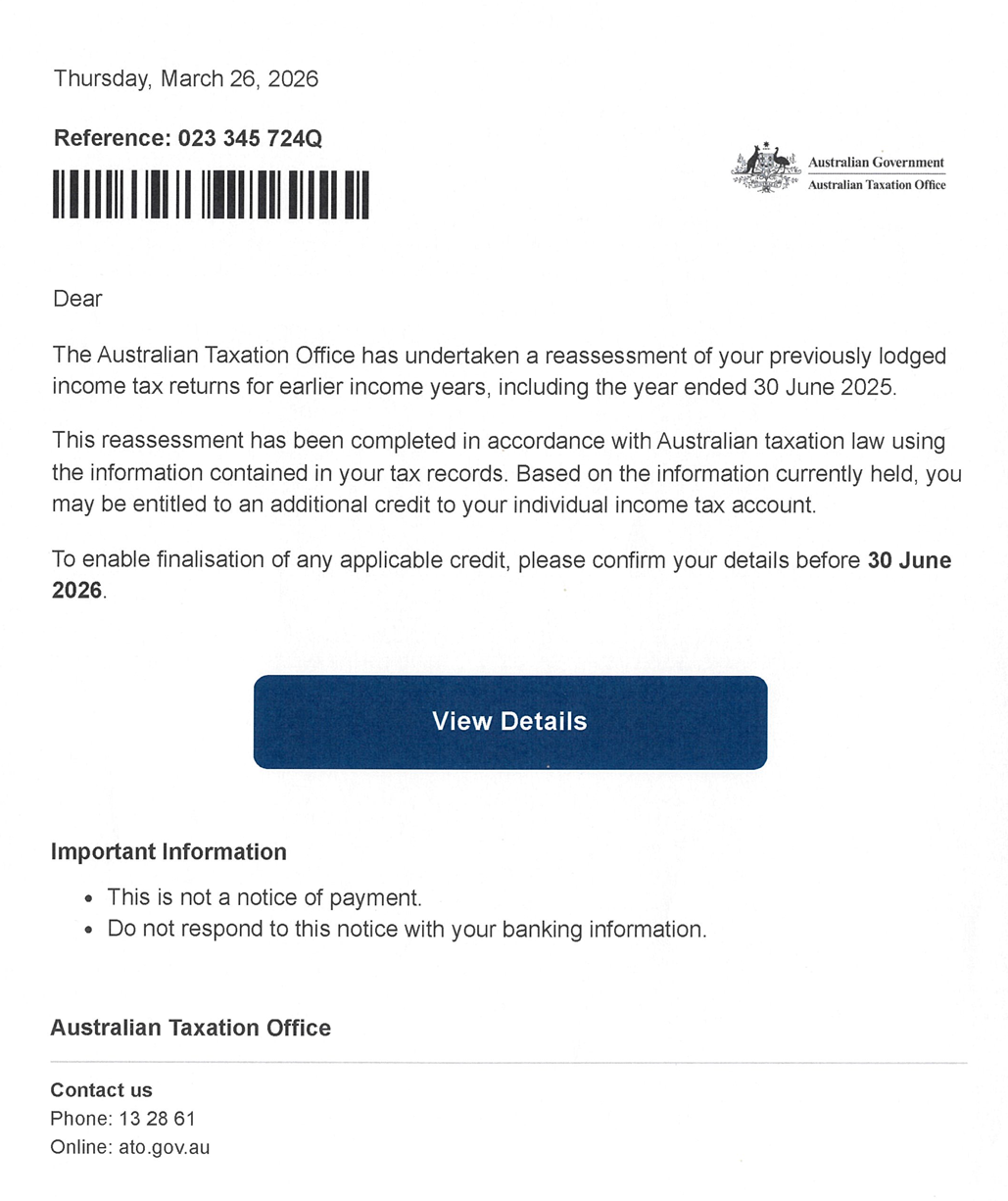
These types of scams are no longer easy to identify at a glance. Gone are the days of poorly written emails with obvious spelling errors. Today’s scammers are investing significant time and effort into replicating official documents, complete with reference numbers, logos and realistic messaging.
Their objective is simple: to create urgency and trust so that recipients act quickly without questioning the authenticity of the communication.
Common tactics include advising of refunds, reassessments, unpaid accounts or requests to “confirm details” via a link. These links often lead to very convincing fake websites designed to capture personal information, login credentials or banking details.
It is important to understand that these scams are not limited to the ATO. We are seeing similar approaches used in communications appearing to come from banks, utility providers and other government agencies. Both individuals and businesses are being targeted, and the financial and personal consequences can be significant.
A key point to remember is that legitimate organisations, including the ATO, will generally not request sensitive information or direct you to click on links in unsolicited emails or messages. Any unexpected communication that creates urgency or asks you to take immediate action should be treated with caution.
If you receive a communication like this, DO NOT click on any links, do not download attachments and do not provide any personal or financial information. Take a moment to pause and assess the situation.
If there is even a small doubt in your mind, play it safe and verify the communication independently. Contact the ATO, your bank or your utility provider directly using trusted methods such as calling their official phone number or visiting in person. Do not rely on the contact details provided in the message itself.
Remaining vigilant is your best defence. A few extra minutes of caution can prevent significant financial loss and stress.
Scam red flags to watch for
- Unexpected messages about refunds, reassessments or urgent payments
- Pressure to act quickly or deadlines that create urgency
- Requests to “confirm” or update personal, tax or banking details
- Links or buttons prompting you to click through to “view details”
- Emails or messages that appear official but come from unusual or unfamiliar addresses
- Attachments you were not expecting
- Generic greetings such as “Dear customer” instead of your name
- Slight variations in logos, formatting or wording compared to genuine communications
- Contact details that do not match official websites or previous correspondence
- Any request for sensitive information via email or SMS
When in doubt, DO NOT act on the message. Verify it independently using trusted contact details.
Contact Indigo Financial on (08) 8212 8585 if you need help with any of your accounting, taxation and business development needs.
Note: The material and contents provided in this publication are informative in nature only. It is not intended to be advice and you should not act specifically on the basis of this information alone. If expert assistance is required, professional advice should be obtained.
ATO is providing targeted support to eligible businesses that are unable to meet their payment obligations due to high fuel costs.
The Australian Taxation Office (ATO) recognises that high fuel costs are affecting some businesses and will provide targeted support to eligible businesses that are unable to meet their payment obligations for three months, until 30 June 2026:
- Streamlined access to more flexible payment plan arrangements, including longer payment terms, no upfront payment, and access to general interest charge (GIC) remission where payment and lodgment conditions are met.
- Remission of GIC and other penalties: high fuel costs will be a relevant factor in consideration of additional requests for remission.
- Support to vary pay as you go (PAYG) instalments where there has been a reduction in taxable income.
During this period, the ATO’s compliance approach will be guided by careful consideration of taxpayers’ circumstances and the current environment.
Businesses and their tax professionals can now assess their eligibility and notify the ATO of their interest in accessing a tailored payment plan and intention to vary PAYG instalments through the ATO’s online services. The ATO will then contact these businesses or their representatives with more information and next steps.
The ATO will continue to monitor the situation and communicate whether it plans to continue or change its approach beyond 30 June 2026 as appropriate.
As an eligible taxpayer you can access the ATO fuel response payment plan with the following conditions:
- No upfront payment
- A 3-year payment plan period of 36 equal monthly instalments
- General interest charge remission (GIC). We will make a decision to remit any general interest charge that has accrued from the time of your application to the date of the third monthly instalment provided you
- pay all instalments agreed under the payment plan for 3 months
- bring any outstanding lodgments up to date in that period.
Note: The ATO fuel response payment plan is available by application until 30 June 2026. You will not have to make a further application for GIC remission for this period.
The ATO will continue to assess the situation and support options available. Updates will be made to this information if the ATO will continue or change this support beyond 30 June 2026.
What to do before accessing the ATO fuel response payment plan
Before applying you must:
- Consider whether you are eligible for an ATO fuel response payment plan
- Gather information and evidence supporting your eligibility.
If you are not eligible, you should prioritise the following actions:
- Pay your employees their wages and ensure you pay their super guarantee entitlements as a priority.
- Pay your creditors so they can pay their employee entitlements.
- Keep up to date with your lodgments and if you are expecting a refund, lodge as soon as you can.
- If you owe money, pay what you can as soon as you can. For the remaining debt you can setup a normal payment plan through online services.
- Contact your registered tax or BAS agent to discuss the options that are right for you.
Eligibility to apply for the ATO fuel response payment plan
You are eligible to apply for the ATO fuel response payment plan if you are an ABN holder who meets the following 4 criteria:
- You have experienced an increase in business operating costs and these costs are either
- directly attributable to higher fuel costs
- indirectly attributable to high fuel costs because of increased transport, logistics or other supply chain costs.
- You have a new tax debt, or you are unable to service an existing tax debt.
- You can demonstrate a reduced capacity to pay due to the high fuel prices. This is separate from a general downturn in business or ordinary cashflow issues. This means that if fuel prices hadn’t been so high, you anticipate you would have been able to meet your payment obligations, including your instalments under existing payment plans.
- Your lodgments are up to date within 3 months of the payment plan being set up. We may cancel your payment plan if lodgments are not up to date within this period. Up-to-date lodgments are also required for us to make a decision to remit GIC under the fuel response payment plans.
The ATO fuel response payment plan is available by application until 30 June 2026.
You can review the Privacy notice for the ATO fuel response payment plans.
Reach out to our team if you need assistance navigating your way through this opportunity from the ATO in this challenging period of fuel insecurity.
Contact Indigo Financial on (08) 8212 8585 if you need help with any of your accounting, taxation and business development needs.
Note: The material and contents provided in this publication are informative in nature only. It is not intended to be advice and you should not act specifically on the basis of this information alone. If expert assistance is required, professional advice should be obtained.
The Fringe Benefits Tax (FBT) year ended on 31 March so if you haven’t been keeping good records then you have some serious work to do right now and our experienced team at Indigo Financial are here to assist you!
Why is fringe benefits tax important for small businesses?
Staying compliant with fringe benefits tax helps you avoid extra costs and gives you a clear view of employee benefit expenses.
Why it pays to stay compliant with fringe benefits tax
- avoid extra tax bills by understanding how benefits increase employment costs
- meet deadlines to avoid fines for late registration, filing or payment
- know which business expenses, such as team dinners, may trigger fringe benefits tax
Common fringe benefits tax challenges for small businesses
- check what counts as a fringe benefit, as definitions can vary
- use the right valuation method for each benefit type
- remember that the fringe benefits tax year runs from April to March, not the standard financial year
Do you need to register for fringe benefits tax?
If your business provides fringe benefits to employees, you’ll likely need to register for fringe benefits tax with the Australian Taxation Office (ATO). You must register as soon as you know you have a fringe benefits tax liability.
If your benefits are exempt, you can still register. Registering lets you lodge a nil fringe benefits tax return and helps you avoid audits for previous years.
You can register for fringe benefits tax at any time of the year. Register online, through a registered tax agent, or by phone. Staying registered makes it easier to manage your obligations each fringe benefits tax year, which runs from 1 April to 31 March.
Important FBT issues for this year
FBT exemption for electric cars
Employers that provide employees with the use of eligible electric vehicles (EVs) can potentially qualify for an FBT exemption. This should normally be the case where:
- The employer owns or leases the car and allows a current employee to use the car;
- The car is a zero or low emission vehicle (battery electric, hydrogen fuel cell or plug-in hybrid electric);
- The car is both first held and used on or after 1 July 2022; and
- The value of the car is below the luxury car tax threshold for fuel efficient vehicles (which is $91,387 for 2025-26 financial year).
Plug-in hybrid vehicles no longer FBT exempt
From 1 April 2025, plug-in hybrid electric vehicles will no longer qualify for the FBT exemption unless:
- The use of the vehicle was exempt before 1 April 2025, and
- There is a financially binding commitment to continue providing private use of the vehicle on and after 1 April 2025.
If there is a break or change to that commitment on or after 1 April 2025 then the exemption won’t normally be available any more.
Overlooking or misreporting FBT on private use of work vehicles
The ATO is actively using sophisticated data analytics to target employers who fail to report or incorrectly report fringe benefits. ATO compliance teams are specifically looking for businesses that:
- Fail to lodge FBT returns despite providing vehicles for private use.
- Misunderstand exemptions, particularly the common misconception that dual-cab utes are automatically exempt from FBT.
- Neglect record-keeping, such as failing to maintain valid logbooks or odometer readings to support their claims.
- Incorrectly apportion usage, often treating private travel—including garaging a vehicle at an employee’s home—as business use.
To ensure compliance, the ATO emphasises that a vehicle is considered “available for private use” if it is garaged at or near an employee’s home, regardless of whether they have permission to use it.
Employers are expected to:
- Correctly identify the vehicle type (which impacts on whether they are providing a car benefit or a residual benefit).
- Maintain robust documentation, as invalid logbooks can lead the ATO to apply the “statutory formula method,” often resulting in higher tax liabilities.
The ATO uses the case study of a Melbourne restaurant to illustrate the severity of non-compliance. In that instance, the lack of valid logbooks and failure to lodge returns resulted in a total liability of $938,000, which included the base tax, a 75% penalty for reckless behaviour, and significant interest charges. This highlights that the ATO is prepared to impose heavy financial penalties on businesses that deliberately avoid or carelessly manage their FBT obligations.
Does FBT apply to your contractors?
The FBT rules tend to apply when benefits are provided to employees and certain office holders, such as directors. FBT should not apply when benefits are provided to genuine independent contractors but determining whether a worker is an employee or contractor can be a complex process in some cases.
Are your contractors really contractors?
The ATO’s ruling TR 2023/4 helps determine whether a worker is an employee or an independent contractor.
If the parties have entered into a written contract, then you need to focus on the terms of that contract to establish the nature of the relationship (rather than looking at the conduct of the parties). However, merely labelling a worker as an independent contractor doesn’t necessarily mean that they won’t be treated as an employee if the terms of the contract suggest that the parties have entered into an employment relationship.
The ATO has also issued PCG 2023/2 that sets out four risk categories. Arrangements will tend to be viewed in a more favourable light where:
- There is evidence to show that you and the worker have agreed on the classification;
- There is a comprehensive written agreement that governs the relationship;
- There is evidence that you and the worker understand the consequences of the classification;
- The performance of the arrangement hasn’t deviated significantly from the terms of the contract;
- Specific advice has been sought confirming that the classification is correct; and
- Tax, superannuation, and reporting obligations have been met when the worker is classified as an employee or independent contractor (whichever relevant).
If your business engages contractors, you should have a process in place to ensure the correct classification of the arrangements and to determine the ATO’s risk rating. These arrangements should also be reviewed over time.
Even when a worker is a genuine independent contractor, just remember that this doesn’t necessarily mean that the business won’t have at least some employment-like obligations to meet. For example, some contractors are deemed to be employees for superannuation guarantee and payroll tax purposes.
Reducing the FBT record keeping burden
Record keeping for FBT purposes can be onerous. However, due to some recent developments your business will have a choice to keep the existing FBT record keeping methods, use existing business records where those records meet the requirements set out by a relevant legislative instrument, or a combination of both methods:
- Travel diaries – see LI 2024/11
- Living-away-from-home-allowance – FIFO/DIDO declarations – see LI 2024/4
- Living-away-from-home – maintaining an Australian home declaration – See LI 2024/5
- Otherwise deductible rule – expense payment, property or residual benefit declaration – See LI 2024/6
- Otherwise deductible rule – private use of a vehicle other than a car declaration – See LI 2024/7
- Car travel to an employment interview or selection test declaration – See LI 2024/14
- Remote area holiday transport declaration – See LI 2024/10
- Overseas employment holiday transport declaration – See LI 2024/13
- Car travel to certain work-related activities declaration – See LI 2024/9
- Relocation transport declaration – See LI 2024/12
- Temporary accommodation relating to relocation declaration – See LI 2024/8
FBT housekeeping
It can be difficult to ensure the required records are maintained in relation to fringe benefits – especially as this may depend on employees producing records at a certain time. If your business has cars and you need to record odometer readings at the first and last days of the FBT year (31 March and 1 April), remember to have your team take a photo on their phone and email it through to a central contact person – it will save running around to every car, or missing records where employees forget.
The top FBT risk areas
Mismatched claims for entertainment – claimed as a deduction but no FBT
One of the easiest ways for the ATO to pick up on problem areas is where there are mismatches.
When it comes to entertainment, employers are often keen to claim a deduction but this can be a problem if it is not recognised as a fringe benefit provided to employees. Expenses relating to entertainment such as a meal in a restaurant are generally not deductible and no GST credits can be claimed unless the expenses are subject to FBT.
Let’s say you taken a client out to lunch and the amount per head is less than $300. If your business uses the ‘actual’ method for FBT purposes, then there often won’t be any FBT implications. This is because benefits provided to clients are not subject to FBT and minor benefits (i.e., value of less than $300) provided to employees on an infrequent and irregular basis are generally exempt from FBT. However, no deductions should be claimed for the entertainment and no GST credits would normally be available either.
If the business uses the 50/50 method, then 50% of the meal entertainment expenses would be subject to FBT (the minor benefits exemption would not apply). As a result, 50% of the expenses would be deductible and the business would be able to claim 50% of the GST credits.
Employee contributions by journal entry in the accounts
Many businesses use after-tax employee contributions to reduce the value of fringe benefits. It is also reasonably common for these contributions to be made by journal entry through the accounting system only (rather than being paid in cash).
While this can be acceptable if managed correctly, the ATO has flagged numerous concerns including whether journal entries made after the end of the FBT year are valid employee contributions.
For an employee contribution made by way of journal entry to be effective in reducing the taxable value of a benefit, all of the following conditions must be met:
- The employee must have an obligation to make a contribution to the employer towards a fringe benefit (i.e., under the employee’s remuneration agreement);
- The employer has an obligation to make a payment to the employee. For example, the parties may agree that the employer will lend an amount to the employee or the employee might be entitled to a bonus that hasn’t been paid yet. If a loan is made by the employer then this could trigger further tax issues that need to be managed;
- The employee and employer agree to set-off the employee’s obligation to the employer against the employer’s obligation to the employee; and
- The journal entries are made no later than the time the financial accounts are prepared for the current year (i.e., for income tax purposes).
Failing to ensure that arrangements involving fringe benefits and employee contributions are clearly documented can lead to problems. For example, the ATO may ask to see evidence of the fact that the employer is actually under an obligation to make contributions towards a fringe benefit. If there is no evidence, then significant FBT liabilities could arise.
Also remember that if the arrangement involves the business providing a loan to an employee this can trigger a separate loan fringe benefit issue that needs to be managed.
Not lodging FBT returns
The ATO is concerned that some employers are not lodging FBT returns when required to.
If your business employs staff (even closely held staff such as family members), and is not registered for FBT, it’s essential to ensure that the position is reviewed to check whether the business could potentially have an FBT liability.
If the business provides cars, car spaces, reimburses private (not business) expenses, provides entertainment (food and drink), employee discounts etc., then you are likely to be providing at least some fringe benefits.
There is a list of benefits that are considered exempt from FBT, such as portable electronic devices like laptops, protective clothing, tools of trade etc. If your business only provides these exempt items, or items that are infrequent and valued under $300, then you are unlikely to have to worry about FBT.
How does the ATO identify employers that are underpaying FBT?
The underpayment of FBT has increasingly become a focal point of the Federal Government’s revenue collection measures in recent years. In response, the ATO has significantly enhanced its FBT data-matching and profiling capabilities by integrating information from a wide range of sources.
This includes data obtained from tax returns, Business Activity Statements, Single Touch Payroll and other third-party sources.
This has resulted in substantial improvements in the ATO’s ability to identify and target employers with a higher risk of FBT non-compliance, leading to a more focuses and effective audit selection process, with a higher strike rate for FBT audit adjustments.
Employers at particular risk of scrutiny include those that do not lodge an FBT return (believing they do not have an FBT liability), especially where ATO data indicates that they may have provided fringe benefits to employees.
Employers that incorrectly apply the FBT rules are also more likely to be scrutinised, as the ATO is better equipped to corroborate information reported in an employer’s FBT return with data from other sources, thereby identifying discrepancies in reported FBT amounts.
Key takeaways
- Register for fringe benefits tax with the ATO as soon as you know you have a liability, even if your benefits are exempt, to avoid audits and manage obligations more effectively throughout the FBT year (1 April to 31 March).
- Utilise key exemptions to reduce your FBT liability, including the minor benefits exemption for irregular benefits under $300, work-related items exemption for business equipment like laptops, and electric vehicle exemption for zero-emission cars below the luxury tax threshold.
- Maintain detailed records including logbooks, receipts and agreements for all benefits provided, keeping documentation for five years and using official ATO calculators to ensure accurate valuations and compliance.
Contact Indigo Financial on (08) 8212 8585 if you need help with any of your accounting, taxation and business development needs.
Note: The material and contents provided in this publication are informative in nature only. It is not intended to be advice and you should not act specifically on the basis of this information alone. If expert assistance is required, professional advice should be obtained.
The ATO is turning up the heat on employers who provide work vehicles for private use. Sophisticated data-matching means assumptions and shortcuts can quickly lead to audits, penalties, interest charges—and even reputational damage.
You can see the latest ATO FBT audit warning here: Misreporting FBT on personal use of work vehicles | Australian Taxation Office
If you provide vehicles to your team, whether to support fieldwork, boost morale, or offer a valuable perk, now is the time to ensure your FBT reporting is watertight. Here’s what the ATO is focusing on—and how to protect your business.
Don’t Assume Dual-Cab Utes Are Automatically Exempt
Dual-cab utes are popular in trades and construction, but despite popular opinion, they’re not automatically FBT-free.
Whether an FBT exemption applies can depend on the vehicle’s design and also how it is used across the FBT year.
Even if a ute is designed to carry a load of at least 1 tonne (ie, it is not classified as a car for FBT purposes) or it isn’t designed mainly to carry passengers (there is a specific formula used for this purpose) FBT could still be triggered if there is some private use of the ute.
The ATO has identified many cases where employers wrongly claimed full FBT exemptions, leading to back taxes plus interest.
The best way to handle ATO enquiries around the FBT exemption for commercial vehicles is to ensure that appropriate evidence is already in place to support the application of that exemption. While the FBT rules don’t specifically require formal logbooks when looking at this exemption, failing to keep records that are similar to a logbook can make it difficult to navigate ATO review or audit activities.
Accurately Apportion Private vs Business Use
If a full FBT exemption doesn’t apply then FBT is typically calculated on private use of work vehicles. You need to determine what portion of running costs—fuel, maintenance, depreciation—relates to personal trips. Ignoring this step can seem harmless but can quickly escalate during an audit.
Thorough record-keeping and proper apportioning can sometimes reduce your FBT liability even if the vehicle is used mainly for business purposes.
Remember that if a FBT liability is triggered it is the employer’s problem.
Lodging FBT Returns
Even if you think the FBT liability for the year might be small or immaterial, you might find that there is still an obligation to lodge an FBT return. The ATO’s analytics flag non-lodgers automatically. Penalties can reach up to 200% of the tax owed, plus interest.
Tip: Mark your calendar—FBT returns are due May 21 each year. Timely filing keeps your business compliant and avoids cash flow shocks.
Keep Reliable Logbooks and Records
A valid logbook tracks odometer readings, trip purposes, and business-use percentages over a 12-week period (renewable every five years). While not every scenario involving a motor vehicle specifically requires a valid logbook, failing to keep logbooks can sometimes lead to significant FBT liabilities that could otherwise have been avoided.
Efficiency tip: Digital logbook apps simplify tracking, save time, and reduce errors. Good records can also support deductions.
Why it Matters Commercially
Non-compliance isn’t just a numbers game. ATO audits divert time and energy from running your business, and ATO attention can affect your reputation with clients, partners, or lenders. Conversely, getting FBT right ensures you pay only what’s required, protects cash flow, and may even reveal tax efficiencies.
Next steps: Review your vehicle policies, update records, and ask us if you need help. We help businesses manage FBT with confidence—making compliance straightforward and stress-free.
Remember: assumptions can be costly, but a proactive approach protects your business, your people, and your peace of mind.
Contact Indigo Financial on (08) 8212 8585 if you need help with any of your accounting, taxation and business development needs.
Note: The material and contents provided in this publication are informative in nature only. It is not intended to be advice and you should not act specifically on the basis of this information alone. If expert assistance is required, professional advice should be obtained.
As Fringe Benefits Tax (FBT) lodgement season approaches, family businesses should carefully review the perks they provide to working directors and family members. A high-profile case involving luxury vehicles provided to three brothers who run a large business empire through a discretionary trust highlights the complexities — and potential risks — of informal arrangements.
While the case initially appeared to expand FBT exposure, the latest decision handed down by the Full Federal Court offers reassurance that not all benefits provided to working owners will automatically trigger FBT.
What may seem like harmless “owner entitlements” or beneficiary perks can still attract scrutiny from the Australian Taxation Office (ATO). However, the courts have emphasised the importance of substance, documentation, and the capacity in which benefits are provided.
The Background
Three brothers operate a substantial business involving petrol stations, convenience stores, fast food, tobacco outlets, and gift shops. They serve as shareholders, directors, and key decision-makers (with powers as appointors under the trust deed), working long hours in executive-style roles without drawing formal cash salaries or wages. Profits and benefits flow through the family discretionary trust (SFT Trust), of which their corporate trustee (SEPL Pty Ltd) is the trustee. The brothers and family members are beneficiaries.
The business provided them with exclusive access to over 40 luxury and high-performance vehicles (including Bentleys and Ferraris) for both business and personal use. Costs associated with personal use were debited to the matriarch’s beneficiary account and later cleared by trust distributions — a mechanism consistent with beneficiary entitlements rather than employment remuneration.
The ATO assessed FBT on the private use component of these car benefits, arguing they were fringe benefits provided to the brothers as “employees” in respect of their employment.
What the Court Decided
The Administrative Appeals Tribunal (AAT) initially ruled in favour of the taxpayer (Re BQKD and Commissioner of Taxation [2024] AATA 1796). It found that the brothers were not “employees” for FBT purposes and that, even on a hypothetical basis, the vehicle benefits were not provided “in respect of” any employment. The benefits were instead linked to their capacities as beneficiaries, proprietors, and controlling family members.
The Commissioner appealed to a single judge of the Federal Court, who in June 2025 (Commissioner of Taxation v SEPL Pty Ltd as trustee of the SFT Trust [2025] FCA 581) allowed the appeal. Justice O’Sullivan held that the brothers were employees under the broad FBT definitions (including via the hypothetical deeming rule in s 137 of the Fringe Benefits Tax Assessment Act 1986 (Cth) — FBTAA) and that the benefits were provided in respect of their employment.
The taxpayer then appealed to the Full Federal Court. On 27 March 2026, in SEPL Pty Ltd as trustee of the SFT Trust v Commissioner of Taxation [2026] FCAFC 36 (Perry, O’Callaghan and Thawley JJ), the Full Court unanimously allowed the appeal. The Full Federal Court basically restored the AAT’s decision.
Key findings:
- Employee status: It was open to the AAT to conclude the brothers were not “employees” for FBT purposes. The definitions of “employee” and “salary or wages” ultimately draw on common law concepts of employment. The AAT properly considered factors such as the absence of employment contracts, no wages or leave entitlements, the presence of employed managers for operational roles, and the brothers’ control being referable to their proprietorial and governance roles rather than traditional employment.
- “In respect of” employment: Even assuming (hypothetically) that the brothers were employees, it was open to the AAT to find there was no sufficient material connection between the benefits and any employment relationship. Here, access to the vehicles was not a substitute for salary or wages. The AAT correctly weighed competing explanations and found the benefits arose primarily from family/trust relationships, not employment.
Why This Matters for Your Business
The case underscores the ATO’s ongoing focus on dual-capacity individuals (e.g., directors who are also beneficiaries and active workers in trust structures). However, the Full Court’s reasoning provides important boundaries:
- Informal perks for working family members in discretionary trusts are not automatically subject to FBT.
- Substance and documentation matter: How benefits are provided, funded, and recorded (e.g., via trust distributions vs. remuneration) can help in determining the outcome.
- Common law employment concepts remain relevant in interpreting FBT definitions.
- Blending roles does not inevitably trigger FBT if the dominant characterisation is beneficiary-based.
Family businesses should still exercise caution. The ATO may continue to scrutinise similar arrangements, particularly where benefits appear to represent a substitute for remuneration or lack clear documentation. Superannuation contributions or executive titles can sometimes support employee characterisation, though they were not decisive here.
Practical Steps to Protect Your Business
Don’t wait for an audit—review your arrangements now:
- Document clearly: If a benefit is a trust distribution to a beneficiary, record it via trustee resolutions. If it’s tied to work duties, treat it as a fringe benefit and calculate FBT accordingly. Or confirm why they fall outside the regime.
- Consider FBT properly: Apply statutory formulas or operating cost methods for cars. Employee contributions (e.g., reimbursing personal use) can reduce or eliminate liability.
- Consider exemptions/concessions: Minor benefits under $300, or salary packaging for EVs, might help.
- Audit overlaps: We also need to check for Division 7A loan issues or deemed dividends if benefits flow through private companies.
- Plan proactively: With ATO focus intensifying (as highlighted in recent compliance updates), model scenarios to minimise tax without losing commercial perks.
Remember that if the ATO discovers some unreported FBT liabilities then the business can also be exposed to penalties and interest.
The SEPL case ultimately favours the taxpayer and reinforces that FBT does not capture every benefit provided to working owners in family trust structures. However, every arrangement turns on its specific facts and evidence.
If your business provides vehicles, phones, travel, or other perks to family members actively involved in operations — especially without formal salaries — now is a good time to review. Our team can help analyse your structures, run FBT calculations or risk assessments, and implement practical fixes to protect profits while maintaining flexibility.
The law in this area is fact-sensitive and continues to evolve. Professional advice tailored to your circumstances is essential.
Contact Indigo Financial on (08) 8212 8585 if you need help with any of your accounting, taxation and business development needs.
Note: The material and contents provided in this publication are informative in nature only. It is not intended to be advice and you should not act specifically on the basis of this information alone. If expert assistance is required, professional advice should be obtained.
« Previous Page — Next Page »