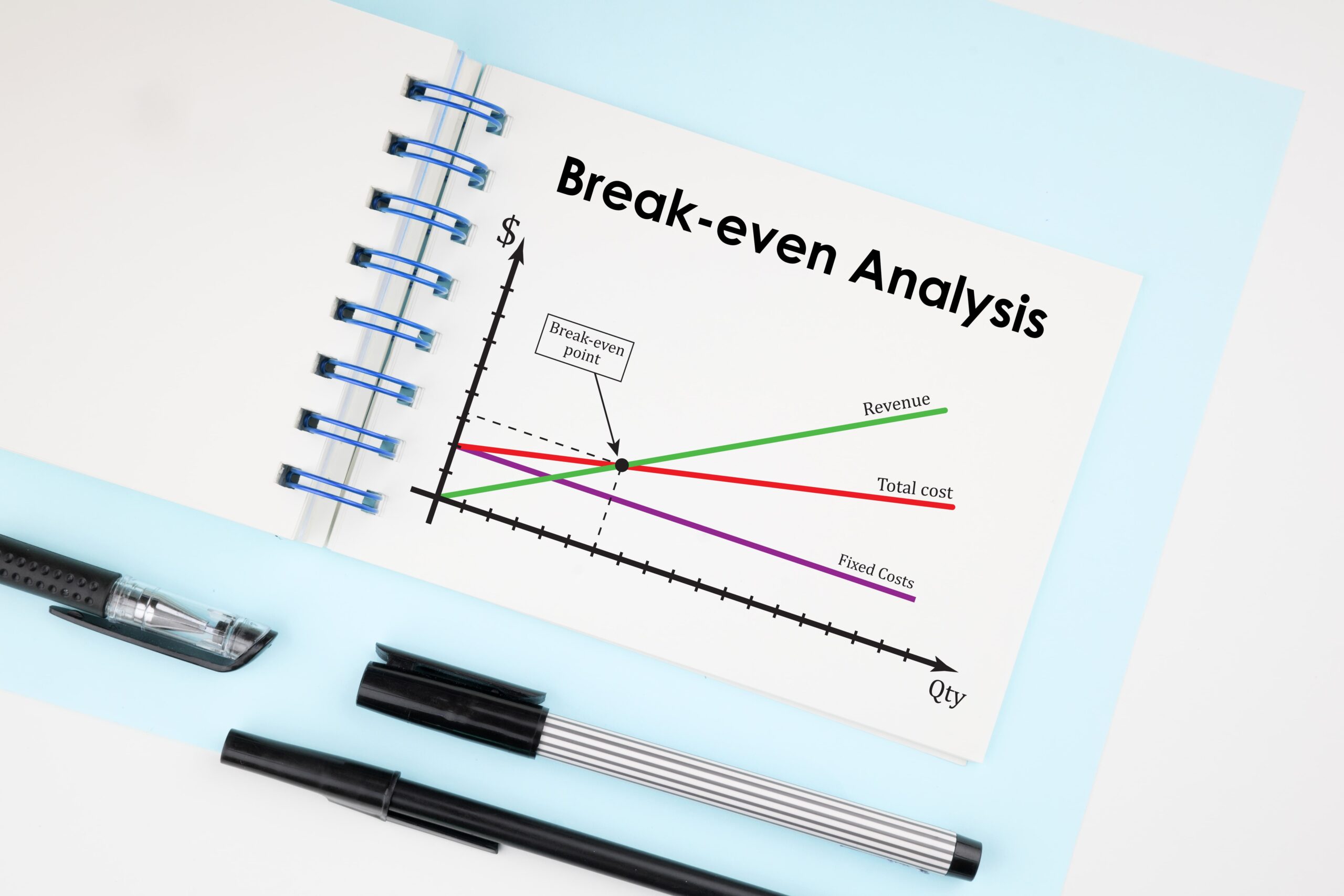
Do you know what the ‘break even’ figure is for various operations being conducted in your business?
‘Break even’ sales are the level of sales necessary to cover all fixed (does not vary relative to production) and variable expenses (relate to production/sales) within your business.
Knowing your breakeven point is critical for business owners and managers. The break even point is the minimum level of sales you need to cover your businesses expenses. This is vital when you are trying to determine how to price your products or services. By knowing this number this allows you to make an informed decision when setting your prices to ensure you generate enough revenue to cover all of your costs and also for the business to make a profit.
Critical point about costs – One thing most people miss from our experience is to ensure that there is a market salary included in the costs to run your business. Therefore, make sure you include this. You are a valuable resource and your business wouldn’t function properly without you.
Further by knowing your breakeven point this helps you make an informed decision if you are looking to expand your business. Whether you are thinking about hiring more people (employees), investing in new equipment, expanding your product or services lines, getting into bigger premises etc. Understanding your breakeven point can help determine how much additional revenue you would need to generate to cover all of the new expenses whilst also still making a profit.
How do you Calculate the Break Even Point?
Remember the Break Even Point – gives the point of no profit or no loss.
To calculate your business’ ‘break even’, you need to know the gross profit percentage for the individual operations within the business for which you’re trying to determine the ‘break even’ amount.
For example:
Fixed cost – $235,000 Variable cost – $622,000
This will be a total cost, at that level of operations of $857,000.
If the gross profit being achieved by that operation or the overall business was 47%, the calculation would then be:
Fixed Cost + Variable Cost
Gross Profit Percentage
$235,000 + $622,000 = $857,000 $857,000 x 100 = $1,823,404 47% 1
Therefore, at this level of operations, the ‘break even’ is $1,823,404.
To prove the calculation:
Sales $1,823,404 x 47% = $857,000
| Less: | ||
| Fixed Cost | $235,000 | |
| Add Variable Cost | $622,000 | |
| $857,000 | ||
| $ NIL |
If you would like our assistance in calculating ‘break even’ figures for your various operations or your overall business, please do not hesitate to contact us.
Here are some great tips and things to consider as we roll into 2024.
Team Members
- Have you reviewed your Human Resources Manual? Are any updates required?
- Do you normally conduct team member appraisals at this time of year? Have these been done?
- Have you conducted a survey of team members on their suggestions to improve services to your customers?
- Is there a need to discuss productivity improvements with team members?
- Are you receiving regular input from your team members on operational issues?
- Are regular team member meetings held?
- Have you encouraged the formation of teams within the business? The team could consider ways and means to improve business productivity and performance.
- Have you empowered team members to exceed customers’ expectations?
- Are there any changes necessary for the team training program in 2024/25?
- Do you conduct exit interviews with any team member who resigns?
Gross Margins
- Are you happy with the key margins being achieved in your business?
- Gross Profit Percentage?
- Labour to Turnover Percentage?
- Net Profit to Turnover Percentage?
Debtors
- Are you receiving a monthly debtors’ aged analysis within 2 working days of the end of each month?
- Are you calculating debtors’ days outstanding each month? How does the days outstanding compare to your budgeted figure?
- Are you going to change any of your policies or procedures for debtors in 2024/25?
Products/Services
- Are any new products or services proposed to be introduced? Have these products or services been subjected to intensive review by the team?
- Have any focus group reviews been conducted?
Bank
- Are there any concerns in your relationship with your bank?
- Do you need to make any operational changes in 2024/25 to enable the business to comply with your bank’s lending requirements?
Insurance
- Have you completed a detailed review of your insurance requirements for 2024/25?
Suppliers
- Have you thought about approaching some of your suppliers for assistance in 2024/25? Assistance could include:
- price reduction;
- longer payment terms;
- promotional assistance;
- joint submission to major prospects; and
- assistance in marketing campaign to compete with competitors.
Wastage, Theft, Pilferage
- Have you quantified the cost to the business from wastage, theft or pilferage?
- Have the team members been informed of these costs?
- Have you developed policies for 2024/25 to try to reduce these costs?
Cashflow Management
- Have you factored in the increased interest rates in your budgeting? Should you be considering trying to lock in a long-term fixed interest rate at this stage?
- Have you reviewed your debtors’ days outstanding? Can strategies be introduced in an attempt to reduce debtors’ days outstanding by the utilisation of a debtors’ reduction program?
- Have you considered the stock turn being achieved from individual products, sections or departments, within your business?
- Are the stock turn rates acceptable? If not, what can be done to improve the stock turn rate (eg. relocation of the stock to a better display area, price adjustment, ceasing to handle this type of stock, better promotion)?
- Does your investment in work in progress exceed 30 days of WIP? Does this mean that progress claims are not being raised regularly?
- Are some jobs not being deliberately finished, so there is a ‘delayed management review’ on the performance of a particular job?
Succession Planning
- Have you developed a succession strategy for your business?
- Have you prepared a summary of the succession strategies that require implementation in 2024/25?
Business Plan
- Have you reviewed your business plan and determined any changes to be implemented in 2024/25?
- If you haven’t prepared a business plan, should this be one of the priorities for 2024/25?
Now is an ideal time to talk to us about business development strategies for your business, particularly relating to:
- a business health check
- business evaluation workshop
- cashflow management, including:
- debtors
- stock
- work in progress reviews
- business plan development for 2024/25
- budgets & cashflow forecasts for 2024/25
- leadership review
- succession planning
- buying a business – if you’re contemplating expanding your business operations
- selling a business – if you’re planning on selling your business
- bank’s/lender’s review
- gross profit analysis review
- break even analysis
- Tracking of key ratios
- sales targets and calculations of “what ifs”
- surviving in difficult times
- catching up regularly (monthly or quarterly) to review the business and keep it going in the right direction
We can help you build a business that works without you. Our Business Advisory Work is suited to all small to medium sized businesses that would like to run a better business. From analyzing where you are currently to assisting to plan and implement your end goals.
The ATO estimates that incorrect reporting of rental property income and expenses is costing around $1 billion each year in forgone tax revenue. A big part of the problem is how taxpayers are claiming interest on their investment property loans.
We’ve seen an uptick in ATO activity focussing on refinanced or redrawn loans. This activity is a result of a major data matching program of residential property loan data from financial institutions from 2021-22 to 2025-26. This data is being matched to what taxpayers have claimed on their tax returns. Those with anomalies can expect contact from the ATO to explain the discrepancy.
If you have an investment property loan and redraw on the loan for a different purpose to the original borrowing, the loan account becomes a mixed purpose account. Interest accruing on mixed purpose accounts need to be apportioned between each of the different purposes the money was used for.
On the other hand, if the redrawn funds are used to produce investment income, then the interest on this portion of the loan should be deductible.
For example, if you have redrawn on the loan to pay for a private holiday, or pay down personal debt, then the interest relating to this portion of the loan balance is not deductible. Not only will the interest expenses need to be apportioned into deductible and non-deductible parts, but repayments will normally need to be apportioned too.
Withdrawals from an offset account are treated as savings rather than a new borrowing. If you have a loan account and an interest offset account is attached to this account that reduces the interest payable on the loan, withdrawing funds from the offset account will typically increase the amount of interest accruing on the loan, but won’t change the deductible percentage of the interest expenses. That is, when you withdraw funds from the offset account this is really a withdrawal of savings and won’t impact on the extent to which interest accruing on the loan account is deductible.
If you have a home loan that was used to acquire your private home and you have funds sitting in an offset account, withdrawing those funds to pay the deposit on a rental property won’t enable you to claim any of the interest accruing on the home loan. However, if you redraw funds from the home loan to acquire a rental property then interest accruing on this portion of the loan should be deductible. The tax treatment always depends on how the arrangement is structured.
Think you might have a problem? Contact us and we can investigate the issue before the ATO contact you.

The tax treatment of this unpaid amount was at the centre of a recent case before the Administrative Appeals Tribunal (AAT) that saw a taxpayer successfully challenge the ATO’s long held position (Bendel and Commissioner of Taxation [2023] AATA 3074). For many years, the ATO’s position has been that if a trust appoints income to a private company beneficiary but does not actually make the payment, this unpaid amount can be treated as a loan. Under Division 7A of the tax rules, these loans can be taxed as unfranked dividends unless they are managed using a complying loan agreement with annual principal and interest repayments.
This AAT decision challenges an important ATO position, with the tax outcomes being potentially significant for trust clients that currently owe (or may have owed in the past) unpaid trust entitlements to related private companies.
But this is not the end of this story. On 26 October 2023, the Tax Commissioner lodged a notice of appeal to the Federal Court. There is no guarantee that the Federal Court will reach the same conclusion as the AAT. We will need to wait and see.
As the case progresses, we will let you know about the impact.
Quote of the month
“Do your little bit of good where you are; it’s those little bits of good put together that overwhelm the world.”
Workers are owed over $3.6 billion in superannuation guarantee according to the latest Australian Taxation Office estimates – a figure the Government and the regulators are looking to dramatically change.
Superficially, the statistics on employer superannuation guarantee (SG) compliance look pretty good with over 94%, or over $71 billion, collected without intervention from the regulators in 2020-21.
The net gap in SG has also declined from a peak of 5.7% in 2015-16 to 5.1% in 2020-21. The COVID-19 stimulus measures helped drive up the voluntary contributions with the largest increase in 2019-20, which the Australian Taxation Office (ATO) says they “suspect reflects the link between payment of super contributions and pay as you go (PAYG) withholding by employers. PAYG withholding is linked to the ability to claim stimulus payments such as Cash Flow Boost.”
Despite these gains, a little adds up to a lot and 5.1% equates to a $3.6 billion net gap in payments that should be in the superannuation funds of workers. Lurking within the amount owed is $1.8 billion of payments from hidden wages. That is, off-the-books cash payments, undisclosed wages, and non-payment of super where employees are misclassified as contractors.
In addition, the ATO notes that as at 28 February 2022, $1.1 billion of SG charge debt was subject to insolvency, which is unlikely to ever be recovered. Quarterly reporting enables debt to escalate before the ATO has a chance to identify and act on an emerging problem.
Employers should not assume that the Government will tackle SG underpayments the same way they have in the past with compliance programs. Instead, technology and legislative change will do the work for them.
Single touch payroll matched to super fund data
Single touch payroll (STP), the reporting mechanism employers must use to report payments to workers, provides a comprehensive, granular level of near-real time data to the regulators on income paid to employees. The ATO is now matching STP data to the information reported to them by superannuation funds to identify late payments, and under or incorrect reporting.
Late payment of quarterly superannuation guarantee is emerging as an area of concern with some employers missing payment deadlines, either because of cashflow difficulties (i.e., SG payments not put aside during the quarter), or technical issues where the timing of contributions is incorrect. Super guarantee needs to be received by the employee’s fund before the due date. Unless you are using the ATO’s superannuation clearing house, payments are unlikely to be received by the employee’s fund if the quarterly payment is made on the due date. The super guarantee laws do not have a tolerance for a ‘little bit’ late. Contributions are either on time, or they are not.
When SG is paid late
If an employer fails to meet the quarterly SG contribution deadline, they need to pay the SG charge (SGC) and lodge a Superannuation Guarantee
Statement within a month of the late payment. The SGC applies even if you pay the outstanding SG soon after the deadline. The SGC is particularly painful for employers because it is comprised of:
- The employee’s superannuation guarantee shortfall amount – i.e., the SG owing.
- 10% interest p.a. on the SG owing for the quarter – calculated from the first day of the quarter until the 28th day after the SG was due, or the date the SG statement is lodged, whichever is later; and
- An administration fee of $20 for each employee with a shortfall per quarter.
Unlike normal SG contributions, SGC amounts are not deductible, even if you pay the outstanding amount.
And, the calculation for SGC is different to how you calculate SG. The SGC is calculated using the employee’s salary or wages rather than their ordinary time earnings (OTE). An employee’s salary and wages may be higher than their OTE, particularly if you have workers who are paid overtime.
It’s important that employers that have made late SG payments lodge a superannuation guarantee statement quickly as interest accrues until the statement is lodged. The ATO can also apply penalties for late lodgment of a statement, or failing to provide a statement during an audit, of up to 200% of the SG charge. And, where an SG charge amount remains outstanding, a company director may become personally liable for a penalty equal to the unpaid amount.
The Danger of misclassifing contractors
Many business owners assume that if they hire independent contractors, they will not be responsible for PAYG withholding, superannuation guarantee, payroll tax and workers compensation obligations. However, each set of rules operates slightly differently and, in some cases, genuine contractors can be treated as if they were employees. There are significant penalties faced by employers that get it wrong.
A genuine independent contractor who is providing personal services will typically be:
- Autonomous rather than subservient in their decision-making;
- Financially self-reliant rather than economically dependent on your business; and
- Chasing profit (that is, a return on risk) rather than simply accepting a payment for the time, skill and effort provided.
‘Payday’ super from 1 July 2026
The Government intends to introduce laws that will require employers to pay SG at the same, or similar time, as they pay employee salary and wages. The logic is that by increasing the frequency of SG contributions, employees will be around 1.5% better off by retirement, and there will be less opportunity for an SG liability to build up where the employer misses a deadline.
Originally announced in the 2023-24 Federal Budget, Treasury has released a consultation paper to start the process of making payday super a reality. Subject to the passage of the legislation, the reforms are scheduled to take effect from 1 July 2026.
What is proposed?
The consultation paper canvasses two options for the timing of SG payments: on the day salary and wages are paid; or a ‘due date’ model that requires contributions to be received by the employee’s superannuation fund within a certain number of days following ‘payday’. A ‘payday’ captures every payment to an employee with an OTE component.
The SGC would also be updated with interest accruing on late payments from ‘payday’.
Currently, 62.6% of employers make SG payments quarterly, 32.7% monthly, and 3.8% fortnightly or weekly.
We’ll bring you more on ‘payday’ super as details are released. For now, there is nothing you need to do.
If you would like our assistance in with any of the above, please do not hesitate to contact us.
Tanya Dalton- Forbes Contributor
We often ask, “How can I be more productive?” But maybe we are asking the wrong question.
For decades, people have been told that time management is the key to productivity. We’ve been taught to create schedules, make to-do lists, and to try getting as much done in as little time possible. But what if this approach is actually doing more harm than good? What if our obsession with time is actually killing our productivity?
As a productivity expert running multiple successful businesses since 2008, I used to be obsessed with time management. I felt I had mastered the art of managing time— I had eliminated unnecessary meetings and even introduced a four day work week, but my team and I still struggled with overwhelm.
However, in the midst of the pandemic, something remarkable happened. When I shifted my focus away from tracking my team’s hours and prioritized the quality of their work instead, our productivity soared. It wasn’t about working remotely; it was that I stopped trying to manage time.
As a society, we’ve unknowingly created work models where we measure productivity in time—not in the quality of the work. We’ve been focusing on efficiency over effectiveness. It’s time for a new approach to work that doesn’t leave us feeling exhausted and unsatisfied.
The Myth of Time Management
The fallacy of time management lies in the belief that time is a controllable factor that can be managed like any other resource. In reality, time is a finite and elusive resource that cannot be controlled or manipulated.
In today’s fast-paced and dynamic business environment, it is becoming increasingly clear that traditional time-oriented models of working are no longer effective. Trying to fit as many tasks as possible into a day, using time management techniques like to-do lists, the Promodo Technique or multitasking give a false sense of control over time; they don’t address the fundamental problem of time being a finite resource. Plus they have the added side effect of creating more errors and lower quality work—making you unproductive.
By focusing mainly on time, we end up neglecting other important factors, such as creativity, collaboration, and innovation.
A Task-Oriented Approach
A task-oriented approach to productivity and work can be a more effective solution. Rather than focusing on the number of hours worked, instead, we prioritize the tasks over time. By making this shift, we place the focus on quality rather than the quantity of work accomplished. Meaning, we spend more effort on tasks that align with the goals and values of the company rather than getting caught up in the busy work.
But, while a task-oriented approach may be more focused on quality than a time-oriented approach, it completely ignores a key resource—time. We cannot pretend time does not exist.
Deadlines are a critical component of productivity and should be used strategically to help team members focus on the most important tasks. When deadlines are clear and realistic, individuals are better able to focus on completing tasks in a timely manner.
A Modern Model for Work and Productivity
The time-focused 40-hour workweek is a relic of the factory days gone by. This rigid scheduling model was actually created 100 years ago to make assembly lines faster—it’s not the most effective model for modern productivity. With the rise of remote work, flexible schedules, and generative AI, a new approach is needed to truly optimize productivity.
When I started using a modern hybrid model for productivity—blending task and time oriented ways for thinking, my team and I were more productive. It helped us simplify the business and every team member found more meaning in our work (and our profit margin reflected that).
Here’s the top three strategies I used to see an immediate boost in my team’s productivity:
Focus on Outcomes
One of the key strategies is shifting to prioritizing outcomes rather than time. Instead of focusing on the number of hours worked (or tasks completed), leaders should focus on their desired results. This requires setting clear goals for each project or task. By communicating clear metrics for success and proposed outcomes, business leaders can provide their team with a clear sense of purpose and direction.
To shift the focus from time management to outcome management, business leaders should communicate to their team that the focus is on achieving results, rather than simply completing tasks within a certain timeframe.
By setting clear metrics for success and tracking progress towards those metrics, this allows team members to see the impact of their work and make data-driven decisions. When focusing on outcomes, you create a results-driven culture enabling your employees to work towards shared goals and ultimately achieve greater success.
Encourage Autonomy
Empowering team members to take ownership of their work and make decisions is another key strategy for implementing this hybrid approach. By giving team members autonomy, leaders can allow them to work more deeply on key tasks, rather than fixating about time constraints. Because they are no longer playing “beat the clock” their attention becomes laser focused on the most important tasks.
To encourage autonomy, leaders should be open to adjusting deadlines or shifting priorities based on changing circumstances or new information. Provide clear guidelines and expectations for tasks, but trust your team members to make decisions and work independently.
By promoting autonomy, you can create an environment where employees feel empowered and engaged, which can lead to better outcomes and greater success for your business.
Communicate Priorities
Clear communication is essential for any successful team, and this is especially true when it comes to prioritizing. Leaders should communicate objectives for the quarter and provide regular updates on progress towards those goals. This helps to ensure that everyone is aligned and working towards the same outcomes.
To communicate priorities effectively, leaders need to prioritize tasks based on importance, rather than time constraints. This means focusing on the tasks that are most critical to achieving the overall goals of the business. Leaders should also make sure that everyone understands how their individual tasks contribute to the larger picture.
By communicating priorities effectively and creating an environment that supports deep work, you can help your team members to stay focused and achieve collaborative goals more effectively. This can ultimately lead to better outcomes and greater success.
As a business leader, it’s important to recognize that time is a finite resource that cannot be managed or controlled. Instead, by prioritizing quality over quantity and focusing on outcomes, we can achieve greater success and create a more fulfilling work environment for ourselves and our teams.
Let’s rethink time management and embrace a new approach to work that integrates task-oriented productivity with a focus on outcomes.
The Australian Taxation Office have released a new draft ruling on self-education expenses. We revisit the deductibility of self-education expenses and what you can and can’t claim.
If you undertake study that is connected to your work you can normally claim your costs of that study as a tax deduction – assuming your employer has not already picked up your expenses. There is also no limit to the value of the deduction you can claim.
While this all sounds great and very encouraging there are still issues to consider before claiming your Harvard graduate degree, accommodation, and flights as a self-education expense.
Clients are often surprised by what cannot be claimed. Self-education expenses are not deductible if you are undertaking the education to obtain a new job or something not connected to how you earn your income now. Take the example of a nurse’s aide who attendees university to qualify as a registered nurse. The university degree and the expenses associated with degree are not deductible as the nursing degree is not sufficiently connected to their current role as a nurse’s aide.
The ATO have recently released a new draft ruling on self-education expenses. While the ruling does not introduce new rules, it does reinforce what the ATO will accept…and what they won’t.
Personal development courses
While not always the case, one of the key challenges in claiming deductions for self-development or personal development courses is that the knowledge or skills gained are often too general. Take the example of a manager who is having difficulty coping with work because of a stressful family situation. She pays for and attends a 4-week stress management course.
In that case, the stress management course is not deductible because the course was not designed to maintain or increase the skills or specific knowledge required in her current position.
When your employment ends part the way through your course
If your employment (or your income earning activity) ends part the way through completing a course, your expenses are only deductible up to the point that you stopped work. Anything from that point forward is not deductible (that is until you obtain a new role and assuming the course remains relevant).
Overseas trips with some work thrown in
Overseas study tours are deductible in limited circumstances. If you are travelling overseas, you need to prove that the dominant purpose of the trip is related to how you earn your income. Factors that help demonstrate this include the time devoted to the advancement of your work related knowledge, the trip not being merely recreational, and that the trip was requested by or supported by your employer. The ATO are strict on this. Take the example of a senior lecturer in history at a University. He takes a trip to China with his wife while on leave over the Christmas break to update his knowledge on his area of academic interest. While his job does not require him to undertake research, he incorporated some of the 600 photos he took and some of the learnings from the tour into the courses he teaches. Despite having a relationship to work, the trip is not deductible as, while relevant in some ways to his field of activity, it is incidental to the overall private and recreational nature of the trip.
Overseas conference with some recreation thrown in
We’ve all had them. Conferences where you spend a few days in sessions and then a day (or more) of touring or golf. When the dominant purpose of the trip is related directly to your work, then the ATO are more accommodating. If the leisure time, for example an afternoon tour organised by the conference, is incidental to the conference itself, then you can claim the full conference expenses. Where you are extending your stay beyond the conference dates and this isn’t considered incidental, then you apportion the expenses and only claim the portion related to the conference. Let’s say you attend a conference for four days, then spend another four days on holiday. Assuming the conference is directly related to your work, you can claim your expenses related to the conference (assuming they were not picked up by your employer), and half of your airfare (as it’s a 50/50 split on how you spent your time between the conference and recreation).
Not fully deductible? Part of the course might qualify
If a particular course is not entirely deductible, a deduction may still be available for some of the course fees where there are particular subjects or modules in that course that are sufficiently related to your employment or income earning activities. In these cases, the course fees would be apportioned. Take the example of a civil engineer who is completing her MBA. While the MBA itself may not have a sufficient connection to her engineering role to be fully deductible, her expenses related to the project management subject she took as part of the degree could qualify.
A warning on large claims
There is no limit on the amount you can claim as a self-education expense but the ATO is more likely to target large self-education expenses. For anyone who has completed post graduate study you know that these expenses can ratchet up very quickly, particularly when you add in any other expenses such as books or travel. It’s important to ensure that there is a clear connection between your current job or business activity and the self education expenses before you claim them. Airfares incurred to participate in self-education, provided you are not living at the location of the self-education activity, are deductible. Airfares are part of the cost of undertaking the self-education activities.
Please contact us should you have self education questions.
$20k deduction for ‘electrifying’ your business Electricity is the new black. Gas and other fossil fuels are out. A new, limited incentive nudges business towards energy efficiency. We show you how to maximise the deduction! The small business energy incentive is the latest measure providing a bonus tax deduction to nudge the investment behaviour of small and medium businesses, this time towards more efficient energy use and electrification. Fossil fuels are out, gas is out, electricity is the name of the game.
Legislation before Parliament will see SMEs with an aggregated turnover of less than $50 million able to claim a bonus 20% tax deduction on up to $100,000 of their costs to improve energy efficiency in the business. But, the tax deduction is time limited. Assuming the legislation passes Parliament, you only have until 30 June 2024 to invest in new, or upgrade existing assets. How much? Your business can invest up to $100,000 in total, with a maximum bonus tax deduction of $20,000 per business entity. The energy incentive is not provided as a cash refund, it either reduces your taxable income or increases the tax loss for the 2024 income year.
What qualifies?
The energy incentive applies to both new assets and expenditure on upgrading existing assets. There is no specific list of assets that can qualify. Instead, the rules provide a series of eligibility criteria that need to be satisfied.
First, the expenditure incurred in relation to the asset must qualify for a deduction under another provision of the tax law. If your business is acquiring a new depreciating asset, it must be first used or installed for any purpose, and a taxable purpose, between 1 July 2023 and 30 June 2024. If you are improving an existing asset, the expenditure must be incurred between 1 July 2023 and 30 June 2024. If your business is acquiring a new depreciating asset the following additional conditions need to be satisfied: · The asset must use electricity; and · There is a new reasonably comparable asset that uses a fossil fuel available in the market; or · It is more energy efficient than the asset it is replacing; or · If it is not a replacement, it is more energy efficient than a new reasonably comparable asset available in the market; or · It is an energy storage, time-shifting or monitoring asset, or an asset that improves the energy efficiency of another asset. If you are improving an existing asset the expenditure needs to satisfy at least one of the following conditions: · It enables the asset to only use electricity, or energy that is generated from a renewable source, instead of a fossil fuel; · It enables the asset to be more energy efficient, provided that asset only uses electricity, or energy generated from a renewable source; or · It facilitates the storage, time-shifting or usage monitoring of electricity, or energy generated from a renewable source.
What doesn’t qualify?
Certain kinds of assets and improvements are not eligible for the bonus deduction, including where the asset or improvement uses a fossil fuel. So, hybrids are out. Solar panels and motor vehicles are also excluded. In addition, the following assets are specifically excluded from the rules: · Assets, and expenditure on assets, that can use a fossil fuel; · Assets, and expenditure on assets, which have the sole or predominant purpose of generating electricity (such as solar photovoltaic panels); · Capital works (such as buildings and structural improvements); · Motor vehicles (including hybrid and electric vehicles) and expenditure on motor vehicles; · Assets and expenditure on an asset where expenditure on the asset is allocated to a software development pool; and · Financing costs, including interest, payments in the nature of interest and expenses of borrowing.
What does qualify?
The legislation contains a few examples of what would qualify: · Electrifying heating and cooling systems · Upgrading to more efficient fridges and induction cooktops (for example replacing gas cook tops) · Installing batteries and heat pumps · Installing an electric reverse cycle air conditioner instead of a gas heater · Replacing a coffee machine with a more energy efficient coffee machine if the manufacturer’s electricity consumption information supports this – keep the documentation! · Thermal storage that can store heat or cold from a renewable source · Solar thermal hot water system (assuming it meets the other criteria) The legislation to implement the energy incentive is before Parliament. We’ll keep you updated on its progress. If you intend to make a major outlay to take advantage of the bonus deduction, talk to us first just to make sure it qualifies.
Please contact us for more clarity in this area.
Quote of the month
“Grit is about doing the hard work, day in and day out, without immediate reward.” Angela Duckworth, academic and psychologist
Source: Forbes
To succeed as an entrepreneur today, you need to take in a constant influx of information. But you also need to know when to lock it down and listen to nothing but your own internal voice. The model of the highly disciplined, overscheduled overachiever just isn’t functional when technology means ’round-the-clock access to you and your energy.
Sure, you sometimes need to put in long, grueling hours to succeed. But if you don’t take breaks, the constant stress will burn you out, which serves nobody. To invest in yourself as a leader, emphasize balance over a high-speed, pressure-cooker lifestyle. Some of these tips may seem a bit counterintuitive, but they’ll boost your odds of long-term success.
1. Treat Your Body Right
First things first: Get. Enough. Sleep. The idea that successful entrepreneurs never rest is a myth the business world needs to stop perpetuating, for everyone’s sake.
As reported in KillerStartups, researcher and author Thomas Corley found that 89% of self-made millionaires get at minimum seven hours of sleep per night. Without proper rest, your brain can’t make the kinds of high-stakes decisions successful leaders face every day.
And if you want to improve your sleep quality, and virtually other metric of your health and happiness, get some exercise. Successful leaders share the habit of engaging in at least 30 minutes of cardio a day. Like sleep, exercise improves your cognitive function so you can make the best decisions for your business.
Nutrition likewise has a powerful impact on your leadership skills — and a domino effect on everything else in your life. Your diet can make or break your mental acuity. It’s crucial to feed yourself well if you want to steer your company to success.
2. Set Goals That Spark Joy
Once you’ve got those Maslow needs covered, it’s time to think bigger. What are your long-term financial and personal goals, and what does success mean to you?
According to Corley, you need to make sure all your goals are truly yours. Yes, you need to be focused on building your business and saving for the future. But don’t fall into the trap of trying to measure up to others.
In his research, Corley found that pursuing one’s own dreams and goals resulted in the greatest long-term happiness and wealth accumulation. In other words, being happy —both at and outside of work — can actually earn you more money.
So look for what brings you joy and motivates you to perform at your best. It could be the adrenaline of achieving greater market share or having the flexibility to spend more time with your loved ones. It doesn’t matter what your objectives are. You’ll still go further in business if you’re chasing goals that light you up.
3. Make Time for Other Passions
On that note, if what makes you happiest isn’t always what pays, that’s OK. Make time for hobbies, passion projects, travel, and anything else that feels intuitively, holistically good.
You may tell yourself you don’t have time, between exercising, eating right, and putting in long hours at work. But don’t convince yourself that every minute of your time should be “productively.” You’ll only burn out, causing both you and your company to suffer.
By contrast, throwing yourself into your hobbies actually makes you a better entrepreneur. A hobby can be the inspiration for a new innovative offering or business practice. It can also help you build connections with other successful, highly motivated people.
As an entrepreneur, you know that your lifestyle takes a certain kind of spark that not everyone has. The kinds of people who prioritize interesting, creative lives tend to be the most successful. Be one of them, and in the process, you’ll meet people who can help you learn, grow, and network.
4. Protect Your Time
There’s really only one way to make sure you can manage any or all of the above. You need to be extremely protective of your time. This doesn’t necessarily mean implementing rigid time management methods — though if they work for you, feel free to continue using them.
What it definitely means is being super clear on your priorities and giving a firm “no” to anything or anyone that interferes. Plan your day not around how many hours you work, but around the actions that make you most functional and effective.
Protecting your time can take a million different forms. Maybe it’s marking yourself “busy” on your calendar, turning your phone off, and wearing noise-canceling headphones. Or perhaps it’s delegating tasks to junior workers, then locking your office door and meditating for 20 minutes. It’s not the method that matters; it’s finding the way that works best for you.
Striking the Right Balance
The life of an entrepreneur hasn’t gotten any easier. That’s why it’s more important than ever to find internal sources of stability and resilience. A successful business needs a firm, steady hand to guide it. So take care of yourself first, and give yourself the fuel you need to make your company soar.
We are happy to work with you on a personal plan to assist you to achieve the above.
Contact us to find out more.
« Previous Page — Next Page »